

Wallpaper Pattern Repeat: A DIY Homeowner's Guide
A wallpaper pattern repeat is the vertical distance between one point in the design and where that exact point appears again on the roll. Before you buy a single roll, do three things: check the repeat measurement on the product label (listed in inches or centimeters), identify the pattern match type, and add the appropriate waste allowance to your roll count.
- Check the roll label or product page for the repeat measurement in inches or cm
- Identify the match type: random, straight-across, half-drop, or multiple-drop
- Add a waste allowance based on match type before placing your order
- If the repeat is not listed, measure a sample or contact the retailer directly
Key Takeaways
Understanding pattern repeat is the single most important step before ordering or hanging patterned wallpaper, because it determines roll count, waste allowance, and installation complexity.
| Point | Details |
|---|---|
| Measure the repeat first | Find the vertical distance between two identical design points on the roll before calculating rolls. |
| Match type drives waste | Random match needs 5–10% extra; multiple-drop match needs 25% or more above the base roll count. |
| Batch numbers are critical | Order all rolls from the same dye lot and keep one spare roll from that batch after hanging. |
| Peel-and-stick eases alignment | Repositionable peel-and-stick format reduces risk when working with drop matches for the first time. |
| Wallsneedlove for custom options | Wallsneedlove offers both peel-and-stick and paste formats with Greenguard Gold certification and 1–3 day custom production. |
Table of Contents
- What is a pattern repeat in wallpaper and why does it matter?
- How do the four pattern match types affect your project?
- How to read the wallpaper roll label
- How to calculate how many rolls you need
- Practical hanging tips for matching patterns correctly
- Common mistakes and how to avoid them
- How custom and digital printing change the repeat equation
- When to DIY and when to hire a professional
- Wallsneedlove makes repeat-aware wallpaper straightforward
- Sources
What is a pattern repeat in wallpaper and why does it matter?
The pattern repeat is the vertical distance between two identical points in the design. To measure it yourself, pick a clear motif on the roll, then measure straight down to where that exact motif appears again. That distance is your repeat.
Repeats can range from less than an inch to the full width of the roll. A small repeat generally produces moderate waste and is straightforward to hang. A large repeat increases both waste and installation complexity, because each strip must be cut to start at the same point in the design cycle.
Why does this matter for planning? Two reasons. First, alignment: every strip must match the adjacent one across the seam, so the design reads as continuous across the wall. Second, roll usage: the larger the repeat, the more material you trim away at the top and bottom of each strip to hit the correct starting point. Large, dramatic repeats create a bold visual effect but often require alternating rolls and more skilled installation to avoid visible joins.
A useful mental image: picture a vertical strip of wallpaper with a flower motif at the top. The repeat is the distance from that flower to the next identical flower directly below it. Every strip you cut must begin at the same point in that cycle.
How do the four pattern match types affect your project?
Pattern repeat and pattern match are different things. The repeat is a vertical measurement. The match is how adjacent strips align across the width of the wall. Confusing the two leads to incorrect waste calculations and under-ordering.
Straight-across match
Every strip starts at the same height. The design runs horizontally across the wall in a continuous line. This is the most common type and the most DIY-friendly of the patterned options. Waste is moderate because you cut each strip to the same starting point.
Half-drop and multiple-drop match
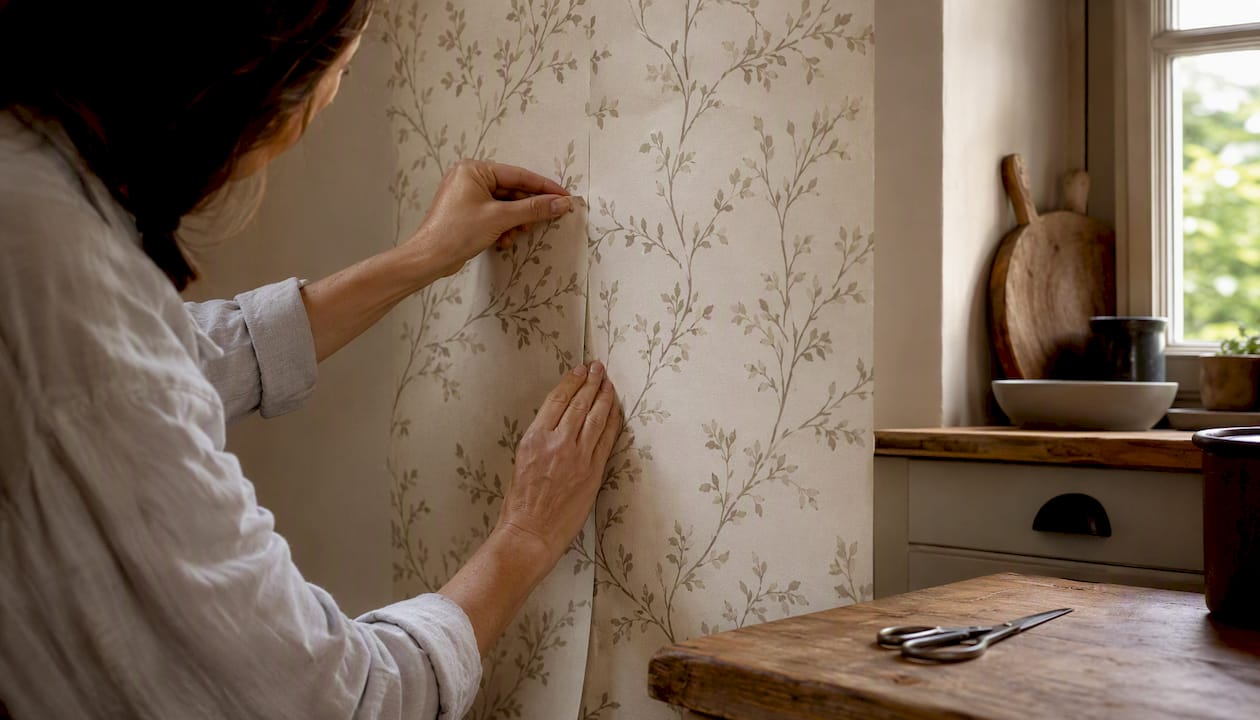
A half-drop match offsets each strip by half the repeat distance. So if your repeat is 24 inches, strip two starts 12 inches lower than strip one. A half-drop typically requires three strips to complete one full vertical repeat; a multiple-drop may require four or more. These types demand careful pre-cutting and sequencing. Waste increases noticeably because the offset means more material is trimmed from the top of alternating strips.
Random or free match
No matching is required across strips. Textures, grasscloth-style designs, and some abstract patterns fall into this category. Free match is the simplest option for DIY because strips can be cut straight from the roll without calculating a starting point. Waste is minimal.
How to identify your match type on the roll: hold two strips side by side. Slide the second strip up and down. If the pattern aligns at the same height, it is a straight match. If it only aligns when offset, it is a drop match. If it looks fine at any position, it is a free match.
Match type directly determines how much extra material to buy. Free match produces the least waste; multiple-drop produces the most.
How to read the wallpaper roll label
Product labels carry several fields that affect your order. Knowing how to read them prevents the most common ordering mistakes.
- Repeat measurement: listed in inches or centimeters, sometimes as “V. Repeat” or “Pattern Repeat.” This is the number you use in your roll calculation.
- Match type: may appear as a word (“straight,” “half-drop,” “free”) or as a small symbol. A straight-match symbol typically shows two horizontal lines aligned at the same height. A half-drop symbol shows lines offset by half. A free-match symbol often shows a single diagonal or wavy line.
- Roll dimensions: usable length per roll and roll width. These are the numbers you use to calculate coverage.
- Batch or dye-lot number: a code that identifies the production run. All rolls in a single project must share the same batch number to avoid color variation between strips.
Some manufacturers mix up repeat and match terminology on their labels, so always cross-reference the symbol with the written description. Before checkout, note the repeat, note the match type, log the batch number, and screenshot the full product spec page.
How to calculate how many rolls you need
The standard formula:
(Wall perimeter × wall height) ÷ usable area per roll = base roll count
Then adjust upward for pattern repeat waste and subtract a modest allowance for large openings like doors and windows.
Worked example
Room dimensions: 13 feet × 11 feet, 8-foot ceiling.
- Wall perimeter: (13 + 11) × 2 = 48 linear feet
- Wall area: 48 × 8 = 384 square feet
- Subtract two standard doors (each roughly 21 sq ft): 384 − 42 = 342 square feet
- A typical roll covers approximately 28–30 square feet of usable area (check your specific roll’s listed coverage)
- Base roll count: 342 ÷ 29 = 11.8, round up to 12 rolls
Now add for pattern repeat waste:
| Match type | Typical waste allowance | Adjusted rolls (12-roll base) |
|---|---|---|
| Random / free match | Low | 13 rolls |
| Straight-across match | Moderate | 12 rolls |
| Half-drop match | Higher | 12 rolls |
| Multiple-drop match | Highest | 12 rolls |
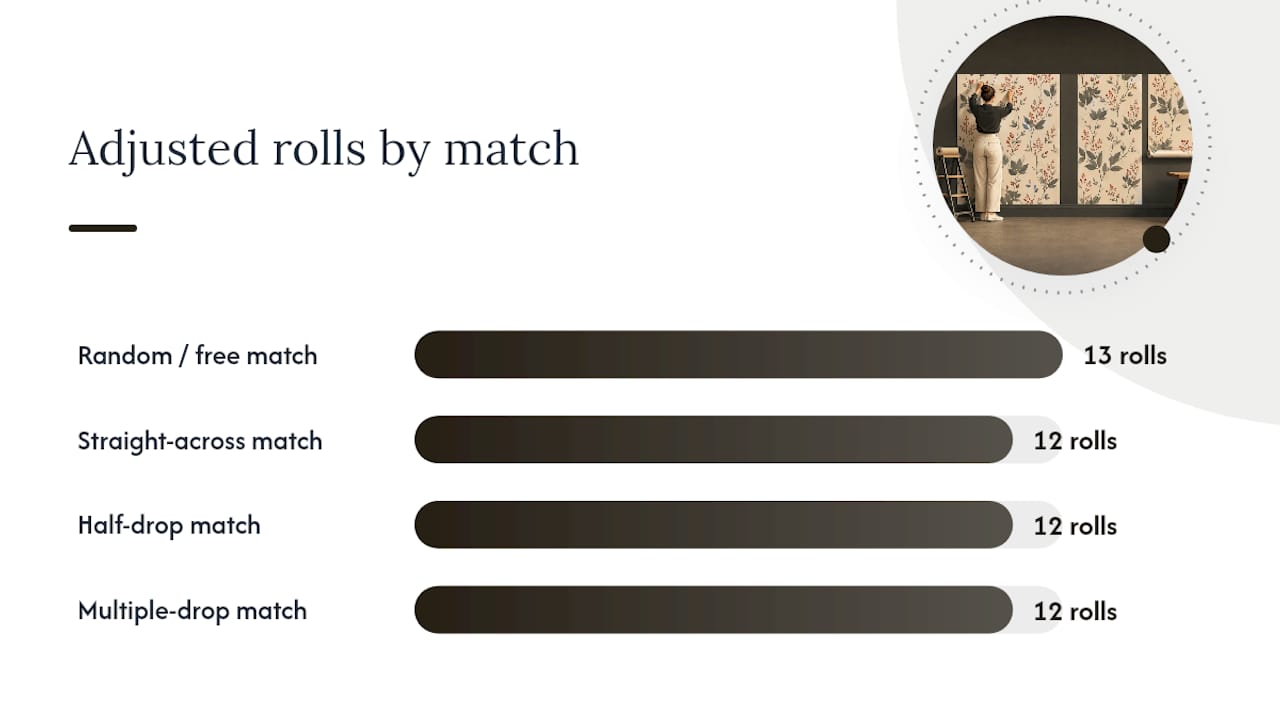
These are planning estimates. Always verify the usable coverage printed on your specific roll before finalizing your order.
Pro Tip: Buy one extra roll beyond your calculated total and confirm the retailer’s return policy before ordering. If you need more paper after the project starts and the original batch is sold out, matching the color exactly becomes very difficult.
For a detailed walkthrough of the full wallpaper ordering process, including how to confirm repeat and batch details before checkout, Wallsneedlove’s ordering guide covers each step.
Practical hanging tips for matching patterns correctly
Getting the calculation right is only half the job. How you cut and sequence the strips determines whether the finished wall looks professional.
Pre-hang preparation
- Check that your wall surface is clean, dry, and primed. Uneven surfaces cause seams to lift and patterns to shift.
- Find your plumb line. Use a level to draw a true vertical line before hanging the first strip. This is the reference for every strip that follows.
- Pre-cut all strips on a flat surface. Label the back of each strip with its number and the top edge. Writing the strip number on the back keeps the hanging order clear and prevents costly sequencing errors.
- Pre-align strips side by side on the floor to confirm the pattern matches before any paste is applied.
- Verify that all rolls share the same batch number.
Sequencing and cutting
- Start at the most prominent wall, usually the one directly opposite the entry door, or center the design on a focal-point wall.
- For straight matches, cut all strips to the same starting point in the repeat cycle.
- For half-drop matches, alternate between two starting points. Strip one starts at the top of the repeat; strip two starts at the midpoint. Continue alternating.
- Leave 2–3 inches of extra length at the ceiling and base of each strip for trimming after the strip is hung and positioned.
- When working around doors and windows, plan your cuts so the pattern continues logically across the opening, especially considering what to consider when replacing interior doors for smooth pattern transitions. Measure and mark before cutting.
- At inside corners, overlap slightly rather than trying to turn a single strip. Use the overlap double-cut method for clean, tight seams.
Reverse-hanging for shading control
Some papers show slight shading variation from one edge to the other due to the printing process. Flipping every other strip (rotating it 180 degrees before hanging) distributes this variation evenly so it is not visible as a directional gradient across the wall. Check the manufacturer’s instructions first, as this technique is not suitable for all designs.
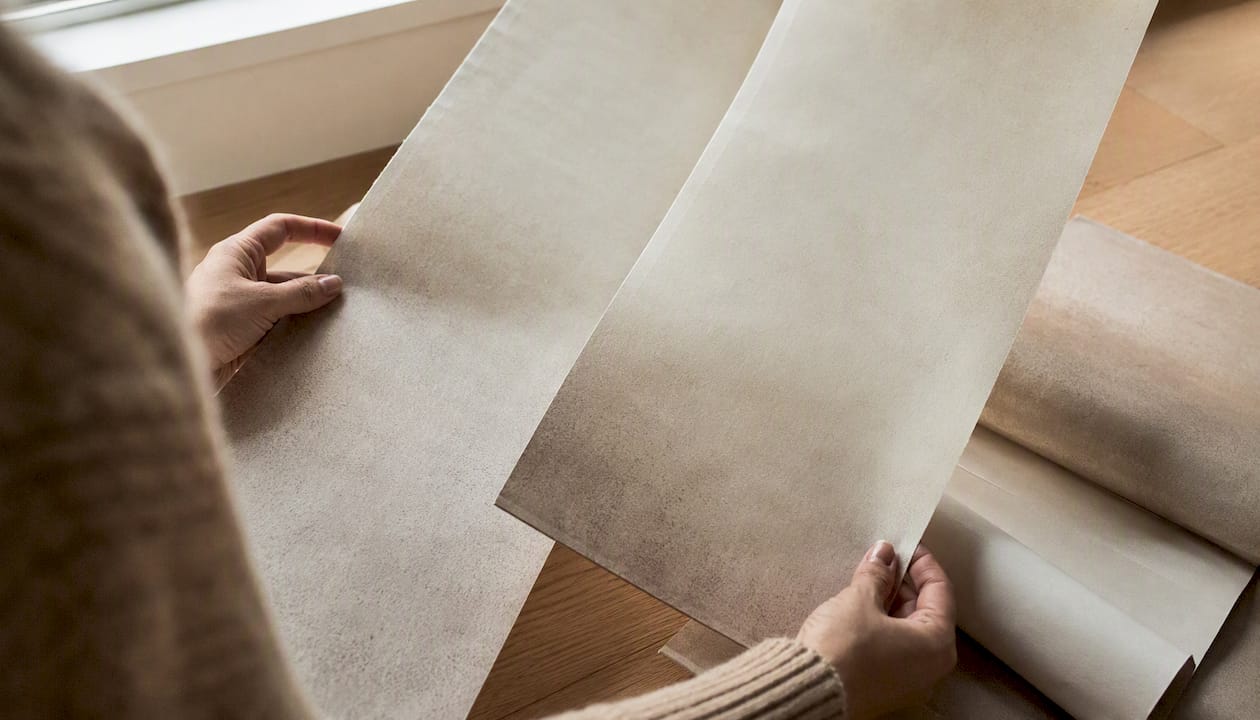
Pro Tip: With drop matches, cut strips from two rolls alternately rather than running through one roll completely. This reduces waste by using the offcuts from roll one as the starting cuts for roll two.
For a full starting checklist, Wallsneedlove’s guide on where to start when wallpapering walks through room layout and first-strip placement in detail.
Common mistakes and how to avoid them
Ordering too few rolls is the most frequent error. It usually happens when the pattern repeat waste is ignored in the calculation. Always apply the waste multiplier from the table above before placing the order.
Ignoring batch numbers causes color mismatches mid-project. Dye lots vary between production runs, sometimes subtly, sometimes noticeably. Order all rolls at once from the same batch. If you need additional rolls later and the original batch is gone, request a sample from the new batch and compare it in natural light before committing.
Skipping surface prep leads to bubbling, peeling seams, and pattern shift after hanging. Prime the wall with a wallpaper-specific primer before starting.
Misreading the label is more common than it sounds. Some manufacturers use repeat and match terminology inconsistently, so cross-check the symbol against the written description on the product page. Screenshot both before checkout.
Troubleshooting a misaligned seam: if a seam does not align after hanging, gently peel the strip back while the adhesive is still wet, reposition, and smooth from the center outward. For paste-the-wall papers, work quickly. For peel-and-stick, you have more repositioning time.
Keeping a spare roll: store one unused roll from the original batch after the project is complete. If a section is damaged later, you have a matching replacement. See Wallsneedlove’s guide on wallpaper installation mistakes for a full list of common errors and fixes.
How custom and digital printing change the repeat equation
Traditional cylinder printing locks designs into fixed repeat sizes determined by the cylinder’s circumference. Digital printing removes that constraint, enabling large-scale designs that are not restricted by roll width and can avoid standard repeats entirely for single-run murals.
For a full-wall mural printed as a single panel or a set of numbered panels, the concept of a repeating tile is replaced by final-panel sizing and seam planning. You provide the wall dimensions, and the design is scaled to fit. There is no repeat to calculate and no offset to manage. The Java Mountain wall mural is one example of this approach: the design is printed to your exact dimensions, so installation focuses on panel sequencing rather than repeat matching.
For repeating designs, digital printing also allows nonstandard repeat sizes that would be impractical with cylinder methods, giving designers more flexibility in pattern scale.
Peel-and-stick vs. traditional paste also affects the installation experience for patterned papers. Peel-and-stick allows repositioning during alignment, which is a meaningful advantage when working with drop matches. Traditional paste papers require faster work and less margin for adjustment. For DIYers tackling a complex repeat for the first time, peel-and-stick reduces the risk of a costly misalignment.
Wallsneedlove offers both formats across its product range, including seamless geometric patterns designed to minimize alignment effort. Orders are typically custom-made within 1–3 days, and all products carry Greenguard Gold certification. For custom sizing or a proof before production, contact Wallsneedlove directly with your final wall dimensions.
For a deeper look at how digital printing changes what is possible with custom designs, Wallsneedlove’s guide on custom digital wallpaper printing covers the full process.
When to DIY and when to hire a professional
Random or free-match papers in a standard rectangular room are well within reach for a confident first-time DIYer, especially in peel-and-stick format. Small straight-across repeats (under 12 inches) in a room without complex angles or many openings are also manageable with careful prep and the calculation steps above.
The case for hiring a professional installer gets stronger in three situations. First, large repeats (over 18–24 inches) combined with a drop match in a room with multiple windows, doors, or an irregular ceiling line. The waste increases, the sequencing is more complex, and a single miscut strip is expensive. Second, multiple-drop matches in any room where seam perfection is visible from the main viewing angle. Third, full-wall murals in commercial spaces where alignment errors are highly visible and reprinting is costly.
The cost and timeline trade-off is real. A professional installer works faster and wastes less material on complex patterns, which can offset the labor cost when the paper itself is expensive. For large repeats, factor in both the extra rolls and the additional installation time when budgeting. Wallpaper scale and pattern choice for different room types is covered in more detail in Wallsneedlove’s wallpaper scale guide for residential spaces.
Wallsneedlove makes repeat-aware wallpaper straightforward
Custom wallpaper does not have to mean a complicated installation. Wallsneedlove prints peel-and-stick and traditional paste options across a full range of styles, from bold geometric repeats to seamless textures and full-wall murals, all custom-made within 1–3 days.

Every product carries Greenguard Gold certification, and detailed installation guides are available for both paste and peel-and-stick formats. For custom sizing, submit your final wall dimensions at checkout and request a proof to confirm color and scale before production begins. Confirm the repeat measurement and batch details on the product page before ordering, and keep a spare roll from the same batch once the project is complete.
Browse the full collection at Wallsneedlove and find a pattern that fits your room, your repeat tolerance, and your installation confidence.
Sources
- How to Measure for Wallpaper Pattern Repeats
- Understanding Wallpaper Pattern Repeats
- Pattern repeat - Wikipedia


Leave a comment