

Nursery Wallpaper Style Options for Every Room
Nursery wallpaper style options are defined by three factors: design pattern, material composition, and installation method. The best choices balance visual appeal with durability and practical ease, creating a space that works for infants and grows with toddlers. Wallsneedlove offers peel-and-stick and traditional paste wallpapers certified to Greenguard Gold standards, making them a trusted source for parents who want style without compromising safety. The right children’s room wallpaper does more than decorate a wall. It sets the tone for the entire room and can save you time, money, and effort when your child’s tastes inevitably change.
1. What are the most popular nursery wallpaper style options?
The top nursery wallpaper designs in 2026 fall into six clear categories: stripes, florals, botanicals, woodland animals, geometrics, and modern minimal. Each serves a different aesthetic goal, but all of them work best when chosen with the room’s long-term use in mind.
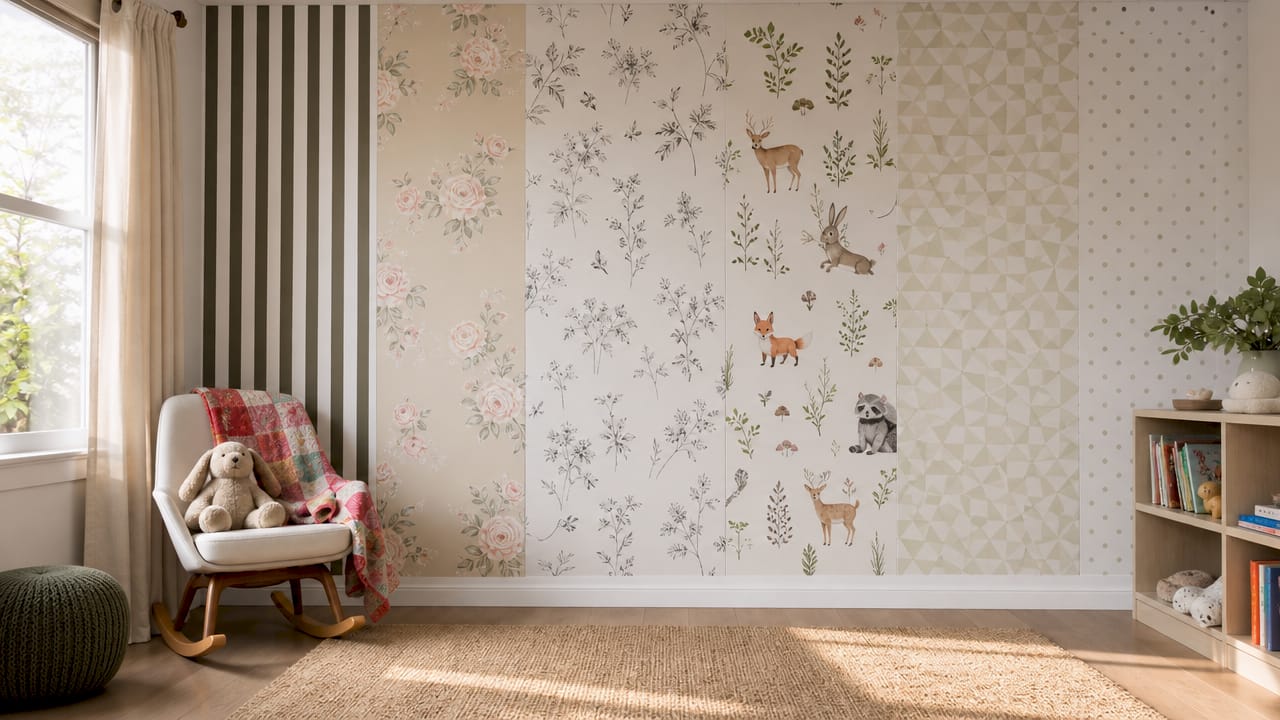
Designers consistently recommend nursery designs that integrate with the overall home style rather than creating an isolated baby-themed zone. A room that feels cohesive with the rest of the house stays tasteful longer and requires fewer full redesigns as your child grows.
Here is a breakdown of the most popular styles:
- Stripes: Classic vertical or horizontal lines. Versatile across color palettes and age groups.
- Florals: Soft, illustrated blooms. Works well in both gender-neutral and traditionally feminine nurseries.
- Botanicals: Leaves, ferns, and plant motifs. Pairs naturally with wood furniture and neutral tones.
- Woodland animals: Foxes, deer, owls, and bears. A perennial favorite for themed nurseries.
- Geometrics: Triangles, hexagons, and dot patterns. Suits modern nursery decor and ages well into a school-age room.
- Modern minimal: Subtle textures, tone-on-tone patterns, or abstract marks. Ideal for parents who prefer understated design.
Pro Tip: Choose a pattern that works without the nursery furniture in the room. If the wallpaper looks good on its own, it will adapt easily as you swap out a crib for a toddler bed or a dresser for a bookshelf.
The 60-30-10 color rule from Nursery Design Studio is the clearest framework for building a balanced nursery palette. One primary color covers 60% of the room, a secondary color covers 30%, and an accent color fills the remaining 10%. Your wallpaper typically carries the primary or secondary role, so choose its base color first before selecting furniture and textiles.
2. Which wallpaper materials are safest for a nursery?
Material choice is the most important decision parents make when selecting wallpaper for a baby’s room. Babies spend more time in their nurseries than in any other room, so air quality and surface safety matter more here than anywhere else in the home.
The 2026 trend toward biophilic, natural materials favors paper and linen-based wallpapers over high-gloss plastics or synthetic vinyl. Natural materials off-gas fewer volatile organic compounds, making them a healthier choice for enclosed spaces where infants sleep.
| Feature | Peel-and-stick | Traditional paste |
|---|---|---|
| Installation | DIY, no tools required | Often requires professional help |
| Removal | Residue-free, clean peel | May damage drywall on removal |
| Washability | Many options are wipeable | Depends on paper weight and finish |
| Renter-friendly | Yes | No |
| Best for | Frequent updates, rentals | Permanent installs, large murals |
Washable nursery wallpaper, including many peel-and-stick options, handles spills and sticky handprints without losing its finish. That durability matters in a room where messes are guaranteed.
Pro Tip: Avoid high-gloss vinyl wallpapers in nurseries. They trap moisture, can harbor mold behind the surface, and release plasticizers that affect indoor air quality. Matte or satin finishes on paper-based or fabric-backed materials are the safer choice.
Wallsneedlove prints on materials that meet Greenguard Gold certification, which sets strict limits on chemical emissions for products used in spaces where children spend significant time. That certification is a concrete benchmark parents can verify, not just a marketing claim.
3. Peel-and-stick vs. traditional paste: which suits your nursery?
Installation method determines how much time, money, and stress you spend getting wallpaper onto the wall. For most parents, peel-and-stick wallpaper is the preferred choice because it requires no professional help and leaves walls clean when removed.
The practical advantages of peel-and-stick for nurseries include:
- No paste, no mess, no drying time.
- Panels can be repositioned during installation, reducing waste from misalignment.
- Removal is clean and residue-free, protecting rental walls or resale value.
- Style updates take an afternoon, not a weekend with professional help.
Traditional paste-to-wall wallpaper still has a place in nurseries, particularly for large scenic murals or textured papers that require a firm, permanent bond. Complex traditional murals often need professional installation to align seams correctly and avoid bubbling. That added cost is worth it when the design is a permanent feature of the room.
For renters, peel-and-stick is the only practical option. It protects the original wall surface and satisfies most lease agreements. Wallsneedlove’s guide on wallpaper for rental walls covers exactly which products work best in leased spaces and how to apply them without voiding a deposit.
4. How room size and lighting affect your wallpaper choice
Room dimensions and natural light directly change how a wallpaper pattern reads on the wall. A pattern that looks balanced in a large showroom can feel crowded in a small nursery, and a subtle texture can disappear entirely in a dim room.
Vertical striped wallpaper makes low ceilings appear taller by drawing the eye upward. This is one of the most practical design tools available, and it costs nothing extra. Unlike character-themed wallpaper, vertical stripes also age well, staying appropriate from infancy through the school years.
A few clear rules for matching wallpaper to room conditions:
- Small rooms: Use small-scale patterns or vertical lines. Large repeat patterns overwhelm compact spaces.
- Low ceilings: Choose vertical stripes or tall botanical prints to add visual height.
- North-facing rooms: Pick warm-toned wallpapers in cream, taupe, or soft terracotta to offset cool natural light.
- South-facing rooms: Cooler tones like sage, dusty blue, or soft gray balance bright direct sunlight.
- Open-plan nurseries: Select wallpaper that connects visually with adjacent rooms. A designer’s approach to open-plan spaces recommends repeating one color from the wallpaper in the adjoining room’s textiles or furniture.
Neutral nursery palettes in 2026 focus on warm taupes, ivories, and natural wood finishes layered with subtle texture. That approach creates depth without visual noise, which matters in a room designed for sleep and calm.
5. Themed wallpaper for kids: how to choose designs that last
Themed wallpaper for kids is the category most parents regret fastest. A jungle theme at age one can feel dated by age three. The solution is not to avoid themes entirely but to choose them at the right level of abstraction.
Specific character prints tied to a single franchise age out quickly. Abstract animal motifs, woodland scenes, or botanical patterns carry a theme without locking the room into one era. A Forest Friends wall mural, for example, reads as a nursery design at age one and as a nature-themed bedroom at age six.
The most enduring nurseries pair neutral walls with natural materials and curated decor rather than relying on a single themed wallpaper to carry the room. Warm woods, rounded furniture silhouettes, and soft textiles do more for a room’s atmosphere than a busy character print.
Color-drenching is a 2026 technique worth considering for themed nurseries. Color-drenching means applying one tone across walls, trim, and paneling to create a unified, architecturally considered look. It reads as mature and considered rather than overly decorated, which means the room stays appropriate longer.
6. How to choose nursery wallpaper that adapts as your child grows
The best wallpaper for a nursery is one you will not need to replace in two years. Choosing patterns and colors with longevity built in saves money and effort. Peel-and-stick designs make updates easy when preferences do change, but starting with a flexible design reduces how often you need to update at all.
Patterns that transition well from nursery to toddler room to school-age bedroom share a few traits. They use color palettes that work with multiple furniture styles. They avoid specific character references. They rely on geometry, nature, or texture rather than narrative imagery.
A seamless geometric pattern in a neutral or two-tone colorway fits a crib-stage nursery and a desk-and-bookshelf bedroom equally well. That flexibility is the single most practical criterion for long-term nursery wallpaper selection.
Key takeaways
The most effective nursery wallpaper combines a timeless pattern, a non-toxic material, and a peel-and-stick installation method to serve the room from infancy through early childhood.
| Point | Details |
|---|---|
| Choose timeless patterns | Geometrics, botanicals, and stripes outlast character themes by years. |
| Prioritize certified materials | Greenguard Gold certification confirms low chemical emissions for children’s spaces. |
| Use the 60-30-10 rule | Let one color dominate, one support, and one accent to keep the room balanced. |
| Match pattern scale to room size | Small rooms need small patterns; vertical lines add height to low-ceiling spaces. |
| Default to peel-and-stick | Residue-free removal protects walls and makes style updates fast and affordable. |
What Wallsneedlove has learned about nursery wallpaper
Parents consistently underestimate how fast a nursery needs to change. A room designed around a specific character or color story at birth often needs a full refresh by age two. The parents who avoid that cycle are the ones who treat the nursery wall the same way they treat the rest of the home: with a design that has staying power.
The peel-and-stick format genuinely changes the calculus here. When removal is easy and clean, parents feel less pressure to get the choice perfect the first time. That freedom leads to better decisions, not worse ones. Choosing a geometric or botanical removable wallpaper as a starting point gives you a room that looks considered from day one and updates in an afternoon when the time comes.
The 60-30-10 color rule is not just a design tip. It is a practical constraint that prevents the most common nursery mistake: too many competing colors and patterns that make the room feel unsettled rather than calm. A baby’s room should feel quiet. Wallpaper that respects that principle always outperforms wallpaper chosen purely for novelty.
— Wallsneedlove
Wallsneedlove nursery wallpaper: styles ready to order
Wallsneedlove carries nursery-ready wallpaper across every major style category, from playful animal prints to clean geometric patterns, all available in peel-and-stick format with Greenguard Gold certified materials.

The Monkeying Around removable wallpaper brings a playful, nature-themed print to nursery walls with the easy removal parents need as children grow. For a more modern nursery decor approach, the Pixel Diamonds geometric wallpaper delivers a clean, age-flexible pattern that works from infancy through the school years. Orders are custom-printed within 1–3 days, and every product ships ready for DIY installation with no professional help required.
FAQ
What is the best wallpaper material for a nursery?
Paper-based or fabric-backed wallpapers with Greenguard Gold certification are the safest choice for nurseries. They off-gas fewer chemicals than vinyl and maintain healthier indoor air quality for infants.
Is peel-and-stick wallpaper safe for rental nurseries?
Peel-and-stick wallpaper is the standard recommendation for renters because it removes cleanly without damaging drywall or paint. Most lease agreements permit it when applied and removed correctly.
How do I choose nursery wallpaper for a small room?
Use small-scale patterns or vertical stripes in small nurseries. Vertical lines draw the eye upward and make low ceilings appear taller, which is especially useful in compact rooms.
When does themed wallpaper for kids become a problem?
Character-specific prints tied to a franchise or single story tend to feel dated within two to three years. Abstract nature motifs, geometrics, and botanicals carry a theme without locking the room into one era.
How often should nursery wallpaper be replaced?
There is no fixed schedule, but peel-and-stick wallpaper makes updates practical whenever the child’s needs or preferences change. Choosing a timeless pattern from the start reduces how often replacement becomes necessary.


Leave a comment