

Wallpaper in Open Plan Spaces: A Designer's Guide
Wallpaper in open plan spaces is the strategic use of patterned or textured wall coverings to define zones, create visual cohesion, and add character to large, open interiors. Unlike rooms with four enclosed walls, open floor plans present a unique challenge: how do you create distinct areas without building walls? Wallpaper solves this by acting as both a decorative and functional tool. The right pattern, placement, and material can anchor a dining zone, connect a kitchen to a living area, and give every corner a clear sense of purpose.
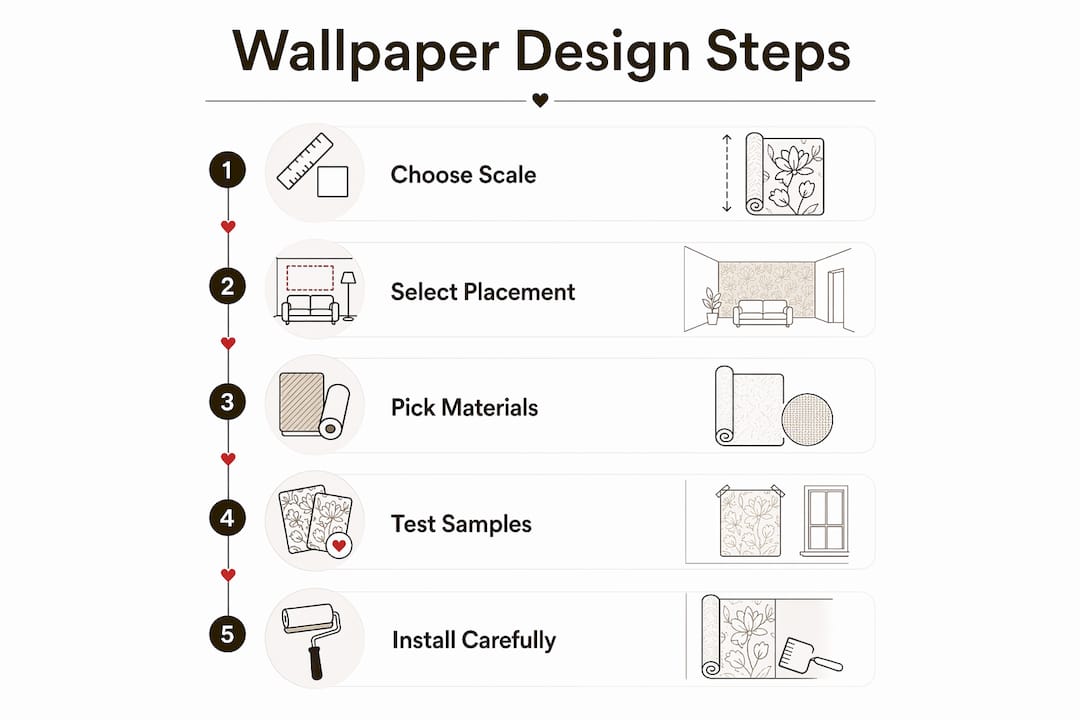
How to choose wallpaper patterns and scales for large open areas
Pattern scale is the single most important decision when decorating open spaces with wallpaper. Larger bold patterns suit spacious rooms, while smaller delicate motifs can look lost or visually cluttered when spread across a large wall. The rule is direct: match the scale of your pattern to the scale of your space.
Bold geometric designs, oversized florals, and large scenic murals all read well from a distance. A small repeating tile pattern that looks charming in a bathroom will fragment and confuse the eye when applied to a 20-foot wall in an open living area. The distance between the viewer and the wall in an open plan layout is much greater than in a standard room, so patterns need enough visual weight to carry across that space.
Color coordination across zones matters just as much as pattern size. When you use a wallpaper with a dominant color in one zone, pull that color into the adjacent zone through furniture, textiles, or paint. This creates a thread of visual continuity that holds the whole space together.
- Bold patterns (large florals, oversized geometrics, scenic murals): best for feature walls in living or dining zones
- Medium-scale patterns (abstract shapes, watercolor washes, botanical prints): work well across longer walls connecting two zones
- Subtle textures (linen effects, soft stone, faux concrete): ideal for full-wall application across an entire open layout
- Small repeating patterns: reserve for accent areas, built-in shelving backs, or powder rooms off the main space
Pro Tip: Before committing to a pattern, order a large sample and tape it to the wall. View it from the farthest point in the room, not just up close. What reads beautifully at arm’s length can disappear or overwhelm from across an open floor plan.
Wallpaper placement strategies to define zones and enhance flow
Placement determines whether wallpaper unifies or fragments an open plan layout. The most effective approach is to use the longest wall for patterned wallpaper. That wall visually connects zones by carrying a consistent color and pattern across the full width of the space.
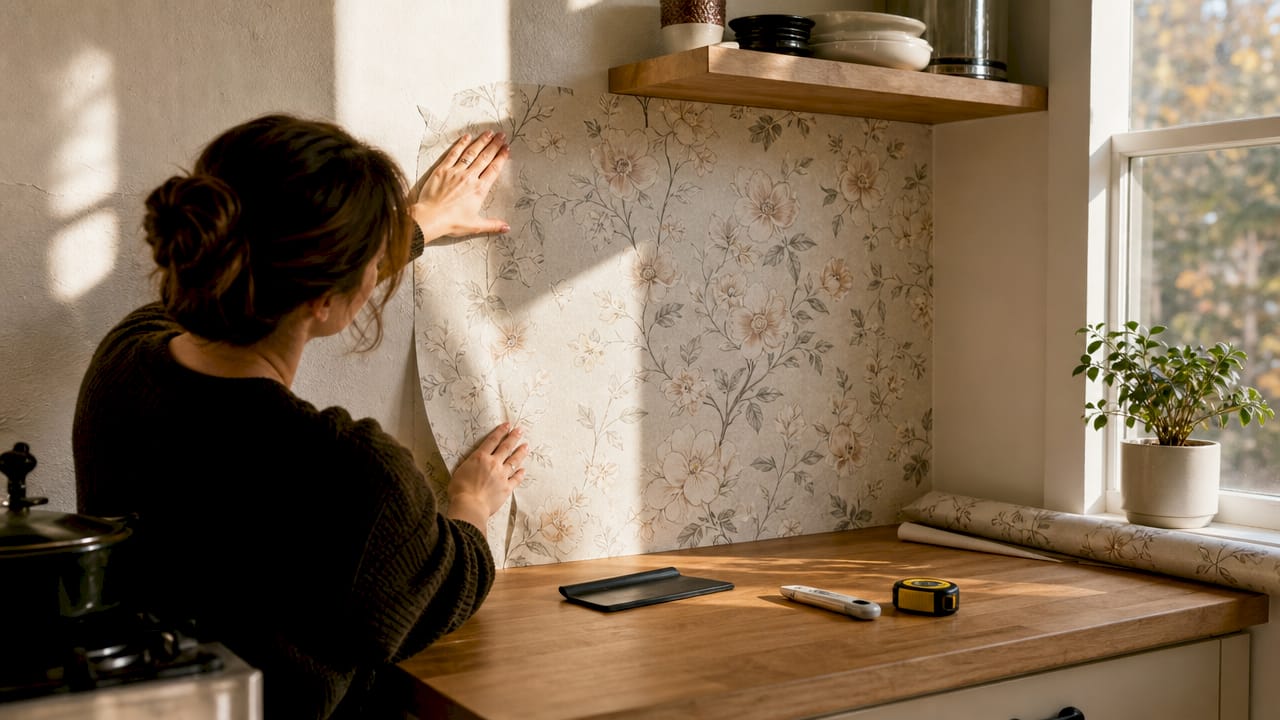
Aligning wallpaper edges with architectural cues is equally critical. Stopping wallpaper at corners, beams, or flooring transitions creates clean, intentional stopping points. These natural boundaries signal a zone change without requiring a physical divider. Stopping mid-wall with no architectural anchor looks accidental and weakens the design.
Accent wall vs. full-room application
| Approach | Effect on space | Best use case |
|---|---|---|
| Single accent wall | Anchors one zone visually | Dining area, reading nook, home office corner |
| Two connected walls | Creates a corner zone | Living room seating area |
| Full-room application | Immersive and expansive feel | Loft-style spaces, studio apartments |
| Ceiling only | Subtle overhead zoning | Above dining table or kitchen island |
Full-room wallpaper application reduces the sense of enclosure and makes open plan spaces feel more cohesive. Accent walls, by contrast, anchor a specific area and give it a distinct identity within the larger layout.
- Identify the longest uninterrupted wall in the space.
- Map out architectural stopping points: corners, columns, door frames, and flooring changes.
- Decide whether you want to unify zones (use the same wallpaper across the longest wall) or separate them (use different wallpapers with a shared color palette).
- Plan ceiling wallpaper as a secondary zoning layer above key activity areas.
Pro Tip: In open floor plans with no natural architectural breaks, use a contrasting wallpaper border or a change in finish (matte to gloss) to signal a zone transition without adding physical structure.
What wallpaper types work best in open plan environments?
The material and finish of wallpaper directly affect how it performs in a large, open space. Each type carries specific advantages depending on the zone, the light conditions, and whether the space is rented or owned.
Peel-and-stick wallpaper is the most flexible option for renters or homeowners who want to update their space without permanent commitment. It applies directly to a clean, smooth wall and removes without damaging the surface. For open plan spaces that evolve with changing furniture or lifestyle, peel-and-stick is the practical choice.
- Peel-and-stick: renter-friendly, repositionable, ideal for accent walls and mural applications
- Traditional paste wallpaper: more durable, better for full-room application in permanent installations
- Wall murals: large-format scenic or abstract images that create a focal point and define a zone in one application
- Textured wallpapers (grasscloth, linen, faux concrete): add depth and tactile interest, promote a cozy feel in defined seating zones
- Light-reflecting wallpapers: improve brightness in darker corners of open layouts, enhancing flow and atmosphere
Matte finishes absorb light and create warmth, making them well suited to living and dining zones where a cozy atmosphere is the goal. Glossy or satin finishes bounce light and work well in kitchens or areas that receive less natural light. Textured wallpapers add a layer of visual interest that flat paint cannot replicate, and they hold up well in high-traffic open plan areas.
Wallsneedlove offers both peel-and-stick and traditional paste options across its full catalog, including Greenguard Gold certified materials. That certification confirms the products meet strict chemical emission standards, which matters in large open spaces where air circulates freely across all zones.
Installation best practices for open plan wallpapering
Open plan spaces amplify installation errors. A seam that drifts slightly on a standard wall goes unnoticed. The same drift on a 15-foot wall in an open layout is visible from across the room.
Establishing a straight vertical guideline before hanging the first panel is the single most important installation step. Use a level and a chalk line to mark a true vertical on the wall. Every subsequent panel aligns to that line. Skipping this step causes cumulative drift that compounds panel by panel.
- Measure and mark a vertical guideline using a spirit level before touching the first panel.
- Start from the most visible wall in the space, not the corner.
- For murals, lay all panels out on the floor first to confirm the image sequence before hanging.
- Order 10% extra wallpaper to account for waste. For large pattern repeats, add an additional 10–15% for matching and trimming.
- Have a second person assist with large panels and murals. Solo installation on wide walls leads to misalignment.
Mural wallpaper requires extra care because errors in the first panel affect every panel that follows. Unlike a repeating pattern where a single misaligned strip is self-contained, a mural is one continuous image split across multiple panels. A small rotation error in panel one creates a visible break in the image by panel four.
Pro Tip: For peel-and-stick murals, apply each panel without fully removing the backing. Peel a few inches at a time, align to your guideline, then press and smooth downward. This method gives you control and reduces the risk of bubbles or misalignment on large walls.
Ceiling wallpaper as the fifth wall for zoning and atmosphere
Ceiling wallpaper is a zoning tool that works without occupying any floor space. Wallpapering the ceiling creates an immersive, cocooning effect above a specific area and signals a zone boundary overhead rather than at eye level. Applied above a dining table or kitchen island, it defines that zone clearly while leaving the rest of the open layout untouched.
- A botanical mural above a dining table creates a defined “room within a room” effect
- A geometric pattern on the ceiling above a seating area anchors the furniture grouping
- A soft watercolor wash on the ceiling of a reading nook adds atmosphere without visual weight on the walls
- Faux wood or stone textures on ceilings add architectural character to otherwise plain open layouts
“Ceiling wallpaper requires precise installation. Irregular ceiling surfaces, gravity, and the difficulty of working overhead make this a project best handled by a professional installer.” — Warner House
Ceiling wallpaper is the most technically demanding application in an open plan space. Uneven surfaces, overhead working conditions, and the need for perfect panel alignment all increase the complexity. For ceiling applications, professional installation is the reliable choice.
Key takeaways
Wallpaper in open plan spaces works best when pattern scale, placement, and material are chosen to match the size and function of each zone.
| Point | Details |
|---|---|
| Scale patterns to room size | Large bold patterns suit open layouts; small motifs lose impact over distance. |
| Use the longest wall | Hanging wallpaper on the longest wall visually connects zones through color and pattern. |
| Align edges with architecture | Stop wallpaper at corners, beams, or flooring changes for clean, intentional transitions. |
| Order extra material | Add 10% for waste and 10–15% more for large pattern repeats to avoid shortages. |
| Consider ceiling wallpaper | Ceiling application defines zones overhead without using floor space, but requires professional installation. |
Wallsneedlove’s perspective on open plan wallpaper design
The most common mistake in open plan wallpaper projects is choosing a pattern that looks right in a small sample but reads wrong at scale. A delicate botanical print that feels refined in a 4x4 inch swatch can look fragmented and busy when stretched across a 12-foot wall. Pattern scale decisions need to be made from the perspective of the room, not the sample card.
The second mistake is treating wallpaper as decoration rather than as a zoning tool. In an open floor plan, every design choice either supports or undermines the spatial logic of the layout. Wallpaper placed without reference to architectural stopping points creates confusion. Wallpaper placed intentionally at a corner, along the longest wall, or overhead above a dining zone creates clarity.
Peel-and-stick options have changed what is possible for homeowners who want to experiment. The ability to apply a bold mural, live with it, and remove it without damage means you can test a design decision before committing. For open plan spaces that evolve over time, that flexibility is genuinely useful. The Earth Wall Mural and the Peek abstract perspective mural are strong examples of designs that hold visual weight at the scale an open plan demands.
Ceiling wallpaper remains underused. Homeowners who are willing to invest in professional installation consistently get the most dramatic zoning results with the least visual disruption to the rest of the space.
— Wallsneedlove
Wallsneedlove’s wallpaper collection for open plan spaces
Open plan spaces need wallpaper that performs at scale, and Wallsneedlove’s catalog is built for exactly that.
The collection includes bold removable options like the Monkeying Around removable wallpaper and large-format murals like the Java Mountain wall mural, both sized to anchor zones in large open layouts. For homeowners who want geometric cohesion across connected zones, the Pixel Diamonds removable wallpaper delivers a modern, repeating pattern that reads cleanly at distance. All products are available in peel-and-stick or traditional paste, ship within 1–3 days, and carry Greenguard Gold certification. The full wallpaper and mural collection covers floral, geometric, scenic, and textured styles to suit every zone in an open floor plan.
FAQ
What is the best wallpaper for a large open plan space?
Large-scale patterns, scenic murals, and bold geometric designs work best in open plan spaces because they hold visual weight from a distance. Small repeating patterns lose impact when spread across wide walls.
How do you use wallpaper to define zones without building walls?
Apply wallpaper to the longest wall to connect zones visually, or use ceiling wallpaper above a specific activity area to define it overhead. Stopping wallpaper at architectural cues like corners or flooring changes creates clean zone boundaries.
Is peel-and-stick wallpaper suitable for open plan areas?
Peel-and-stick wallpaper is a practical choice for open plan spaces, especially for renters. It applies to smooth walls, removes without damage, and allows design changes without permanent commitment.
How much extra wallpaper should you order for an open plan project?
Order at least 10% extra for waste. For wallpaper with large pattern repeats, add an additional 10–15% to account for matching and trimming during installation.
Can wallpaper go on the ceiling in an open plan space?
Ceiling wallpaper defines zones effectively and creates an immersive atmosphere above dining or seating areas. The installation requires precision and is best handled by a professional due to irregular ceiling surfaces and overhead working conditions.


Leave a comment