
Custom Mural Contract and Specification Guide
A binding mural installation contract must cover scope and dimensions, panel layout, technical print specs (file format, resolution, color profile, bleed), a signed color mockup referenced as a contract exhibit, payment milestones, IP and usage terms, installation responsibilities, acceptance criteria, and dispute resolution. Use this checklist before signing or placing any order:
- Scope: exact wall dimensions, panel count, substrate, adhesive type, and finish
- Files: TIFF or layered PSD, minimum 150–300 dpi at final scale, embedded color profile (sRGB or Adobe RGB)
- Panel layout: numbered panels, printed panel map, overlap allowances, seam placement rules
- Color proof: signed color mockup and strike-off sample attached as contract exhibits
- Payment: deposit, progress milestones, final holdback on acceptance
- Installation: site readiness conditions, installer qualifications, acceptance test after first three panels
- Acceptance criteria: visual match to signed mockup, seam tolerance, adhesion standard
Pro Tip: Architect and manufacturer specs recommend rotating every other panel 180° during printing to reduce lateral color shift — record this requirement in the technical spec section of the contract. Wallsneedlove products carrying Greenguard Gold certification meet low-emission standards; request that certification number in the materials spec.
Table of Contents
- What should the scope of work and deliverables include?
- How do technical print specs and color continuity work?
- What payment terms and lead times should the contract include?
- How should the proofing and approval process be structured?
- Who is responsible for installation and site readiness?
- What IP and licensing terms belong in a mural contract?
- What warranties, insurance, and termination terms are standard?
- Sample contract clauses and a compact spec-sheet template
- Do murals require permits or regulatory compliance?
- Should the contract include a confidentiality clause?
- What termination conditions go beyond simple cancellation?
- Wallsneedlove makes custom mural specs straightforward
- Key Takeaways
- Why the spec sheet matters more than the contract language
- Useful sources and standards to consult
What should the scope of work and deliverables include?
A clear scope prevents disputes over what was promised. Require these deliverables in writing:
| Deliverable | Specification Required |
|---|---|
| Final artwork files | Layered PSD or TIFF, embedded color profile, full-resolution |
| Full-size image proof | Mapped to wall photo, showing panel seam placement |
| Strike-off / sample panel | Physical color sample approved before full production |
| Materials list | Substrate type, adhesive, primer, protective finish |
| Panel map | Numbered diagram showing sequence, width, height, overlap |
Document every recess, outlet, and obstruction with annotated photos and an elevation drawing. Acceptance criteria should specify a visual match to the signed mockup, seam tolerance within 1/16 inch, full surface adhesion, and a color variation threshold described in Delta E or agreed descriptive terms. Anything outside those tolerances triggers a documented defect and remedial process before final payment releases.
How do technical print specs and color continuity work?
File and color requirements belong in the contract, not in an email thread. Specify:
- Resolution: minimum 150 dpi at final printed scale; 300 dpi preferred for close-viewing installations
- File types: TIFF or layered PSD; high-res PDF accepted only with embedded fonts and color profile
- Color profile: sRGB or Adobe RGB as agreed in writing; CMYK conversion handled by printer unless otherwise stated
- Bleed and trim: minimum 0.5-inch bleed on all panel edges; trim marks required on production files
Color continuity is the most common technical failure in large-format mural printing. Rotating alternate panels 180° during printing, or reverse-hanging alternate strips on the wall, reduces the lateral color shift that occurs across a printer’s width. Record whichever method applies in the contract’s technical spec section.
Require numbered panels, a printed panel map, and the manufacturer’s hang instructions shipped with the order. Panels should acclimatize to room temperature for at least 48 hours before installation. Wallsneedlove’s paneling layout guide covers numbering conventions and downloadable panel maps.
Pro Tip: Inspect the first three installed panels for color uniformity and adhesion before continuing. Any defect found at that point should halt installation immediately — contact the printer before applying additional panels.

What payment terms and lead times should the contract include?
Wallsneedlove produces many custom orders within 1–3 days, but the contract should still build in a buffer for shipping, site readiness, and any permit delays.
Production note: Wallsneedlove’s standard custom production turnaround is 1–3 days for most prints, making it practical to stage payment milestones tightly around delivery and install dates.
A common payment structure for mural projects ties milestones to deliverables:
- Deposit (50%): due at contract signing, non-refundable after design work begins
- Progress payment: due on signed mockup approval before production starts
- Pre-ship payment: due when panels clear quality check and are ready to ship
- Final holdback (10–15%): released on written acceptance after installation
Example independent contracts use a non-refundable design fee plus a 50% deposit to secure the booking. The contract should also assign responsibility for shipping costs, storage fees if panels arrive before the site is ready, lift or equipment rental, and reprint costs in the event of manufacturing defects. Late-payment remedies — typically interest at a stated rate after 30 days — should appear in writing.
How should the proofing and approval process be structured?
The signed color mockup is the legal reference point for the entire project. Attaching it as a contract exhibit limits disputes about artistic intent after production begins.
The approval process should cover:
- Digital mockup mapped to a wall photo (color, composition, scale confirmed in writing)
- Physical strike-off sample signed and dated by both parties
- Written list of what the approval covers: color accuracy, panel sequence, seam placement, and text/logo positioning
- Defined revision rounds (two included revisions is a common industry standard) with a stated fee for additional rounds
- A change-order form that requires written sign-off before any revision enters production
Pro Tip: Replace vague color descriptions with Pantone or hex codes in both the contract and the mockup exhibit. “Warm gray” means different things to different monitors; PMS 430 C does not.
Who is responsible for installation and site readiness?
Defining installer qualifications and site conditions in the contract prevents finger-pointing on install day. Require a minimum of three years of commercial wallcovering experience or a manufacturer-certified applicator credential.
Site readiness checklist before installation begins:
- Ambient and substrate temperature above 65°F for at least 48 hours prior to install and maintained throughout
- Substrate moisture content at or below 4%, verified with a moisture meter
- Walls clean, smooth, primed with a mold-inhibiting wallcovering primer, and free of loose paint or previous wallcovering
- Adequate lighting and power access confirmed; lift equipment arranged if ceiling height requires it
- Panels stored flat in a conditioned space, not rolled, for at least 48 hours before hanging
For surface repair needs before priming, plaster wall repair guidance covers common defects that affect mural adhesion. After the first three panels are installed, conduct a formal acceptance inspection: document color uniformity, seam alignment, and adhesion. Any defect triggers a written notice and halts further installation until resolved.
What IP and licensing terms belong in a mural contract?
Copyright in a custom mural typically stays with the artist unless the contract explicitly transfers it. Three standard options:
- Full assignment (buyout): all rights transfer to the buyer; artist retains no reproduction rights
- Exclusive license: buyer has sole rights to use the image for defined purposes and territory; artist cannot license it elsewhere
- Non-exclusive license: buyer may use the image for stated purposes; artist may license the same design to others
The contract should state permitted uses (display only, marketing materials, merchandise), territorial limits (single location vs. nationwide), time limits if any, and fees for uses beyond the original grant. Sublicensing rights and revenue sharing for commercial reproductions require explicit language. Credit and attribution expectations — whether the artist’s name appears on signage or in marketing — should be agreed in writing. Under the federal Visual Artists Rights Act (VARA), artists retain certain moral rights unless they are waived in writing.
What warranties, insurance, and termination terms are standard?
Manufacturers commonly provide a 5-year written warranty against manufacturing defects such as delamination and significant fading. The contract should state what the warranty excludes: vandalism, moisture infiltration from building failures, and improper installation.
Insurance and termination terms to require:
- General liability insurance: $2M–$5M coverage is a common industry range for mural projects
- Worker’s compensation where applicable; certificates of insurance due before installation begins
- Force-majeure clause covering weather delays, permit holds, and supply disruptions
- Termination for cause: if the artist fails to install the approved design or misses the completion date, the owner may cover or remove installed portions and recover prepaid funds
- Partial-payment remedy: if the owner terminates without cause after production begins, a defined kill fee covers work already performed
Municipal mural agreements in cities like San Francisco require a minimum 10-year maintenance commitment and 60-day removal notice — useful models even for private projects.
Sample contract clauses and a compact spec-sheet template
Use these clauses as starting points and adapt them to your project:
Scope of Work: “Contractor shall supply and install [X] panels of custom-printed vinyl wallcovering measuring [W × H] per panel at [location], per the panel map attached as Exhibit A.”
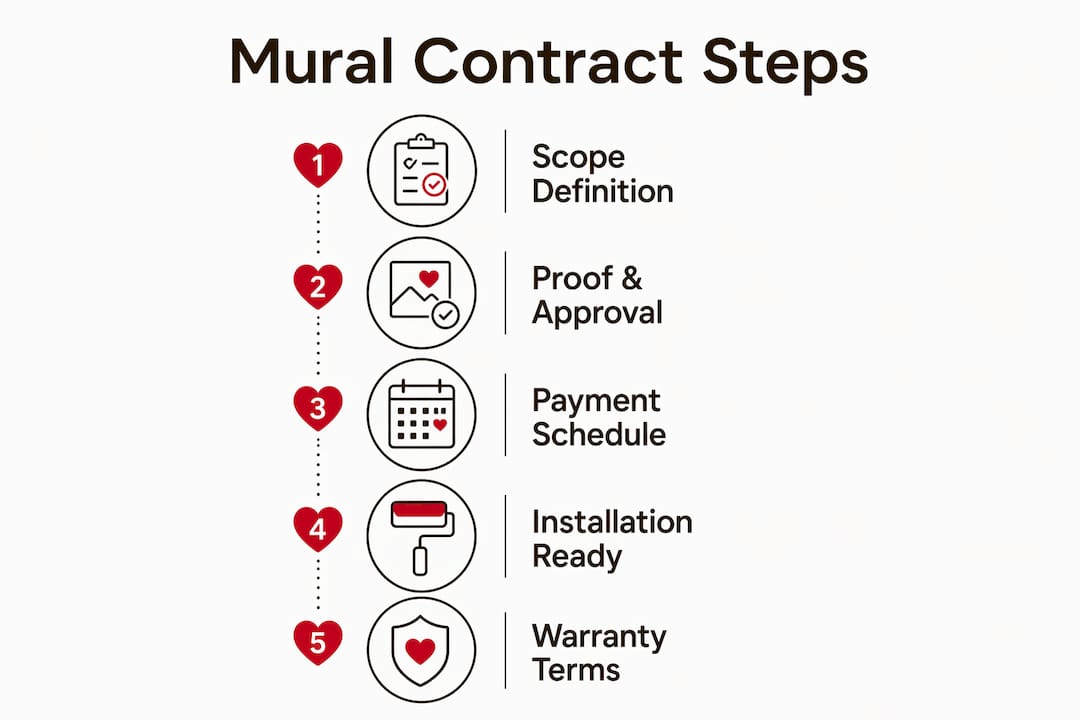
Approval: “Production shall not begin until Owner has signed the color mockup and strike-off sample attached as Exhibit B. Signed approval constitutes acceptance of color, composition, and panel sequence.”
Payment: “Owner shall pay a 50% deposit at signing, a progress payment on mockup approval, and the remaining balance less a 10% holdback on written acceptance of the completed installation.”
Change Orders: “Any change to scope, materials, or design after mockup approval requires a written change order signed by both parties before work proceeds. Additional revision fees apply beyond two included rounds.”
IP/Licensing: “Artist grants Owner a non-exclusive, perpetual license to display the Work at [location] only. Reproduction for marketing or merchandise requires a separate written agreement.”
Warranty: “Manufacturer warrants the wallcovering against defects in materials and workmanship for five years from installation date, excluding damage from moisture infiltration, vandalism, or improper installation.”
Dispute Resolution: “Disputes shall first be submitted to mediation. If unresolved within 30 days, disputes shall proceed to binding arbitration under AAA Commercial Rules in [state/county].”
| Spec Field | Value to Fill In |
|---|---|
| Wall dimensions (W × H) | _______ ft × _______ ft |
| Panel count and size | _______ panels, each _______ in wide |
| Substrate | Peel-and-stick vinyl / paste vinyl |
| Adhesive | Manufacturer-specified mildew-inhibiting adhesive |
| Finish | Matte / satin / gloss / liquid topcoat |
| File format | TIFF or layered PSD |
| Resolution | _______ dpi at final scale |
| Color profile | sRGB / Adobe RGB |
| Bleed | 0.5 in all edges |
| Approval checklist | Signed mockup ☐ Strike-off ☐ Panel map ☐ |
| Holdback amount | _______ % released on written acceptance |
Attach exhibits by file name and date: “Exhibit B — Color Mockup — [ProjectName] — [Date].pdf.” Number panel files to match the panel map: “Panel_01,” “Panel_02,” and so on.
Do murals require permits or regulatory compliance?
For exterior or publicly visible murals, local mural policies typically require written permission from the property owner, a municipal permit, and sometimes a design review by a public arts commission. Interior commercial murals may trigger fire-rating compliance: wallcoverings in commercial spaces commonly must pass ASTM E84 flame-spread testing, and the contract should require the manufacturer’s ASTM E84 certification as a submittal. Greenguard Gold certification addresses indoor air quality for low-emission products. Assign permit responsibility explicitly in the contract — who applies, who pays the fee, and what happens if a permit is delayed.
Should the contract include a confidentiality clause?
Yes, particularly for commercial projects where the design is proprietary or the client’s brand identity is involved. A confidentiality clause should cover the design files, color specifications, pricing, and any business information exchanged during the project. Both parties should agree not to share or publish images of the work until a defined release date or until the client gives written approval. For residential projects, a simpler non-disclosure covering file sharing and social media posting before installation is complete is usually sufficient.
What termination conditions go beyond simple cancellation?
Standard cancellation covers a client changing their mind before production. Termination conditions address more specific failures:
- Termination for cause by owner: artist fails to deliver the approved design, misses the completion deadline, or uses non-approved materials. Owner may halt payment, recover deposits for unperformed work, and engage a replacement contractor.
- Termination for cause by artist: owner fails to make scheduled payments, refuses to provide site access, or materially changes the scope without a signed change order. Artist retains all payments received and may retain the design files.
- Termination for convenience: either party may exit with written notice (commonly 14–30 days). The contract should define a kill fee — typically the value of work completed plus non-recoverable material costs.
- Insolvency or force majeure: if either party becomes insolvent or a sustained force-majeure event (permit denial, structural damage to the site) makes completion impossible, the contract should specify how partial payments are settled and who owns the completed panels.
Town of Lyons mural contracts require the artist to refund any advance if installation is not completed — a practical model for private agreements as well.
Wallsneedlove makes custom mural specs straightforward
Wallsneedlove produces custom-printed murals and wallpaper with a typical turnaround of 1–3 days, ships with manufacturer installation instructions, and offers Greenguard Gold-certified options for projects where low-emission materials are specified. The custom mural ordering process includes paneling guidance, file spec requirements, and sample resources that map directly to the contract checklist in this guide.
Buyers can request strike-off samples before committing to full production, and Wallsneedlove’s specifying guide for clients provides panel map templates and ordering checklists ready to attach as contract exhibits. For commercial minimum-order questions, the commercial spaces guide covers quantity thresholds and pricing structure. Start your custom order at wallsneedlove.com and request a sample panel before production begins.
Key Takeaways
A complete mural contract requires a signed mockup exhibit, a numbered panel map, a staged payment schedule with a holdback, defined installer qualifications, and explicit IP terms — every item documented before production starts.
| Point | Details |
|---|---|
| Signed mockup as exhibit | Attach the approved color mockup and strike-off to the contract before production begins. |
| Panel map and file checklist | Require numbered panels, a printed panel map, and TIFF/PSD files at 150–300 dpi with an embedded color profile. |
| Deposit and holdback schedule | Use a 50% deposit at signing and a 10–15% holdback released only on written acceptance after installation. |
| Installer qualifications and acceptance test | Require three-plus years of commercial wallcovering experience; inspect the first three panels before continuing. |
| IP and usage terms | State permitted uses, territory, and time limits; include VARA waiver language if full assignment is intended. |
| Wallsneedlove | Provides Greenguard Gold-certified options, 1–3 day production, panel maps, and installation instructions with every order. |
Why the spec sheet matters more than the contract language
Most mural disputes do not start with a legal clause. They start with a vague color call, a missing panel number, or an assumption about who primes the wall. The contract language is the remedy; the spec sheet is the prevention.
Revision caps are worth negotiating carefully. Two included revisions is a reasonable standard, but the contract should also define what counts as a revision — a color tweak to a single panel is not the same as a full composition change. Pricing reprint risk for large murals is equally specific: if a manufacturing defect appears after three panels are installed, the contract should already state who pays for reprinting and re-shipping the affected panels, not just that “defects will be remedied.”
Request a strike-off before approving full production. It is the single most effective step for avoiding a costly reprint, and it costs far less than a second production run.
Useful sources and standards to consult
- ASTM E84 and commercial vinyl wallcovering specs: covers flame-spread testing, moisture requirements, color-continuity protocol (panel rotation), and 5-year warranty language — the primary technical reference for any commercial mural spec sheet.
- Koroseal digitally printed vinyl mural spec: manufacturer submittal requirements, strike-off approval process, and warranty language for digitally printed murals.
- San Francisco Public Works mural agreement: a real municipal mural installation and maintenance agreement showing IP licensing, maintenance obligations, and termination clauses.
- City of Santa Cruz commissioned artwork agreement: standard public-art contract covering VARA moral rights waiver, change-order process, and payment schedule structure.
- Street artist commission and mural contract guidance: practical advice on signed mockup exhibits, revision caps, Pantone/hex color calls, and force-majeure clauses.
- Wallsneedlove paneling layout guide: panel numbering, downloadable panel maps, and ordering guidance for custom murals.
- Wallsneedlove custom digital printing guide: file preparation, substrate options, and digital printing process overview for spec sheet reference.


Leave a comment