

Scenic Mural Wallpaper Style Guide for Home Decorators
Scenic mural wallpaper is defined as a large-format, continuous image printed across multiple panels that turns a single wall into a complete visual scene. Unlike patterned wallpaper, which repeats a motif across the surface, scenic murals create a single uninterrupted composition. That distinction matters because the mural becomes the room’s focal point, not just its background. This scenic mural wallpaper style guide covers the most popular design categories, how to match murals to specific rooms, and how to install and style them for maximum effect.
What is a scenic mural wallpaper style guide?
A scenic mural wallpaper style guide is a practical framework for selecting, placing, and styling large-format wall murals in residential interiors. The term “scenic mural wallpaper” is widely used by decorators and retailers, while the broader industry also refers to this category as photomural or panoramic wallpaper. Both terms describe the same product: a non-repeating image that spans an entire wall. Understanding this distinction helps you search for the right product and communicate clearly with suppliers like Wallsneedlove.
The core design principle behind scenic murals is straightforward. The mural replaces artwork, creating a room’s personality without clutter. Furniture and accessories support the mural’s impact rather than compete with it. That principle separates scenic murals from decorative wallpaper, where the wall is texture rather than statement.

Popular scenic mural wallpaper styles and motifs
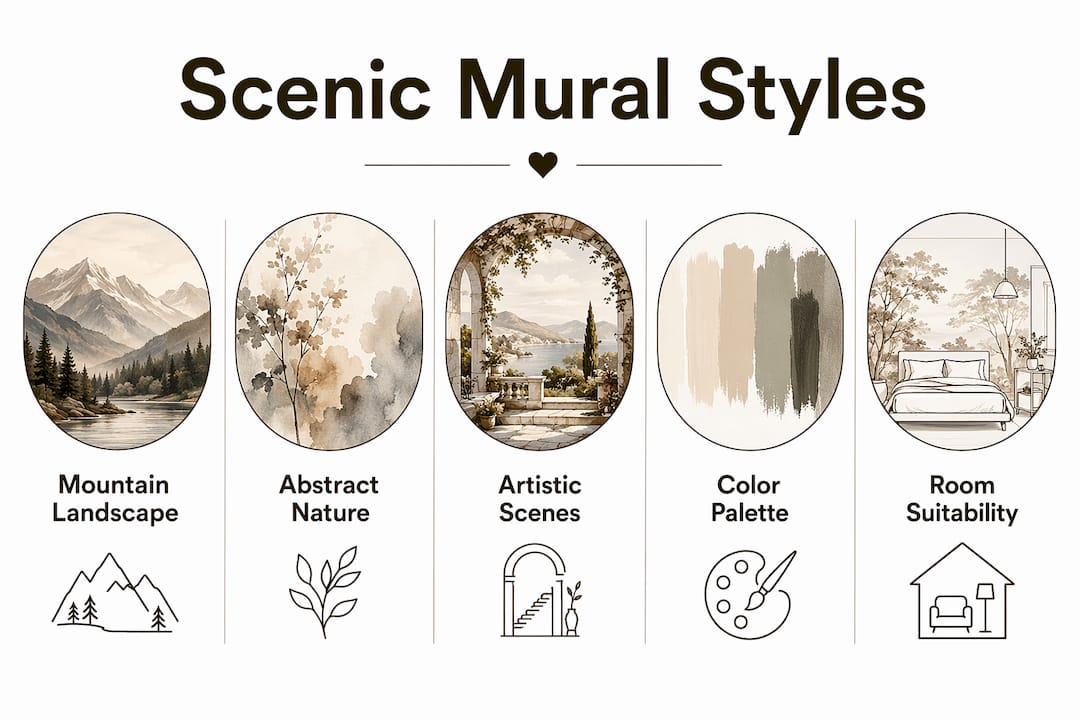
Scenic wallpaper designs fall into three broad categories: natural landscapes, abstract nature-inspired compositions, and illustrated or artistic scenes. Each category carries a distinct mood and suits different rooms and decorating goals.
Natural landscapes include mountain ranges, forests, coastlines, and open meadows. These designs work well in living rooms and bedrooms because they create a sense of depth and calm. A misty forest mural in a bedroom, for example, reads as restful rather than stimulating.
Abstract nature-inspired designs use organic shapes, watercolor washes, and botanical elements without depicting a literal scene. These suit spaces where a full photographic landscape would feel too literal, such as a home office or a dining room with modern furniture.
Illustrated and artistic scenes include hand-drawn cityscapes, vintage maps, and painterly compositions. These add personality and work well in nurseries, reading rooms, and entryways where a more playful or curated aesthetic fits.
Color palette choices drive mood as directly as subject matter does. Soft blues and earth tones promote serenity, dark tones add sophistication, and bright colors energize a space. Choosing the palette before the motif prevents mismatches between the mural’s mood and the room’s function.
| Style | Typical Colors | Mood | Best Rooms |
|---|---|---|---|
| Mountain landscape | Gray, white, blue | Calm, dramatic | Bedroom, living room |
| Forest scene | Green, brown, mist | Serene, grounding | Bedroom, nursery |
| Coastal view | Aqua, sand, white | Airy, relaxed | Bathroom, living room |
| Abstract botanical | Sage, blush, cream | Soft, modern | Office, dining room |
| Illustrated scene | Varied, often muted | Playful, curated | Nursery, entryway |
Layering a mural with room décor requires restraint. Keep textiles, rugs, and furniture in solid colors or simple textures that echo the mural’s palette. A forest mural pairs naturally with linen upholstery in warm beige. A coastal scene works with white furniture and natural rattan accents.
How to choose mural wallpaper for different rooms
Room function determines mural theme. A bedroom calls for calm, restful imagery. A living room can handle more dramatic compositions. A nursery benefits from soft, illustrated scenes rather than photorealistic landscapes. Matching the mural’s energy to the room’s purpose is the first decision to make.
Wall size and natural light shape the choice as much as theme does. Light, panoramic views with soft gradients make compact spaces feel larger and more open. A dark, dense forest mural on the only wall of a small bedroom will shrink the room visually. Check how much natural light the wall receives before committing to a dark palette.
Pairing the mural with existing furniture and accessories requires a clear hierarchy. Designer Elana Tenenbaum Cline notes that murals should balance bold and understated elements, with furniture remaining secondary. That means choosing simple, low-profile furniture when the mural is complex, and reserving statement pieces for rooms with simpler wall treatments.
Common pitfalls to avoid:
- Choosing a mural scale that does not match the wall. A small-scale illustrated scene on a 12-foot wall loses its impact.
- Ignoring undertones. A mural with warm amber tones will clash with cool gray furniture.
- Placing a busy mural behind a gallery wall. The two compete and neither wins.
- Selecting a high-contrast mural for a room with no natural light. Dark spaces need lighter murals.
Pro Tip: Before ordering, print a scaled version of the mural on standard paper and tape it to the wall. Live with it for two days to check how the colors shift in morning and evening light.
For living rooms specifically, reviewing wallpaper styles for living room walls helps narrow down which scenic compositions work at larger scales. Understanding wallpaper scale for residential spaces is equally useful when the room has unusual proportions.
Installation and styling tips for scenic mural wallpaper
Accurate measuring is the most critical step before installation. Lining up mural panels before application prevents visual mismatches and preserves the image’s integrity. Measure the wall height and width, then lay all panels on a flat surface in order before touching the wall.
Installation steps:
- Clean and prime the wall surface. Remove dust, grease, and loose paint.
- Mark a level vertical line on the wall as a starting guide.
- Lay all panels on the floor in sequence and confirm the image alignment.
- Apply the first panel at the marked line, smoothing from center outward to remove air bubbles.
- Align each subsequent panel carefully, matching the image at every seam.
- Trim excess material at ceiling, floor, and corners with a sharp utility knife.
- Wipe the surface with a damp cloth to remove adhesive residue.
Peel-and-stick mural wallpaper provides a renter-friendly option with repositionable panels. Traditional paste methods offer a more permanent result and are better suited to textured walls. The installation method affects both ease of application and how long the mural holds up over time.
Styling after installation follows one rule: keep everything else simple. Use solid-color curtains, minimal wall accessories, and furniture that does not block the mural’s lower third. Lighting matters too. Warm directional lighting from floor lamps or track lights brings out depth in landscape murals. Overhead fluorescent lighting flattens the image.
Pro Tip: When installing a multi-panel mural, number each panel on the back before you begin. Panels that look similar at a glance are easy to mix up mid-installation, and a numbering system prevents costly mistakes.
Maintenance of mural wallpapers requires gentle cleaning with a soft damp cloth. Avoid harsh chemicals or abrasive scrubbers, which strip color and damage the surface finish. Proper care extends the mural’s lifespan significantly.
Decorating with scenic mural wallpaper without overwhelming the space
Using a scenic mural as an accent wall rather than covering all four walls prevents the room from feeling enclosed. One mural wall anchors the space and gives the eye a clear focal point. The remaining walls stay neutral, which lets the mural breathe.
Strategies for successful integration:
- Match textiles to the mural’s secondary colors. If the mural features a forest with amber highlights, bring those tones into throw pillows or a rug.
- Use lighting to frame the mural. A picture light mounted above the mural or uplighting from the floor treats the wall like a piece of art.
- Keep wall art off the mural wall. Hanging frames over a scenic mural breaks the composition and reduces its visual power.
- Choose furniture with clean lines. Ornate furniture competes with a detailed mural. Simple silhouettes let the wall do the work.
- Repeat one mural color in a small accent. A single vase or cushion in the mural’s dominant color ties the room together without effort.
Open-plan spaces need extra care. Reviewing wallpaper in open-plan spaces provides specific guidance on how murals interact with sightlines and zoning in larger rooms. The general rule is to place the mural on the wall that faces the main seating area, so it reads as a backdrop rather than a divider.
Scenic mural wallpaper also affects perceived room temperature. Cool blue and green palettes read as refreshing in warm climates or south-facing rooms. Warm amber and terracotta landscapes add coziness to north-facing rooms that receive little direct sunlight. Color psychology and spatial perception work together when you choose a mural with both factors in mind. Interior designers who specialize in this area, including those who use interior design SEO services to reach clients, consistently cite mural placement and color selection as the two decisions that most affect a room’s final atmosphere.
Key Takeaways
Scenic mural wallpaper creates the strongest results when the mural functions as the room’s single dominant visual element, supported by simple furnishings and a carefully matched color palette.
| Point | Details |
|---|---|
| Define the focal wall first | Choose one wall for the mural and keep the remaining walls neutral. |
| Match mural mood to room function | Calm landscapes suit bedrooms; dramatic scenes work in living rooms. |
| Measure and pre-align panels | Lay all panels in sequence before installation to prevent image mismatches. |
| Use color psychology deliberately | Soft blues and earth tones promote calm; dark tones add depth and sophistication. |
| Keep surrounding décor simple | Solid-color textiles and clean-lined furniture let the mural lead visually. |
What experience with scenic murals has taught us
The most common mistake decorators make is treating a scenic mural like a background. It is not a background. It is the room’s primary design statement, and every other decision in the space should follow from it. When you choose the mural last, after the furniture and textiles are already in place, you almost always end up with a conflict that is expensive to resolve.
The second lesson is about scale. Decorators consistently underestimate how large a mural needs to be to read correctly in a room. A mountain scene that looks dramatic in a product photo can look like a postcard when installed on a 10-foot wall with 9-foot ceilings. Always calculate the actual printed dimensions against your wall measurements before ordering.
Trend longevity is a real concern with scenic murals, and the honest answer is that naturalistic designs age better than trend-driven ones. A misty forest or a coastal horizon will still feel current in five years. A highly stylized graphic mural tied to a specific design moment may not. Wallsneedlove’s catalog reflects this: the most enduring options are the ones grounded in nature rather than graphic trends.
The Hometaping Wall Mural and the Out Wall Mural are good reference points for how naturalistic compositions hold up across different room styles. Both demonstrate how a well-chosen scenic mural functions as permanent art rather than temporary decoration.
— Wallsneedlove
Scenic mural wallpaper collections at Wallsneedlove
Wallsneedlove offers a curated range of scenic mural wallpaper designed for residential and commercial interiors, available in both peel-and-stick and traditional paste formats.
The Java Mountain Wall Mural is a strong starting point for decorators who want a dramatic, large-scale landscape. For a nature-themed option with a lighter feel, the Forest Friends Wall Mural delivers a serene, inviting composition suited to bedrooms and nurseries. All murals are custom-printed within 1–3 days and carry Greenguard Gold certification, confirming low chemical emissions for indoor use. Browse the full mural wallpaper collection to find the right scenic design for your space.
FAQ
What is scenic mural wallpaper?
Scenic mural wallpaper is a large-format, non-repeating image printed across multiple panels that covers an entire wall with a single continuous scene. It differs from patterned wallpaper, which repeats a motif across the surface.
How do I choose mural wallpaper for a small room?
Choose murals with light, open compositions and soft color gradients, which make compact spaces feel larger and more open. Avoid dark, dense imagery in rooms with limited natural light.
What is the difference between peel-and-stick and paste mural wallpaper?
Peel-and-stick murals are repositionable and renter-friendly, while traditional paste murals offer a more permanent bond suited to textured walls. The installation method affects both ease of application and long-term durability.
How do I maintain scenic mural wallpaper?
Clean mural wallpaper with a soft, damp cloth and avoid harsh chemicals or abrasive scrubbers. Gentle care preserves the color and surface finish over time.
Should a scenic mural cover all four walls or just one?
One accent wall is the standard recommendation. A single mural wall anchors the room without making the space feel enclosed, and it preserves the visual balance that makes the design work.


Leave a comment