

Retail Store Wallpaper Style Examples That Boost Branding
For most retail stores, large-scale murals, textured neutrals, geometric repeats, and botanical prints deliver the strongest branding impact per square foot. The right choice depends on your sector, placement, and how the wall needs to work alongside product displays.
Quick picks by use case:
- Fastest visual impact: Large-scale custom murals on a single feature wall. They anchor the store’s identity immediately and photograph well for social media.
- Best for product focus: Textured neutrals and minimal patterns. They add depth without competing with merchandise.
- Kid-friendly or themed zones: Whimsical, high-contrast prints that reinforce the area’s purpose.
TL;DR: If you have one wall to commit to, a custom mural scaled to your sightline is the single highest-return choice. For the rest of the store, textured neutrals or a geometric repeat keep the space cohesive without pulling attention from the products.
Table of Contents
- What are the best retail store wallpaper style examples?
- How do you choose wallpaper styles by retail sector?
- Where in your store should wallpaper go?
- What materials and specs should you require for commercial retail wallpaper?
- What do production timelines and costs look like for retail wallpaper?
- How do you translate brand identity into a custom wallpaper or mural?
- What wallpaper trends work best for pop-ups and seasonal retail installs?
- Wallsneedlove certifications, turnaround, and project support
- Key Takeaways
- The case for restraint in retail wallpaper design
- Wallsneedlove custom murals and wallpaper for retail spaces
- Useful sources and further reading
What are the best retail store wallpaper style examples?
Custom digital wallpaper creates immersive brand experiences and functions as a storytelling backdrop that paint simply cannot replicate. Below are ten styles that consistently perform in commercial retail environments, with notes on where each works best.
| Style | Visual Descriptor | Ideal Store Types | Best Placement | Merchandising Fit |
|---|---|---|---|---|
| Large-scale mural | Full-wall photographic or illustrated scene | Fashion, home, food/coffee | Feature wall, entry | Brand storytelling backdrop |
| Textured/faux finish | Concrete, plaster, linen, or wood grain | Tech, menswear, home goods | Full perimeter or accent | Neutral product shelf backdrop |
| Geometric repeat | Bold or subtle grid, diamond, or hex pattern | Tech, modern fashion, beauty | Feature wall, fitting room | Structured, high-contrast display |
| Botanical/biophilic | Leaf, vine, or floral motif at varying scales | Beauty, wellness, home, kids | Feature wall, ceiling | Organic contrast to hard fixtures |
| Minimal/neutral | Tone-on-tone texture, subtle stripe | Luxury fashion, jewelry, tech | Full perimeter | Clean backdrop for premium product |
| Vintage/retro | Heritage typography, faded florals, aged prints | Coffee, bookstore, boutique | Feature wall, POS area | Nostalgic brand narrative |
| Kid-friendly/whimsical | Playful characters, bright color blocks | Kids’ apparel, toy, family café | Play zones, fitting rooms | Reinforces themed product areas |
| Industrial/concrete-look | Raw concrete or brick faux texture | Streetwear, hardware, food hall | Full perimeter or feature | Urban, utilitarian product context |
| Metallic/reflective accent | Foil, shimmer, or mirror-effect pattern | Jewelry, beauty, luxury retail | Fitting rooms, display alcoves | Adds perceived luxury and light |
| Photographic product backdrop | Lifestyle photography or brand imagery | Any sector with a hero product | Display backdrop, window reveal | Directly supports product story |
Statement wallpapers function as gallery-like focal points that increase the perceived value of nearby product displays. A well-placed mural does the same work as a curated art installation, at a fraction of the cost.
Pro Tip: When selecting a pattern repeat for a store with open shelving, choose a repeat height that is either shorter than your shelf spacing or significantly taller. A repeat that lands mid-shelf creates visual noise and fragments the pattern. Aim for a full motif to appear either above or below each shelf line.
How do you choose wallpaper styles by retail sector?
Color choices influence shopper behavior in measurable ways: younger shoppers tend to respond to brighter, bolder palettes, while older shoppers often prefer subtler tones. Matching color intensity to your target demographic is one of the most direct levers a designer has.
Fashion retail
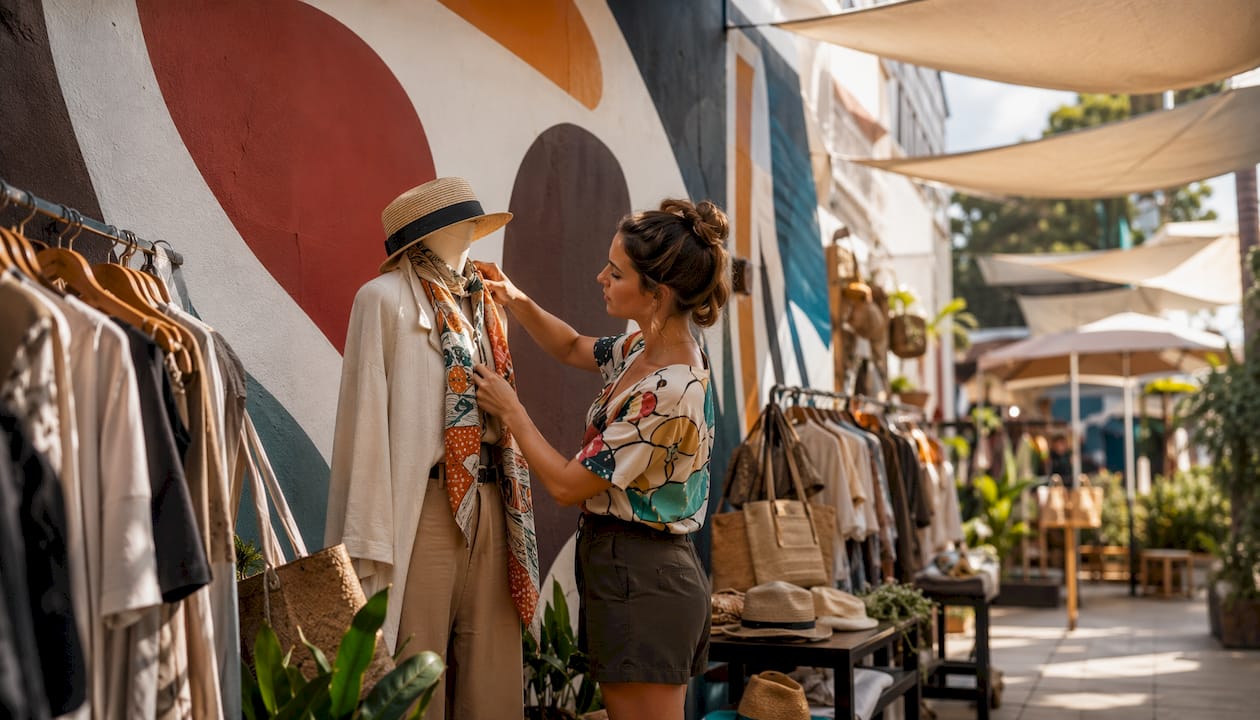
Editorial murals and minimal neutrals work best here. A large-scale black-and-white mural or a tone-on-tone textured wall keeps the focus on the clothing. Bold color belongs in the product, not the wall. For fast fashion targeting younger shoppers, a geometric repeat in a saturated accent color on one fitting-room wall adds energy without overwhelming the floor.
Beauty and wellness
Soft botanicals, blush textures, and luxe metallic accents align with the aspirational tone most beauty brands need. Biophilic motifs (leaf, vine, delicate floral) signal freshness and natural ingredients. Avoid high-contrast industrial finishes; they conflict with the softness most beauty products project.
Food and coffee
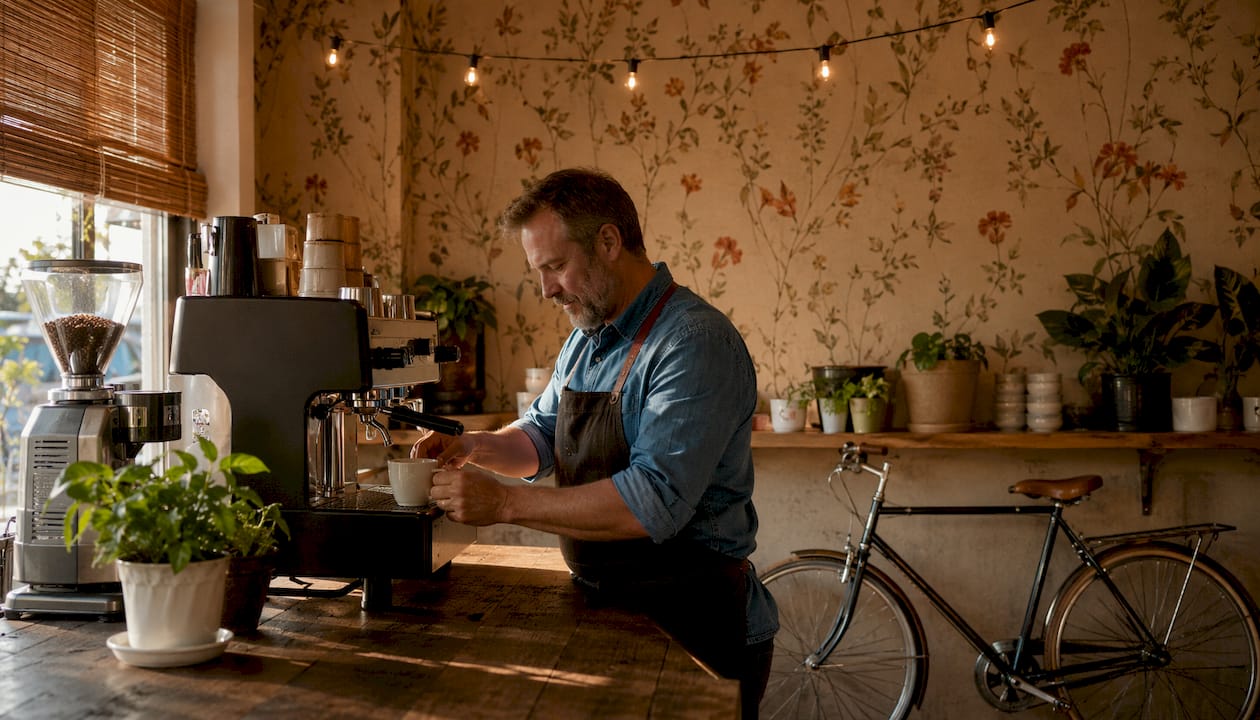
Cozy murals, vintage typography, and subtle organic patterns support signage and menu boards without competing. Warm tones (terracotta, ochre, deep green) extend dwell time. Keep pattern scale moderate so it reads well at table height and does not distract from food photography moments.
Home goods and furniture
Large-scale scenic murals and faux textures (wood grain, plaster, linen) let shoppers visualize the product in a real interior context. A faux wood grain wallpaper behind a furniture vignette does the work of a full room set at a fraction of the build cost.
Kids’ retail
High-contrast, playful prints with recognizable characters or bold color blocks. Contrast matters here because children respond to visual stimulation, and parents use the wall as a wayfinding cue. Scale up the motifs; small repeats read as adult patterns in a kids’ context.
Tech and electronics
Minimal geometrics or near-future mural graphics. Cool neutrals (slate, charcoal, white) with a single geometric accent wall keep the space feeling precise and current. Avoid warm or organic patterns; they undercut the brand promise of precision.
Color-psychology summary by sector:
- Warm tones (terracotta, amber, deep green): Food, coffee, home goods, wellness
- Cool neutrals (slate, white, charcoal): Tech, menswear, luxury fashion
- Aspirational mid-tones (blush, sage, dusty gold): Beauty, boutique fashion, jewelry
- High-contrast brights: Kids’ retail, fast fashion, pop-ups targeting Gen Z
Where in your store should wallpaper go?
Placement determines whether wallpaper works as a branding tool or just as decoration. The highest-value locations in most stores follow a clear hierarchy.
Feature/hero wall. The wall a customer faces when they enter is the single most valuable surface. A large-scale mural or bold pattern here sets the brand tone in the first three seconds of the visit. Keep this wall free of heavy shelving so the design reads fully.
Fitting rooms. Fitting rooms are where purchase decisions happen. A well-chosen wallpaper in a fitting room increases dwell time and creates a shareable moment. Metallic accents and botanical prints both perform well here because they photograph attractively under typical fitting-room lighting.
Display backdrops. Wallpaper behind a product vignette or hero display acts as a stage set. A scenic wall mural behind a lifestyle product display tells a story that a plain painted wall cannot. Change the backdrop seasonally to refresh the display without rebuilding the fixture.
Point-of-sale area. The POS wall is the last brand impression before the customer leaves. A vintage or brand-heritage pattern here reinforces identity at the moment of transaction.
Ceilings and entry alcoves. Ceiling wallpaper in an entry alcove creates an arrival moment that feels intentional and premium. Geometric or botanical patterns work well overhead because they read as texture from below rather than as a competing focal point.
Window reveals. The interior reveals of a storefront window frame the display from inside. A patterned reveal adds depth and context to window merchandising without requiring a full interior installation.
Pro Tip: Before finalizing placement, stand at the store entrance and photograph the target wall with your phone. Then overlay a scaled mockup of the wallpaper pattern. Patterns that look balanced in a flat sample can feel overwhelming or too small once they are on a wall viewed from 20 feet away. The photo test takes five minutes and prevents costly reprints.
For more placement guidance specific to storefronts, the wallpaper for small business storefronts guide covers focal-area strategy in detail.
What materials and specs should you require for commercial retail wallpaper?
Commercial retail environments are harder on wall surfaces than residential ones. High foot traffic, cleaning cycles, and fire codes all require specifications that standard residential wallpaper does not meet.
Material options and where each fits
- Peel-and-stick removable vinyl: Best for temporary installs, pop-ups, and leased spaces where surface damage is a concern. Repositionable during install; removes cleanly from most painted surfaces.
- PVC-free removable vinyl: The preferred choice when sustainability or indoor air quality is a procurement requirement. Pairs well with Greenguard Gold certification as a low-VOC signal for retail chains and landlords.
- Non-woven paste wallpaper: More durable than peel-and-stick for permanent installations. Dimensionally stable, less prone to shrinkage, and easier to hang in large panels without seam gaps.
- Mural-backed substrates: Used for large-format photographic murals. Typically printed on a heavy non-woven or fabric-backed material that handles seams cleanly at scale.
Durability and maintenance
- Ask for a Class A or Class 1 fire rating (ASTM E84) for any wallpaper in a public retail space. This is the standard most commercial landlords and building codes require.
- Request abrasion resistance data (Wyzenbeek or Martindale test results) for any wall in a high-traffic zone such as a corridor or POS area.
- Specify Type II commercial wallcovering (ASTM F793) for walls that will be wiped down regularly. Type II withstands scrubbing; Type I does not.
- Use a mild soap-and-water solution for routine cleaning. Avoid solvent-based cleaners on vinyl-coated surfaces; they degrade the print layer over time.
- For stain resistance in food retail, ask specifically about the surface coating. A matte laminate finish resists grease better than an uncoated print.
Safety and environmental compliance
Greenguard Gold certification is a strong procurement signal for retail chains and landlords focused on indoor air quality and corporate sustainability policies. It confirms that the product meets strict chemical emission limits, which matters in enclosed retail spaces with limited ventilation.
Pro Tip: Order a physical sample before committing to full production. Mount a 2’ x 3’ (60 x 90 cm) piece in the target location and evaluate it under store lighting at peak hours. Document any color shifts or glare issues before approving the production run. This one step eliminates the most common and costly installation surprises.
For commercial minimum-order requirements and procurement notes, the custom wallpaper minimum order guide covers what to expect when placing a large-format commercial order.
What do production timelines and costs look like for retail wallpaper?
Planning a retail wallpaper install requires lead time for production, shipping, site prep, and the install itself. Missing any one of these in the schedule is the most common cause of delayed store openings.
Typical production and install timeline
- Brief and design approval: 3–7 days (longer for custom murals requiring original artwork)
- Digital proof review: 1–2 days
- Production/printing: Custom orders are typically made within 1–3 days for standard sizes; larger commercial runs may take 5–7 business days
- Shipping: 2–5 business days depending on destination and carrier
- Surface prep (wall cleaning, priming, patching): 1–2 days on-site
- Installation: 1–3 days depending on square footage and complexity
- Buffer for touch-ups and punch list: 1 day
Total minimum realistic lead time for a custom retail install: 10–18 business days from brief approval.
Ballpark cost ranges by project scope
| Project Scope | Estimated Wallpaper Cost | Notes |
|---|---|---|
| Small accent wall | $150 | Single panel or small mural; peel-and-stick or paste |
| Mid-size feature wall (100–200 sq ft) | $400 | Custom mural or pattern repeat; substrate affects price |
| Full 1,000 sq ft store | $2,000 | Multiple walls; professional install adds $1–$3 per sq ft |
| Pop-up or seasonal display | $200 | Removable vinyl preferred; modular panels reduce waste |
Cost ranges are estimates based on typical commercial print pricing. Final pricing varies by substrate, print complexity, quantity, and installer rates in your market.
Pro Tip: Schedule wallpaper installation during a store closure or overnight shift. A 200 sq ft feature wall typically takes a professional team 4–6 hours. Installing during trading hours costs you sales and creates dust and adhesive fumes that affect the customer experience. Build the install into your store calendar as a closed event, not an afterthought.
How do you translate brand identity into a custom wallpaper or mural?
A branded mural is only as strong as the brief behind it. Vague direction produces generic output; a tight creative brief produces a wall that looks like it was always part of the store.
Step-by-step design process
- Creative brief: Define the brand story the wall needs to tell, the color palette (with hex or Pantone references), the mood (editorial, playful, organic, industrial), and any mandatory brand elements (logo, wordmark, mascot).
- Concept mockups: Request 2–3 scaled mockups showing the design at actual wall proportions. Evaluate at the scale it will be seen, not at thumbnail size.
- Color proofing: Request a physical color proof or a printed sample before approving production. Screen colors and print colors diverge; what looks correct on a monitor may print warmer or cooler.
- Final file delivery: Supply files at 150–200 DPI at final print size for photographic murals. Include 2–3 inches (5–8 cm) of bleed for seams. Provide all vector artwork (logos, wordmarks) at 300+ DPI or in EPS/PDF format to prevent scaling artifacts.
- Production: Confirm substrate, finish (matte, satin, gloss), and seam layout before the print run starts.
File prep checklist
- Color profile: sRGB for digital proofing; confirm CMYK conversion with your printer before final output
- Resolution: 150–200 DPI at 100% final print size for photographic content; vector for all logo elements
- Bleed: minimum 2 inches on all seam edges
- File format: TIFF or high-resolution PDF for raster content; EPS or PDF for vector elements
- Seam map: request a seam layout diagram from the printer so the installation team knows where panels meet
Rollout specs
- Approve a physical sample on-site before the full production run
- Confirm seam alignment on patterned repeats before installation begins
- For stores with signage overlays (wayfinding, price points, seasonal graphics), design the mural with clear zones where signage will sit so it does not obscure key motifs
- Plan seasonal overlays as separate peel-and-stick panels that layer over the base mural rather than replacing it
What wallpaper trends work best for pop-ups and seasonal retail installs?
Current commercial wallpaper trends favor geometric repeats, textured neutrals, and large-scale graphics alongside a strong wave of biophilic motifs. Nostalgic retro patterns are also gaining ground in food, coffee, and lifestyle retail, where heritage aesthetics reinforce brand authenticity.
Biophilic designs (oversized tropical leaves, vine patterns, pressed botanical prints) are the most broadly applicable trend across sectors right now. They work in beauty, home goods, food, and kids’ retail without feeling niche. Bold geometrics are the second-strongest trend, particularly in tech and modern fashion contexts where a clean, graphic wall signals precision.
Temporary installs: best material choices
Peel-and-stick removable vinyl is the standard choice for pop-ups and seasonal displays. It adheres to most painted surfaces without primer, removes without surface damage, and can be repositioned during install if alignment is off. For a short-term activation in a leased space, it is the only substrate that protects the security deposit.
Low-tack adhesive panels are a step up for installations that need to last 4–12 weeks. They hold more securely than standard peel-and-stick but still remove cleanly. Modular mural panels (printed in sections rather than as one continuous roll) allow teams to swap only damaged or soiled segments without replacing the entire installation.
For landscape-inspired murals and seasonal art-driven campaigns, current landscape art trends offer useful direction on color and composition choices that translate well to large-format retail walls.
Pro Tip: Design seasonal overlays as modular peel-and-stick panels that layer over a permanent base mural. The base mural stays year-round; the overlay panels swap for each campaign. This approach cuts seasonal wallpaper costs significantly on repeat campaigns because only the overlay panels need to be reprinted, not the full wall.
Wallsneedlove certifications, turnaround, and project support
Wallsneedlove holds Greenguard Gold certification, which confirms that its printed wallpapers and murals meet strict chemical emission limits for indoor air quality. For retail chains, this certification satisfies most corporate sustainability procurement requirements and is increasingly required by commercial landlords in Class A retail spaces.
Custom orders are typically made within a few days, which makes Wallsneedlove a viable option for short-lead retail activations, seasonal resets, and pop-up builds where standard commercial print lead times are too long.
What support is available for retail projects
- Digital proofs: Scaled mockups before production so designers can confirm color and layout
- Physical samples: Order a sample panel to test on-site under store lighting before approving the full run
- Installation guides: Step-by-step instructions for both peel-and-stick and paste applications, covering surface prep, panel alignment, and seam finishing
- Custom sizing: Murals and patterns printed to exact wall dimensions, eliminating the waste and seam complexity of standard-roll products
Short case examples from retail installs illustrate how these capabilities translate to real projects:
For open-plan retail spaces and showrooms, the wallpaper in open-plan spaces guide covers scale and placement decisions specific to larger floor plates.
Key Takeaways
The most effective retail wallpaper programs pair a style matched to the store’s sector and customer with a substrate specified for the space’s traffic, maintenance, and fire-rating requirements.
| Point | Details |
|---|---|
| Match style to sector | Large-scale murals suit fashion and home; minimal geometrics fit tech; botanicals work across beauty and wellness. |
| Specify commercial-grade materials | Require Class A fire rating, Type II cleanability, and Greenguard Gold certification for any permanent retail install. |
| Test before full production | Mount a 2’ x 3’ sample on-site and review under operational lighting before approving the production run. |
| Build a realistic schedule | Allow a minimum of 10–18 business days from brief approval to completed install, including buffer time. |
| Wallsneedlove for quick-turn retail | Custom orders typically made within 1–3 days, with Greenguard Gold certification, physical samples, and custom sizing available at wallsneedlove.com. |
The case for restraint in retail wallpaper design
The most common mistake in retail wallpaper projects is choosing a pattern that looks strong in isolation but fights the merchandise once the store is stocked. A mural that photographs beautifully in an empty store can fragment completely when shelving, signage, and product are layered in front of it.
The better approach is to treat the wall as a supporting actor, not the lead. For most stores, that means one bold statement surface (the feature wall or fitting room) and neutral or textural choices everywhere else. The feature wall earns the visual drama; the rest of the store lets the product carry it.
Cross-team coordination matters more than most designers expect. Visual merchandising, store operations, and marketing rarely align on wallpaper timing unless someone forces the conversation early. The install schedule, the signage overlay plan, and the seasonal refresh calendar all need to be agreed before the first panel is ordered. A wall that marketing wants to change every quarter needs a peel-and-stick substrate from day one, not a paste application that requires a full strip and repaint to update.
For a 1,000 sq ft boutique, the practical recommendation is one custom mural on the feature wall, a textured neutral on the perimeter, and peel-and-stick panels in the fitting rooms for seasonal rotation. For a pop-up, go entirely peel-and-stick with modular panels so the team can pack out cleanly and reuse undamaged sections at the next activation.
Wallsneedlove custom murals and wallpaper for retail spaces
Wallsneedlove offers custom-printed murals and wallpaper in both peel-and-stick and traditional paste formats, sized to exact wall dimensions so there is no guesswork on seams or waste. Every product is Greenguard Gold certified, which covers the indoor air quality requirements most commercial landlords and retail chains now require in procurement specs.
Production runs on a 1–3 day turnaround for custom orders, which means a retail designer can move from approved proof to shipped product in under a week. Physical samples are available before full production, and installation guides cover both substrate types for DIY and professional application.
For a feature wall mural, the Java Mountain wall mural is a strong example of a large-scale scenic option suited to home goods or lifestyle retail. For a kids’ zone or themed display, the Monkeying Around removable wallpaper shows how a playful botanical print works at retail scale. Browse the full catalog and order a sample at Wallsneedlove.
Useful sources and further reading
- Wallsneedlove product catalog and sample ordering: wallsneedlove.com — custom murals, peel-and-stick and paste options, Greenguard Gold certified
- Small business storefront wallpaper guide: Wallpaper for Small Business Storefronts — placement strategy and focal-area guidance
- Trending patterns for retail: What wallpapers are trending now — nine current patterns with commercial applications
- Removable wallpaper for temporary installs: Go Bold in Small Spaces with Removable Wallpaper — substrate guidance for pop-ups and seasonal displays; includes modular panel advice
- Commercial minimum orders: Custom Wallpaper Minimum Order for Commercial Spaces — procurement notes and minimum-order requirements for large-format commercial jobs
- Color psychology in retail: The Psychology of Retail Store Interior Design, Part 1: Color — Fohlio; demographic color-preference research for retail designers
- Custom digital wallpaper in retail spaces: Retail Spaces: The Impact of Custom Digital Wallpaper — Wallace Graphics; brand storytelling and immersive environment case material
- Statement wall art theory: Statement Wall Art Explained: What It Is and Why It Works — Noirci Studio; focal-point and perceived-value research for retail display design
- Wallpaper and room atmosphere: Why Wallpaper Changes Room Atmosphere — Wallsneedlove; covers on-site sample testing protocol and lighting evaluation


Leave a comment