

Custom Wallpaper Minimum Order for Commercial Spaces
The custom wallpaper minimum order commercial standard typically starts at 200 square feet, driven by printing setup costs and production requirements. That threshold exists because traditional print methods require significant machine preparation before a single panel rolls off the press. Digital printing has changed this picture considerably, allowing businesses to order smaller runs without paying a premium for unused setup capacity. For commercial spaces focused on branding, knowing which print method applies to your order directly affects your budget and timeline.
What determines minimum order quantities for commercial custom wallpaper?
The minimum order quantity for commercial custom wallpaper depends on the printing technology a supplier uses. Traditional screen or offset printing involves substantial setup work, which is why wholesale printing services commonly require a 200 sq. ft. minimum to keep pricing competitive for trade partners. That minimum offsets the cost of preparing plates, mixing inks, and calibrating equipment before production begins.
Several factors push minimums up or down:
- Printing method. Traditional printing carries fixed setup costs that require volume to justify. Digital printing has no equivalent setup fee.
- Material type. Specialty substrates like textured wallcovering or fabric-backed vinyl often carry higher minimums than standard paper stock.
- Supplier category. Trade customers such as sign shops and interior graphics firms frequently access different pricing tiers and minimums than retail buyers.
- Finish and coating. Scratch-resistant or UV-coated finishes may require minimum runs to justify coating line setup.
- Custom sizing. Print-to-size orders with non-standard dimensions can affect how efficiently a supplier uses their material rolls.
Understanding setup costs and pricing is the first step toward choosing the right supplier for your project. A supplier that specializes in commercial orders will be transparent about which minimums apply to which materials.
Pro Tip: Ask suppliers to separate their setup fee from their per-square-foot rate. That breakdown reveals whether a higher minimum is protecting their margin or genuinely reflecting production costs.
How does digital printing technology impact minimum orders?
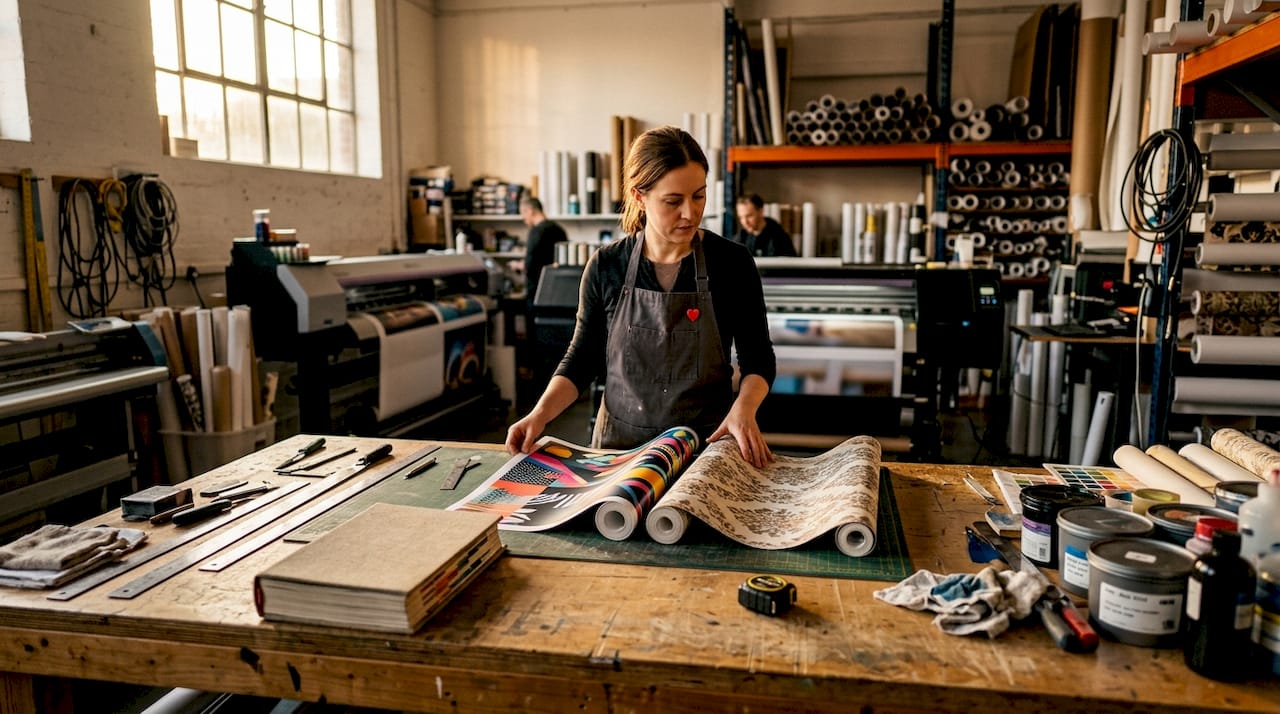
Digital printing has transformed custom commercial wallpaper from fixed minimum batch orders to flexible, on-demand runs that better suit diverse business needs. The technology prints directly from a digital file onto the substrate, eliminating the plate and screen preparation that drives traditional minimums. A restaurant that needs one accent wall covered in a branded mural can order exactly that, with no excess inventory.
The practical advantages for commercial buyers are significant:
- No fixed minimum print length. Digital suppliers can produce a single panel or a full building’s worth of wallcovering from the same file.
- Print-to-size accuracy. Panels are cut to exact client specifications, reducing waste and installation complexity.
- On-demand reordering. If a panel is damaged during installation, a replacement can be printed without triggering a full minimum order.
- Faster turnaround. Without setup time, production begins immediately after file approval.
Commercial wallpaper also needs to perform under daily wear. UVgel printed wallpaper is scratch-resistant and smudge-proof, making it well suited for restaurants, hotels, and retail environments where walls take regular contact. That durability factor matters when choosing between digital and traditional production for high-traffic spaces.
Statistic callout: Digital production supports single-roll or small-batch wallpaper printing with minimal waste. That capability removes the financial barrier that previously forced small businesses to over-order just to meet a supplier’s threshold.
For a deeper look at how this technology works, Wallsneedlove covers the full process in its guide to custom digital wallpaper printing.
Traditional vs. digital commercial wallpaper printing: which fits your order?
The choice between traditional and digital printing is primarily a question of volume and customization depth. The table below compares the two methods across the factors that matter most to commercial buyers.
| Factor | Traditional printing | Digital printing |
|---|---|---|
| Minimum order | ~200 sq. ft. | No fixed minimum |
| Setup cost | High (plates, screens, calibration) | None |
| Per-unit cost at high volume | Lower | Slightly higher |
| Custom sizing | Limited | Print-to-exact-size |
| Turnaround time | Longer | Faster |
| Best use case | Large, uniform installations | Branded murals, accent walls, small runs |
| Material options | Standard commercial substrates | Wide range including textured and specialty |
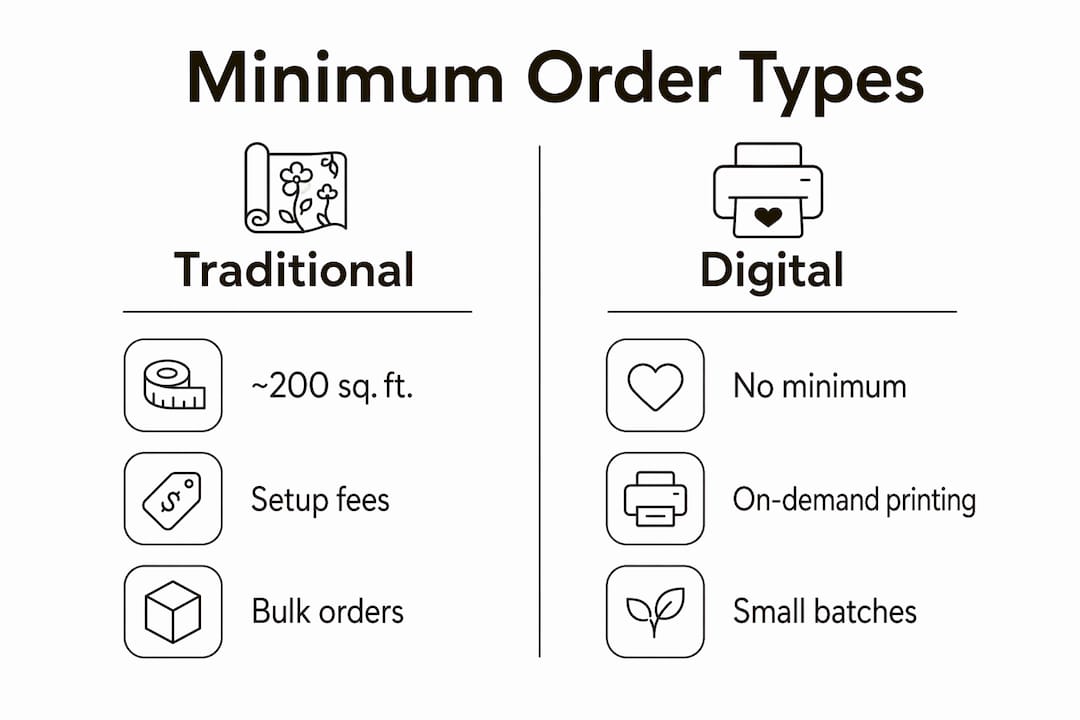
Traditional printing makes economic sense for large, uniform installations where the same design covers thousands of square feet. A hotel chain refreshing all guest room corridors with a single repeating pattern would likely benefit from the lower per-unit cost that comes with high volume. The setup cost becomes negligible when spread across a large run.
Digital printing wins for personalized wallpaper for businesses that need unique designs per location, branded accent walls, or short-run test installations before committing to a full rollout. Custom wallpaper is widely used in commercial spaces for branding, thematic decor, and customer experience, and digital production makes that accessible at any scale.
Pro Tip: If your project involves multiple locations with slightly different wall dimensions, digital printing eliminates the waste that comes from cutting standard-sized traditional panels to fit non-standard walls.
How to determine the right minimum order quantity for your project
Calculating the right order size for a commercial wallpaper project requires a methodical approach. Ordering too little means a costly reprint. Ordering too much wastes budget on material that sits in storage.
- Measure every wall surface accurately. Calculate total square footage by multiplying width by height for each wall. Add 10% to account for pattern matching, trimming, and installation errors.
- Define your design scope. A single repeating pattern across all walls is simpler to calculate than a custom mural that requires precise panel alignment. Murals need exact dimensions provided to the printer.
- Identify your print method. Confirm whether your supplier uses digital or traditional printing. That determines whether a minimum order applies and how it affects your total cost.
- Factor in material durability requirements. Textured wallcovering is preferred for commercial interiors where depth and a premium look are necessary, particularly in hospitality, retail, and office branding. Durability requirements may push you toward specific substrates with their own minimums.
- Request a trade pricing breakdown. Trade customers often access volume discounts that change the cost-per-square-foot calculation. Ask specifically about pricing tiers at 200, 500, and 1,000 square feet.
- Plan for future reorders. Order a small surplus if the design may need patching or if you manage multiple locations. Digital suppliers can reprint from the same file, but having extra panels on hand avoids delays.
The wallpaper ordering process follows similar logic for both commercial and residential projects. The key difference is that commercial buyers should always confirm durability ratings and installation requirements before finalizing quantities.
For businesses working with branded environments, wall graphics are another format worth considering alongside wallpaper. Bold business wall graphics can complement or replace wallpaper in specific zones, giving designers more flexibility in how they treat different surfaces.
Key takeaways
The commercial minimum order for custom wallpaper starts at 200 sq. ft. for traditional printing but drops to zero with digital production, making the choice of print method the single most important decision for commercial buyers.
| Point | Details |
|---|---|
| Traditional minimum order | Most traditional print suppliers require at least 200 sq. ft. to offset setup costs. |
| Digital printing flexibility | Digital production supports single-panel orders with no fixed minimum and no setup fee. |
| Material affects minimums | Specialty substrates like textured wallcovering may carry their own minimum order thresholds. |
| Measure before ordering | Add 10% to your total square footage to cover trimming, pattern matching, and installation errors. |
| Trade pricing tiers | Trade customers often access lower per-square-foot rates at volume thresholds of 200, 500, and 1,000 sq. ft. |
What commercial buyers often get wrong about minimum orders
The most common mistake commercial buyers make is assuming that a higher minimum order always means a better price per square foot. That logic holds for traditional printing but breaks down completely with digital production. A business that orders 400 sq. ft. from a digital supplier to “hit a better tier” may simply be paying for material it does not need.
The second misunderstanding involves material selection. Buyers often choose standard residential wallpaper for commercial installations because it has no minimum and ships quickly. That decision creates problems within months. Commercial spaces need scratch resistance, color stability, and surfaces that can be wiped clean. Specifying the wrong material means a reprint and reinstallation, which costs far more than getting it right the first time.
Working with a supplier that understands commercial print orders changes the outcome. Wallsneedlove carries Greenguard Gold certification, which means its products meet strict chemical emission standards for indoor air quality. That certification matters in offices, schools, and healthcare environments where air quality standards apply. Suppliers without that credential may not be suitable for certain commercial projects regardless of their pricing.
The advice that actually saves money is simple: get a detailed quote that separates material cost, setup cost, and finishing cost. Then compare that against a digital supplier’s per-panel rate. The right answer depends on your specific square footage, not on a general rule about minimums.
— Wallsneedlove
Wallsneedlove custom wallpaper for commercial spaces
Wallsneedlove offers custom-printed wallpaper and wall murals suited for commercial interiors, with options in peel-and-stick and traditional paste formats. Orders are typically produced within 1–3 days, and the Greenguard Gold certification covers all products, making them appropriate for offices, hospitality venues, and retail environments.
Businesses can choose from geometric patterns like Pixel Diamonds, scenic murals like Java Mountain, or nature-themed designs like Monkeying Around for branded accent walls. The full catalog at Wallsneedlove covers floral, watercolor, faux texture, and abstract styles, all available in custom sizes to fit specific commercial wall dimensions without excess waste.
FAQ
What is the typical minimum order for commercial custom wallpaper?
The standard minimum order for traditional commercial wallpaper printing is 200 sq. ft., set to offset setup costs. Digital printing suppliers often have no fixed minimum, allowing orders as small as a single panel.
Does digital printing eliminate minimum order requirements?
Digital production supports on-demand printing from a single roll to large quantities with no fixed minimum. This makes it the preferred method for businesses that need branded murals or accent walls in specific sizes.
How do I calculate how much wallpaper to order for a commercial space?
Measure the total square footage of all walls to be covered, then add 10% for trimming, pattern matching, and installation errors. Confirm your supplier’s minimum order threshold before finalizing the quantity.
What material should commercial spaces use for custom wallpaper?
Commercial interiors require wallcovering with scratch resistance, color stability, and cleanability. UVgel printed wallpaper and textured wallcovering are both rated for high-traffic environments like restaurants, hotels, and offices.
Can businesses order custom wallpaper without a large upfront commitment?
Digital printing removes the large upfront volume requirement. Businesses can order exact quantities for a single location, then reorder from the same file if additional panels are needed later.


Leave a comment