
Specifying Custom Murals for Clients: A Practical Guide
Specifying custom murals for clients is the process of translating a client’s vision into a wall artwork that reinforces brand identity and transforms a space. Done well, it covers everything from gathering wall dimensions to submitting final print files. Interior decorators, business owners, and homeowners all benefit from a clear workflow. Wallsneedlove offers branded mural options for both residential and commercial projects, making it a practical starting point for any specification process.
What are the key requirements for specifying custom murals for clients?
The first step in any custom mural project is a thorough site assessment. Measure every wall accurately, noting height, width, and any obstacles like outlets, windows, or doors. Surface material matters too. Painted drywall, concrete, and brick each require different substrate preparation before installation.
Artwork file preparation is equally critical. High-quality mural printing requires files at 240–300 DPI at print size, with accepted formats including PDF, TIFF, PSD, AI, and JPEG. That resolution standard exists because large-format printing magnifies every pixel. A file that looks sharp on screen at 72 DPI will print blurry at mural scale. Vector files are preferred for logos and text because they scale without any loss of quality.
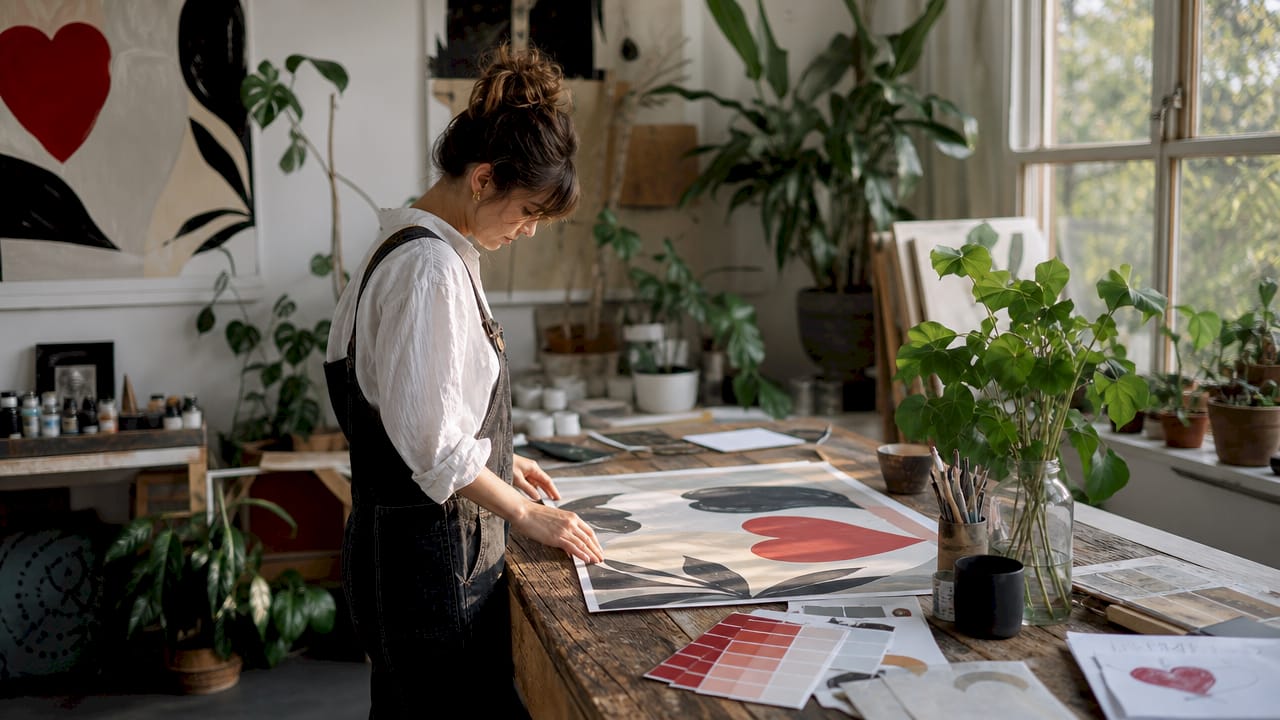
Understanding the client’s branding and aesthetic goals shapes every decision that follows. Ask whether the mural needs to match existing brand colors, reinforce a specific mood, or serve as a focal point in a lobby or retail floor. Document these goals in writing before any design work begins.
Technical file specifications at a glance
| Specification | Requirement |
|---|---|
| Minimum resolution | 240–300 DPI at print size |
| Preferred file formats | PDF, TIFF, PSD, AI, JPEG |
| Vector files | Required for logos and text |
| Font handling | Outline all fonts to prevent errors |
| Color mode | CMYK for accurate print color |
Pro Tip: Request a scaled proof print at roughly 12 inches by 12 inches before approving the full run. This catches color shifts and resolution issues before they become expensive mistakes.
How to present custom mural options to clients effectively
Client buy-in depends on how clearly you communicate the design intent. Digital mockups placed on a photo of the actual wall are the most effective tool for this. They let clients visualize scale, color, and placement without any guesswork. Most clients struggle to read flat design files, so a realistic room render closes the gap between concept and approval.
A strong first impression matters more than most people realize. Clients form a judgment about a space within 7 seconds of entering it. A well-placed custom mural signals professional intent and brand identity within that critical window. This makes the presentation of mural options a direct argument for the project’s business value, not just its aesthetics.
A structured client presentation checklist keeps the process organized and reduces revision cycles. Cover these points in every presentation:
- Wall dimensions and confirmed measurements
- Design concept with color palette and style reference
- Digital mockup on the actual wall photo
- Material options, including peel-and-stick versus traditional paste
- Budget range and production timeline
- Revision process and approval sign-off steps
Pro Tip: Always present two or three design directions rather than one. Clients who choose between options feel more ownership over the final result and approve faster.
Address client concerns about durability and removal upfront. Large-format murals typically last 5–7 years and are designed for clean removal without damaging the underlying surface. That lifespan makes them practical for businesses that refresh branding periodically.
What are the main steps from specification to installation?
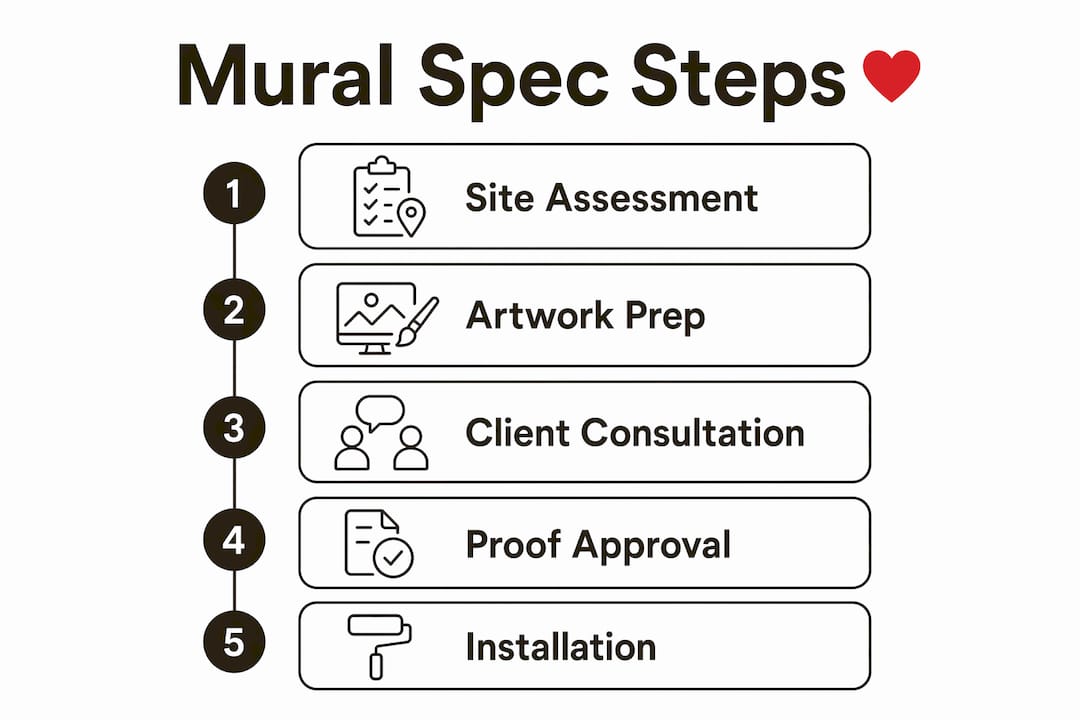
A well-run custom mural project follows a clear sequence. Skipping any phase creates problems downstream, from sizing errors to surface failures.
- Design finalization. Lock the artwork file with client sign-off before sending anything to print. Changes after this point cost time and money.
- File submission. Submit files meeting the 240 ppi resolution standard with all fonts outlined. Confirm color mode is CMYK.
- Print production. Wallsneedlove produces custom orders within 1–3 days. Confirm substrate choice, either peel-and-stick or traditional paste, at this stage.
- Site preparation. Clean and prime the wall surface. Remove dust, grease, and any loose paint. Smooth surfaces produce the cleanest results.
- Installation. Follow panel sequencing carefully. Start from a plumb vertical line and work outward. Overlap seams per the manufacturer’s instructions.
- Quality review. Inspect seams, edges, and color consistency under the room’s actual lighting conditions.
For commercial projects, CSI MasterFormat Section 09 84 00 governs mural specifications. This standard covers fire ratings, print resolution, substrate requirements, and installation documentation. Specifying murals under this section protects both the designer and the client in commercial build-outs. Greenguard Gold certification, which Wallsneedlove carries, satisfies most commercial indoor air quality requirements within this framework.
Common issues and how to prevent them
Sizing errors are the most frequent problem. They almost always trace back to measurements taken without accounting for baseboards, crown molding, or ceiling drops. Measure twice, and photograph the wall with a tape measure visible in the frame. Surface preparation failures cause bubbling and peeling. Any wall with moisture issues, fresh paint under 30 days old, or a textured finish needs extra prep time.
Pro Tip: For open-plan office spaces, divide the mural across panels that align with architectural features like columns or partition walls. This makes installation cleaner and allows partial replacement if one section is damaged.
What benefits do custom murals offer client projects?
Custom murals deliver measurable results beyond aesthetics. Office art reduces stress for 78% of employees, boosts morale for 67%, and increases productivity for 64%. Those numbers reflect a direct return on the investment in a mural project. For business owners, that makes a custom mural a functional asset, not just a decorative one.
Murals also function as organic marketing tools. A well-designed mural becomes a landmark that visitors photograph and share on social media without any prompting. This third-party endorsement effect delivers continuous authentic marketing that paid advertising cannot replicate. Retail spaces and hospitality venues benefit most from this dynamic, but any client-facing business can capture it.
“Murals generate ‘third-party endorsement’ by becoming landmarks that encourage organic social media content creation, offering continuous authentic marketing that outperforms paid ads.”
The benefits extend to residential clients as well. A custom mural in a home office, hallway, or living room creates a focal point that no off-the-shelf product can match. For homeowners, the impact on customer experience translates into a more personal, memorable space.
Key benefits for business owners and homeowners include:
- Reinforced brand identity in client-facing spaces
- Reduced employee stress and improved morale in workplaces
- Organic social media content generated by visitors
- Flexible branding refresh cycles with removable materials
- Unique focal points that off-the-shelf decor cannot provide
- Greenguard Gold certified options for safe indoor environments
The installation itself can function as a marketing event, generating social media content and building public anticipation before the space even opens. Treating the reveal as a brand moment multiplies the mural’s marketing value from day one.
Key Takeaways
Specifying custom murals for clients requires precise measurements, print-ready artwork files, structured client presentations, and a clear installation workflow to deliver projects that perform both visually and commercially.
| Point | Details |
|---|---|
| File resolution is non-negotiable | Submit artwork at 240–300 DPI at print size with fonts outlined to avoid print errors. |
| Present mockups, not flat files | Digital renders on actual wall photos close the gap between concept and client approval. |
| Follow CSI 09 84 00 for commercial work | This standard covers fire ratings, substrates, and installation docs for commercial projects. |
| Murals deliver measurable ROI | 78% of employees report reduced stress from office art, making murals a functional business investment. |
| Installation is a marketing opportunity | Treat the mural reveal as a brand event to generate organic social media content from day one. |
What working with custom murals has taught us at Wallsneedlove
The most common mistake we see is treating the specification process as a design task rather than a communication task. The artwork is only half the work. The other half is making sure the client understands exactly what they are approving, at what scale, on which wall, in which lighting conditions. Projects that skip the digital mockup step almost always generate revision requests after production, and that costs everyone time.
The shift toward designing murals specifically for social media shareability is real and worth planning for. Clients now ask whether a mural will “photograph well” before they ask about durability. The answer depends on contrast, scale, and placement relative to natural light. Advising clients on this early in the process adds genuine value and sets the project apart from a standard paint or wallpaper job.
Material choice shapes the entire client relationship after installation. Peel-and-stick options from Wallsneedlove give clients the freedom to refresh their space without contractor costs. That flexibility turns a one-time project into an ongoing relationship. For hallways and transitional spaces, removable murals are the practical default because those areas see the most wear and the most frequent redesigns.
The clients who get the most value from a custom mural are the ones who treat it as a brand asset from the start. That means briefing it like a marketing project, not an interior design afterthought. When you bring that framing to the first client meeting, the entire specification process becomes faster and more focused.
— Wallsneedlove
Custom mural options from Wallsneedlove for your next project
Wallsneedlove offers a wide range of custom murals suited for both residential and commercial projects, with orders produced within 1–3 days and Greenguard Gold certification for safe indoor use.
The Forest of Shadows wall mural is a strong choice for client-facing spaces that need a dramatic, nature-inspired focal point. For spaces that call for a playful, memorable design, the Vintage Rainbow delivers bold visual impact with the flexibility of peel-and-stick installation. Both options are available in custom sizes to match exact wall dimensions. Wallsneedlove also provides design support and a detailed installation guide, making the process straightforward for decorators and first-time installers alike. Browse the full collection to find the right fit for your client’s space and brand.
For painting and mural professionals looking to grow their client base, Vaultio’s painting marketing resources offer practical strategies for attracting high-value projects.
FAQ
What file format is best for submitting custom mural artwork?
PDF, TIFF, PSD, AI, and JPEG are all accepted formats for mural printing. Files must be prepared at 240–300 DPI at print size, with all fonts outlined to prevent rendering errors.
How long does a custom mural last?
Large-format custom murals typically last 5–7 years. Peel-and-stick versions are designed for clean removal without damaging the wall surface, making them practical for periodic branding updates.
What specification standard applies to commercial mural projects?
Commercial mural projects follow CSI MasterFormat Section 09 84 00. This standard covers fire ratings, print resolution, substrate selection, and installation documentation for architectural finishes.
How do custom murals benefit retail and office spaces?
Office art reduces stress for 78% of employees and boosts morale for 67%. In retail spaces, murals become social media landmarks that generate organic marketing without paid advertising costs.
What is the most common mistake when specifying a custom mural?
The most common mistake is taking measurements without accounting for baseboards, crown molding, or ceiling drops. Always photograph the wall with a tape measure visible and confirm dimensions before submitting files for print.


Leave a comment