

Wall Mural vs Signage Explained: A Legal and Practical Guide
What sets a wall mural apart from signage under U.S. law?
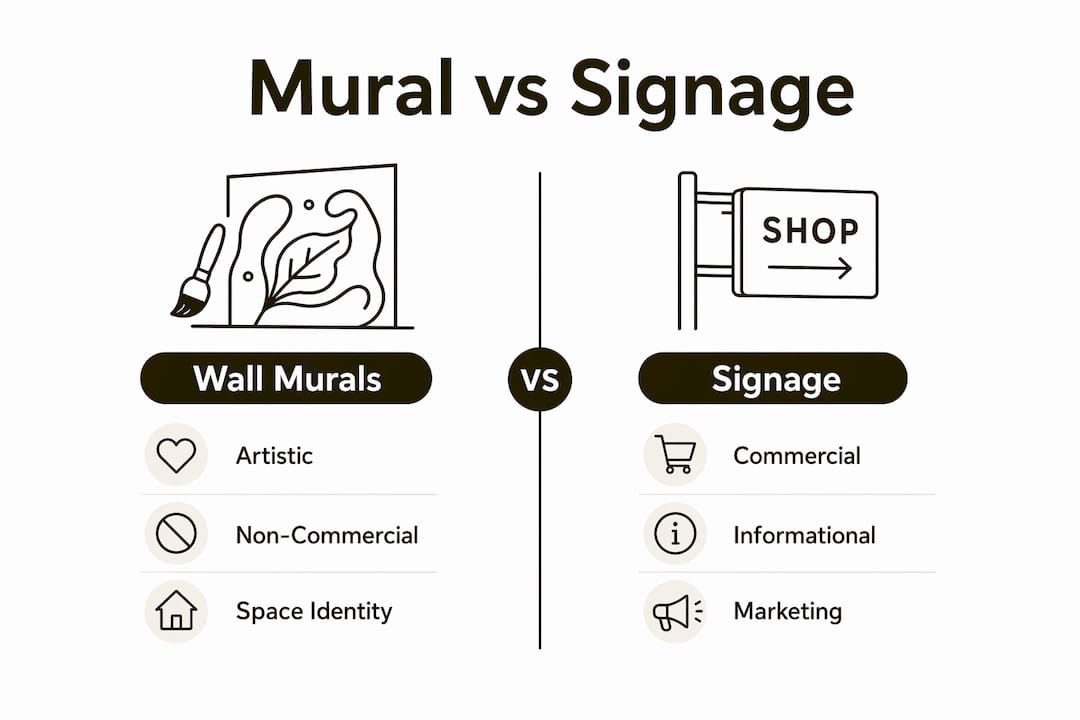
The core distinction between a wall mural and signage comes down to one question: does the display convey commercial speech? A mural is a large-scale artistic work applied directly to a wall surface. Signage is a visual display designed to communicate commercial or directional information. That difference in purpose drives nearly every legal, permitting, and zoning consequence that follows.
Under most U.S. municipal codes, murals are generally exempt from sign ordinances when they contain no commercial speech. The moment a mural includes a logo, product image, or business reference, it can be reclassified as a sign and subjected to permit requirements, size limits, and zoning restrictions.
Here is a quick breakdown of the key differences:
- Purpose: Murals create immersive artistic environments; signs convey specific commercial or directional information.
- Legal classification: Murals with no commercial content are typically treated as artwork; signs are regulated commercial speech.
- Permitting: Signs require permits and must comply with size and placement rules; purely artistic murals often do not.
- Application method: Murals are painted or printed directly onto wall surfaces; signs are commonly mounted on hardware or applied as removable vinyl.
- Materials: Vinyl graphics are removable and made for temporary to medium-term use; direct wall printing produces permanent, seam-free results suited to long-term murals.
- Community impact: Murals affect neighborhood identity and emotional experience; signs primarily serve functional communication.
How municipal law draws the line between murals and signage
The legal framework separating murals from signage in the United States is built on the distinction between commercial speech and artistic expression, and it is far less clear-cut in practice than it sounds in theory.
Commercial speech vs. artistic expression
Commercial speech is expression tied to the economic interests of the speaker and audience. Artistic expression, by contrast, conveys ideas, culture, or aesthetics without a direct commercial purpose. Courts use this distinction to determine whether a mural falls under First Amendment protection as artwork or qualifies as regulable commercial speech subject to sign ordinances.
The problem is that courts apply this distinction inconsistently. Four cases decided between 2009 and 2012 illustrate the range: Complete Angler, LLC v. City of Clearwater, City of Tipp City v. Dakin, Neighborhood Enterprises, Inc. v. City of St. Louis, and Wag More Dogs, Ltd. Liability Corp. v. Cozart. The murals in the first three cases were ultimately permitted to remain. The mural in Wag More Dogs was ordered removed because cartoon dogs in the mural incorporated the business’s logo, shifting the work from protected artistic expression into regulable commercial speech.
How municipal ordinances typically work
Most municipal sign ordinances classify a mural as signage only when it contains commercial content. Arlington County’s ordinance, for example, mandates that outdoor murals include no picture, symbol, or device that relates to a commercial business, product, or service offered on the premises. A mural meeting that standard is classified as a work of visual art and exempt from sign restrictions. One that does not is treated as a sign.
Permitting requirements, size caps, and location restrictions then apply to anything classified as signage. Purely artistic murals typically bypass this process entirely, though some municipalities require pre-approval through a cultural commission or planning department.
Real-world municipal examples
- Los Angeles, CA: After a decade-long mural ban triggered by a lawsuit from outdoor advertising companies, the city created a mural ordinance in 2013 that lifted the ban, differentiated murals from outdoor advertisements, and established a registration process.
- Goose Creek, SC: The city’s ordinance regulates commercial advertising murals based on location rather than content, reducing First Amendment exposure while still allowing murals on business premises.
- Newport, KY: Newport’s mural ordinance includes 18 placement restrictions administered jointly by the Planning and Development Department and the Historic Preservation Commission, adding a layer of regulatory complexity beyond standard sign codes.
- Salina, KS: A mural depicting flying saucer-like hamburgers on a restaurant wall was classified as a sign because it depicted food sold inside. The city has spent substantial legal fees pursuing the case, which is now before the 10th Circuit Court of Appeals.
According to the National Zoning Atlas, there are over 30,000 zoning jurisdictions across the United States, each with its own definitions and processes. There is no national standard.
The content-neutrality problem
Legal scholarship argues that basing mural regulation on commercial versus non-commercial speech creates a content-based distinction that can violate the First Amendment. Regulations that require a zoning official to read the content of a mural to determine its classification are, by definition, content-based. The better regulatory approach focuses on the type of sign and its location rather than what it says, which reduces constitutional exposure and produces more consistent enforcement.
How murals and signage differ in function, design, and impact
The legal distinction between murals and signage reflects a deeper functional difference. Signs are built to communicate. Murals are built to transform.

What signage does
Signage conveys specific, localized information: a business name, a price, a direction, a promotion. It is designed for quick comprehension. Mounted on hardware or applied as removable vinyl, a sign is discrete, replaceable, and tied to a commercial purpose. Vinyl wall graphics are a common format for promotional signage, lasting 3–7 years before requiring replacement. They are cost-effective for short-term campaigns but carry the risk of adhesive damage on removal.
What murals do
A mural alters the identity of a space. Applied directly to a wall surface through hand-painting or direct printing, a well-executed mural is seamless, large-scale, and permanent in character. It does not ask the viewer to read it. It asks them to experience it. Research conducted in Philadelphia and Berlin found that murals increased feelings of calm, inspiration, and neighborhood connectedness beyond what unadorned walls produced. Participants in West Philadelphia reported perceiving the neighborhood as safer and more interesting after viewing murals. In Berlin, participants who engaged with a publicly accessible neighborhood art exhibition felt more connected to the area and reported greater overall well-being.
Studies also show that public mural projects produce measurable personal well-being benefits for most respondents who encounter them. That kind of impact is simply outside the scope of what a sign can do.
Practical differences in application and materials
| Feature | Wall Mural | Signage |
|---|---|---|
| Application method | Direct wall printing or hand-painting | Vinyl, hardware-mounted, or printed panels |
| Removability | Typically permanent; repainting required for changes | Removable vinyl; hardware signs can be uninstalled |
| Visual character | Seamless, large-scale, immersive | Discrete, bounded, often framed or mounted |
| Durability | Long-lasting with proper surface prep | Vinyl lasts 3–7 years; hardware signs vary |
| Permit requirement | Usually exempt if non-commercial | Required under most municipal sign codes |
| Community impact | Affects neighborhood identity and well-being | Primarily functional and informational |
Understanding why wall murals improve customer experience in commercial settings comes down to this table. Murals do something signs cannot: they make a space feel cared for.
Common misconceptions that get property owners into trouble
Most mural-versus-signage disputes do not start with bad intentions. They start with a misunderstanding of where the line is, and by the time the classification is contested, the costs are already mounting.
Misconception 1: Artistic intent protects the mural
Property owners frequently assume that commissioning a professional artist and calling the result “art” is enough to keep a mural out of sign ordinance territory. It is not. Municipal codes do not ask whether the work was created with artistic intent. They ask whether the finished image contains commercial speech. A beautifully executed mural of flowers on a florist’s exterior wall can be classified as a sign if the flowers are the product the business sells, regardless of the artist’s credentials or the owner’s stated purpose.
Misconception 2: Small commercial elements do not matter
The Wag More Dogs case is the clearest example of how a single design detail can change a mural’s legal classification. The cartoon dogs in that mural were not a logo. They incorporated a logo. That one element was enough for Arlington County to classify the entire mural as signage. Property owners who include even minor brand references in a mural take on real legal exposure.
Misconception 3: Municipal enforcement is consistent
It is not. Because classification often depends on the subjective judgment of a zoning official reading the content of a mural, outcomes vary widely across jurisdictions and even within the same city over time. The ambiguity in mural versus sign classification frequently results from municipal codes relying on subjective artist intent rather than clear objective criteria. That subjectivity creates risk for owners who plan a mural without first confirming how their local code handles it.
Misconception 4: Historic preservation rules do not apply
In communities with historic districts, a mural may need to satisfy preservation requirements on top of sign ordinance compliance. Newport, Kentucky’s 18-condition mural ordinance, administered through the Historic Preservation Commission, is a direct example. Property owners in historic zones should expect a more complex approval process.
Practical challenges for municipal officials
- Overlapping jurisdiction between planning, zoning, and cultural commissions creates coordination gaps.
- Ad hoc enforcement without a formal mural program leads to inconsistent decisions and legal challenges.
- Content-based distinctions in sign ordinances create First Amendment exposure that courts have repeatedly flagged.
- Without a mural registration process, cities lack documentation to defend classification decisions in court.
Pro Tip: Before commissioning any exterior mural on a commercial property, request a pre-application meeting with your local planning or zoning department. Ask specifically how your municipality’s sign ordinance defines commercial speech and whether a mural program or registration process exists. Getting that answer in writing before the artist picks up a brush is far cheaper than litigating it afterward.
Best practices for keeping a wall mural out of sign ordinance territory
Compliance starts before the design is finalized. Property owners and decorators who treat mural planning as a legal exercise from the beginning avoid the disputes that cost cities like Salina, Kansas over $800,000 in legal fees.
Consult local authorities before commissioning
Contact your local planning or zoning department before any mural work begins. Ask whether your municipality has a formal mural program, a registration process, or specific design guidelines. Some cities, like Los Angeles post-2013, have dedicated mural ordinances that provide a clear path to approval. Others rely on general sign codes that require careful interpretation. Knowing which situation you are in shapes every decision that follows.
Keep commercial content out of the design
This is the single most effective compliance measure. Selecting non-commercial content and documenting artistic intent supports classification as a mural exempt from signage regulation. No logos. No product images. No business names. No depictions of items sold on the premises. A mural of a mountain landscape on a coffee shop wall is art. A mural of coffee cups on the same wall is a sign.
Choose materials that match the mural’s intended permanence
Direct wall printing and hand-painting are the standard methods for murals intended to last. They produce seamless, surface-integrated results that read visually as artwork rather than applied graphics. Removable vinyl, by contrast, is associated with promotional signage and may influence how a zoning official classifies the work. For guidance on application methods for murals, matching the material to the intended use is a practical starting point.
Document everything
- Record the artist’s statement describing the work’s non-commercial purpose.
- Photograph the completed mural and retain design files showing no commercial content.
- Keep correspondence with planning or zoning officials confirming classification.
- If a mural program exists, complete the registration process and retain the approval documentation.
This documentation becomes the primary defense if a zoning official later challenges the classification. Courts have ruled both ways on mural cases with similar facts. The difference often comes down to how well the property owner can demonstrate non-commercial intent.
Engage the community and relevant commissions
Municipalities that develop clear mural programs with community input reduce legal uncertainty and avoid costly disputes. For property owners, proactively engaging neighbors, local arts organizations, and cultural commissions before installation builds goodwill and creates a record of community support. In cities where approval runs through a Cultural Commission, as in Goose Creek, South Carolina, that engagement is part of the formal process. Elsewhere, it is simply good practice.
Pro Tip: When working with an artist on a commercial property mural, include a clause in the commission agreement specifying that the final design will contain no commercial speech, logos, or product imagery. This protects both the property owner and the artist if the classification is later challenged.
For property owners working through the full specification process, a practical guide to specifying custom murals covers the technical and compliance considerations in detail.
The color choices within a mural also carry weight beyond aesthetics. Research on the role of color in interior environments shows that color selection directly affects how a space is perceived and experienced, a factor worth considering when designing murals intended to shape neighborhood or commercial identity.
Wallsneedlove offers custom wall murals built for interior spaces
Custom wall murals for residential and commercial interiors sit in a different regulatory category than exterior murals on commercial buildings. Interior murals are not subject to municipal sign ordinances. That means property owners, decorators, and business owners can focus entirely on design, materials, and installation quality rather than permitting and zoning compliance.

Wallsneedlove produces custom-printed wall murals and wallpaper in a full range of styles, from scenic and floral to geometric and faux texture, available in peel-and-stick or traditional paste formats. Orders are custom made within 1–3 days. All products carry Greenguard Gold environmental certification, which matters for commercial spaces with air quality standards to meet. The peel-and-stick format is particularly useful for business interiors where future changes are likely, offering the visual impact of a permanent mural without the commitment of direct-to-wall printing.
For a starting point, the Java Mountain wall mural demonstrates the scale and detail achievable with custom printing, while the removable wallpaper collection shows how peel-and-stick options work for spaces that need flexibility. Browse the full catalog at Wallsneedlove to find the right format for your space.
Key Takeaways
The legal classification of a wall mural versus signage in the U.S. turns on one factor: whether the display contains commercial speech, which triggers sign ordinance requirements including permits, size limits, and zoning restrictions.
| Point | Details |
|---|---|
| Commercial speech triggers sign rules | Any logo, product image, or business reference in a mural can reclassify it as signage under most municipal codes. |
| No national standard exists | With over 30,000 zoning jurisdictions in the U.S., classification rules and enforcement vary widely by community. |
| Murals carry measurable community benefits | Research in Philadelphia and Berlin shows murals increase perceived safety, well-being, and neighborhood connectedness among most respondents. |
| Documentation protects property owners | Recording artistic intent, design files, and planning department correspondence is the primary defense against reclassification. |
| Wallsneedlove for interior applications | Wallsneedlove custom murals and peel-and-stick wallpaper serve residential and commercial interiors where sign ordinances do not apply. |


Leave a comment