

Order Maximalist Wallpaper in 1 to 3 Days with WallsNeedLove
Maximalist wallpaper uses saturated color, layered pattern, and large-scale imagery to make a wall the focal point of a room rather than a backdrop. The practical way to get the look without regret is a custom mural or a large-repeat peel-and-stick design sized to your exact wall, since both limit waste and installation risk compared to guessing at standard rolls. Some companies sell both formats directly, with custom printing built around the request.
TL;DR:
- Custom murals and large-repeat peel-and-stick designs minimize waste, installation risk, and are best suited for size-specific wall coverage.
- Large-scale floral and scenic murals work well as focal points in living rooms, bedrooms, or ceilings, especially when scaled to enhance visual impact from any distance.
- Peel-and-stick wallpaper is ideal for renters and temporary spaces due to easier removal, while paste applications offer longer durability and seamless finishes for long-term use.
- Accurate measurement, pattern matching, and sample testing are critical to achieving the desired scale, color accuracy, and minimizing costly reorders.
- Planning for overage, professional installation for complex patterns, and regular surface maintenance are essential to keep maximalist wallpaper looking sharp over time.
Table of Contents
- What Are the Main Styles of Maximalist Wallpaper?
- Which Rooms Work Best for Bold Wallpaper?
- Peel-and-Stick or Paste: Which Should You Choose?
- How Do You Choose Scale, Color, and Quantity?
- What Are Smart Ways to Style a Maximalist Wall?
- Why Wallsneedlove Fits Maximalist Wallpaper Projects
- How Much Does Maximalist Wallpaper Cost?
- How Long Does It Take From Order to Finished Wall?
- How Do You Keep Maximalist Wallpaper Looking Sharp?
- Designer Viewpoint: Balancing Scale, Color, and Meaning
- Ready to Order Your Maximalist Wallpaper
- Sources
What Are the Main Styles of Maximalist Wallpaper?
Maximalist wallpaper draws from a handful of recurring motif families, and each one reads differently on a wall. Large-scale florals and botanicals feel lush and organic, good for rooms that want warmth without looking busy up close. Geometric patterns, from Art Deco diamonds to repeating chevrons, bring structure and energy, and they tend to photograph well in commercial spaces like lobbies or retail fitting rooms. Illustrative murals, scenic landscapes, or Gatsby-style motifs with metallics and fan shapes push furthest into statement territory, since they act more like art than pattern.
Trending styles right now lean into large-scale florals, wavy stripes, and artist-designed patterns, often placed somewhere unexpected like a ceiling or the back of an open shelf. Scale changes how a motif behaves. A small floral repeat can feel like wallpaper from across the room but turn busy up close, while an oversized print holds its shape from any distance and often needs fewer seams to look intentional.
Pairing rules keep each motif from fighting the room around it:
- Florals and botanicals pair well with matte black or brass hardware and simple linen textiles.
- Geometric and Art Deco wallpaper ideas look sharpest against glossy finishes, mirrored surfaces, or velvet upholstery.
- Illustrative murals need the least competition. Keep furniture low profile and let the wall carry the room.
- Bold pattern wallpaper with metallics reads best under warm lighting rather than cool overhead fixtures.
Wallsneedlove’s breakdown of current wallpaper trends covers nine of these patterns in more depth if you want to see how they scale across full rooms.
Which Rooms Work Best for Bold Wallpaper?
Placement decides whether maximalist decor feels curated or chaotic, and the room’s function should drive the choice more than the pattern itself.
- Living rooms and dining rooms handle full-room pattern drenching well, since they’re low-traffic compared to kitchens and hallways, and a single dominant wall or all four walls both work if furniture stays simple.
- Bedrooms suit an accent wall behind the headboard, where a large-scale mural or floral becomes the room’s visual anchor without overwhelming a small footprint.
- Kitchens and bathrooms benefit from peel-and-stick durability on backsplashes or powder room walls, where moisture and cleaning matter more than in a den.
- Ceilings work as a surprise fifth wall, especially in dining rooms or entryways, and this is where oversized florals or scenic murals get noticed without competing with furniture.
- Backs of shelving or built-ins let you use a bold remnant of pattern in a contained space, a good entry point if you’re nervous about committing to a full wall.
- Open-plan spaces need a cohesive palette that repeats across zones. Designers often carry one dominant hue from the wallpaper into furniture and rugs to keep the kitchen, living, and dining areas from fragmenting into separate rooms.
Wallsneedlove’s guide to wallpaper in open-plan layouts walks through how to make one pattern work across multiple sightlines. For commercial interiors, a bold wall can also do double duty as a branding tool. Office design that leans into statement-making choices tends to shape how employees and visitors experience company culture, not just the room’s looks.
Peel-and-Stick or Paste: Which Should You Choose?
The material decision comes down to how long you’ll live with the wall and how much risk you want to take on during installation.
Peel-and-stick wallpaper is renter-friendly and easier to remove, which makes it the lower-risk choice for apartments, temporary commercial installs, or anyone testing a bold pattern for the first time. Paste-applied wallpaper tends to last longer and gives a more seamless finish, since the adhesive bonds tightly to the wall and hides seams better on large murals. Here’s how they stack up:
- Ease of install: Peel-and-stick wins for DIY; paste generally needs two people and more patience.
- Durability: Paste holds up better over years, especially in high-traffic commercial spaces.
- Finish quality: Paste-applied murals often disappear into the wall; peel-and-stick can show faint seams on very large installs.
- Removal: Peel-and-stick comes off clean in most cases; paste requires steaming or scoring, which is worth flagging for landlords.
Surface prep matters more than most buyers expect. Walls need to be clean, dry, and free of texture before either format goes up, and pattern repeats on large murals need careful alignment from the first panel. Complex geometric repeats or multi-panel scenic murals are where hiring a professional installer pays off, since a half-inch misalignment on a Gatsby-style geometric print shows immediately.
Pro Tip: Order an extra panel or a few extra square feet on any patterned job. Cutting mistakes happen, and matching a dye lot later is harder than buying a little more up front.
How Do You Choose Scale, Color, and Quantity?
Getting from inspiration to an accurate order takes a few deliberate steps, not guesswork.
- Measure every wall you’re covering, floor to ceiling and corner to corner, then subtract door and window openings.
- Calculate the pattern repeat. Large-scale prints need less overage than small repeats, but murals sized to your wall eliminate this math entirely.
- Check scale against furniture and sightlines. Stand where you’ll actually see the wall most often, not just at the doorway, before settling on a print size.
- Test color under your room’s actual lighting, since north-facing rooms mute warm tones and south-facing rooms intensify them.
- Order a sample before committing to a full run. A swatch on the wall for a day or two reveals more than a screen ever will.
- Avoid the two most common mistakes: ordering standard rolls for an odd-shaped wall instead of a custom mural, and skipping the sample step on a pattern with strong color.
Wallsneedlove’s wallpaper scale guide for residential spaces has more detail on matching print size to room dimensions if you’re working with an unusual layout.
What Are Smart Ways to Style a Maximalist Wall?
Pattern mixing works when one element stays constant, usually color, while scale or motif shifts between pieces. A geometric wallpaper paired with a solid velvet sofa in a matching hue reads as intentional; the same wallpaper paired with three other competing patterns reads as clutter.
Murals suit rooms that want one dramatic focal point, like a dining room or a hotel lobby, while repeating patterns suit rooms that need pattern across multiple walls without a single “hero” moment. Textiles do a lot of the balancing work: a busy botanical wall calms down fast with linen curtains or a jute rug in a neutral tone.
- Layer one bold wall with two or three solid textures (velvet, linen, matte wood) rather than additional patterns.
- Use metallics sparingly. A little gold or brass in the wallpaper goes further than matching hardware throughout the room.
- Let murals stand alone. Scenic and large-format murals work best as the only pattern in a room.
- For a lower-commitment version, simple painted shapes or taped geometric accents can echo a maximalist mural’s effect on a tighter budget.
Peel-and-stick formats specifically reduce installation risk for renters and commercial pop-ups that need a high-impact look for a limited run, like a seasonal retail display or a short-term event space.
Why Wallsneedlove Fits Maximalist Wallpaper Projects
Some companies print wallpaper and murals to order, which matters for maximalist designs since odd wall dimensions and large-scale motifs rarely fit standard roll sizes cleanly. Custom orders are often produced within a few days, a fast turnaround for anyone working against a moving date or a client deadline.
- Custom murals sized to your exact wall, removing the repeat-matching guesswork on scenic and geometric prints.
- Both peel-and-stick and traditional paste formats, so renters and long-term homeowners get a format that fits their situation.
- A style range spanning florals, geometrics, faux textures, and illustrative murals, covering most maximalist motif categories in one place.
- Support for local artists, which shows up in original pattern designs rather than only licensed reprints.
- Environmental certification claims, including Greenguard Gold, noted on relevant product pages for buyers weighing indoor air quality.
If you’re new to installation, Wallsneedlove’s living room wallpaper styles guide and scale guide linked earlier both walk through measuring and layout before you commit to a design.
How Much Does Maximalist Wallpaper Cost?
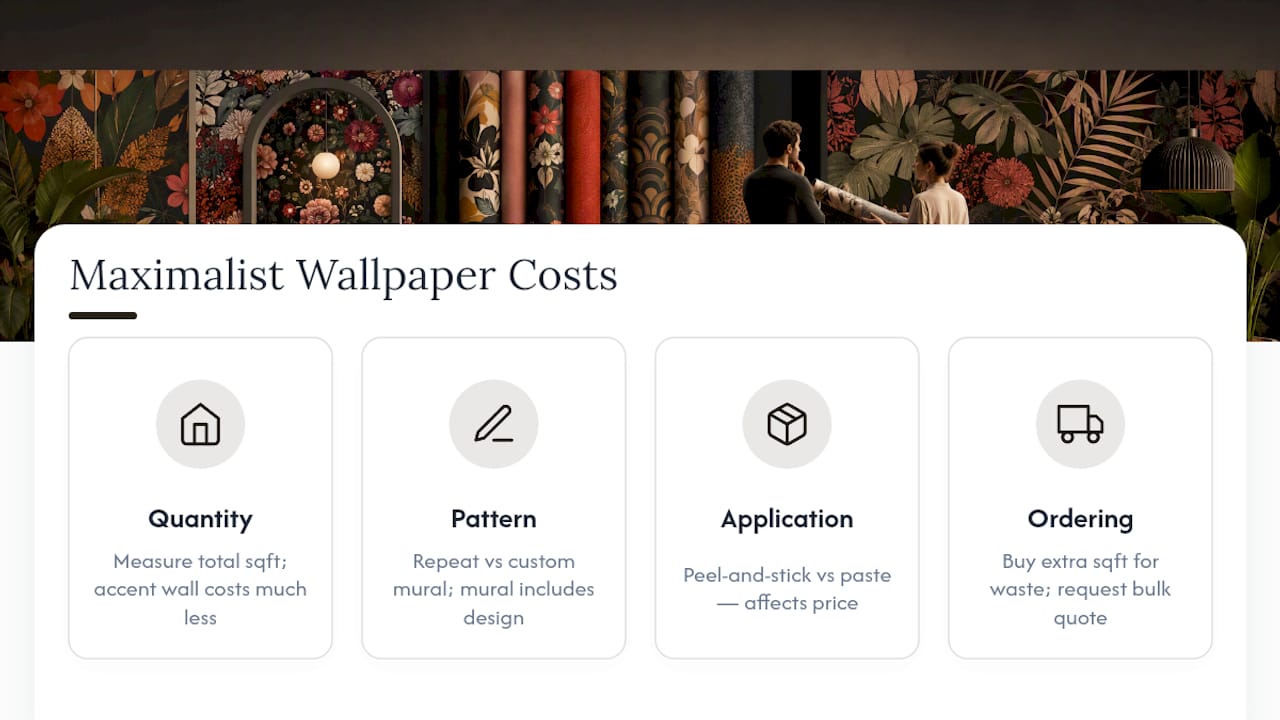
Wallpaper pricing is most often quoted per square foot, and suppliers commonly publish price-per-square-foot rates across multiple colorways for a given collection, which makes it easier to compare a small accent wall against a full-room job before you order.
Three variables move the number more than anything else: total square footage, whether you choose a repeating pattern or a fully custom mural, and peel-and-stick versus paste (custom mural pricing usually reflects the design work involved, not just the material). An accent wall behind a bed costs a fraction of wrapping an entire open-plan living and dining area, so measuring accurately before you shop prevents sticker shock later.
Budgeting for a maximalist project also means planning for overage. Buying a few extra square feet beyond your measured total covers cutting waste and pattern matching, and it’s cheaper to add that cushion at checkout than to reorder later and risk a dye-lot mismatch. Commercial buyers outfitting multiple rooms or a full retail space should request a quote for the full footprint rather than pricing wall by wall, since bulk custom orders often come with more predictable per-square-foot costs than piecing together several small orders.
How Long Does It Take From Order to Finished Wall?
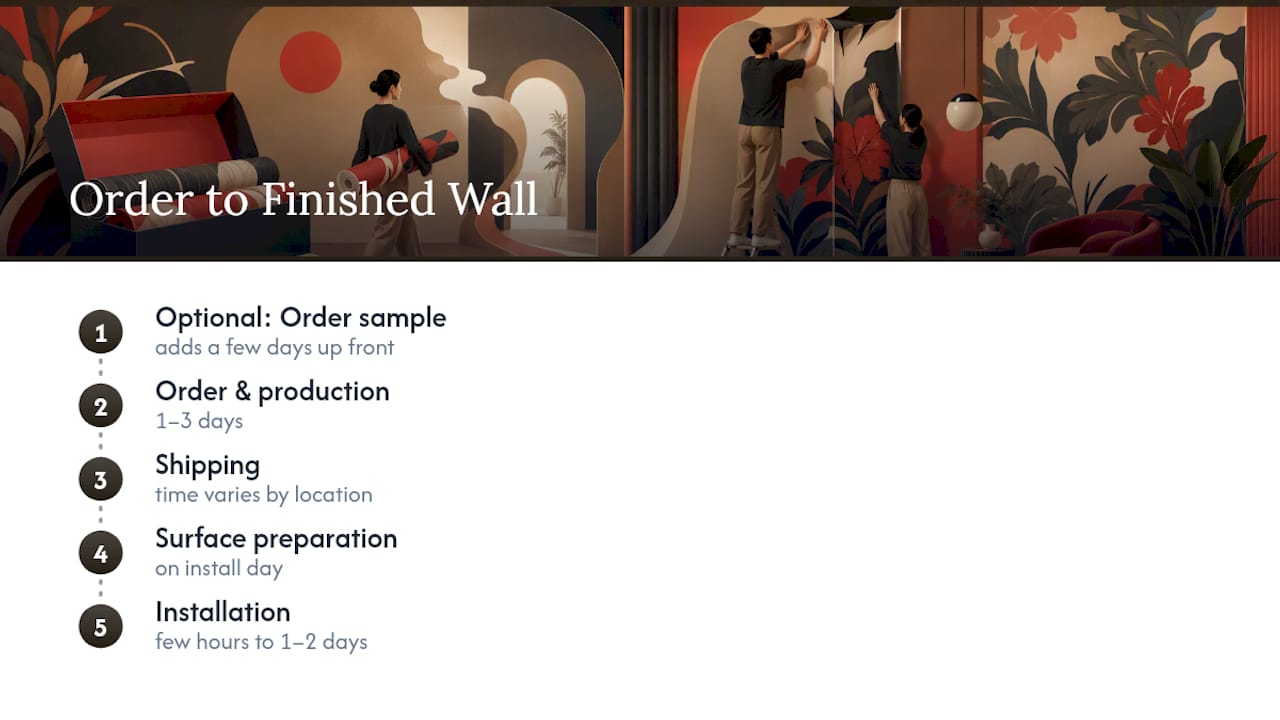
Some custom wallpaper and murals are typically produced within a few days of ordering, which is fast compared to the multi-week production times common with fully bespoke wall coverings elsewhere. Shipping time comes after production, so build that into your overall timeline if you’re working toward a fixed date like a move-in or an event.
Installation time depends on the format and the room. A single peel-and-stick accent wall in a bedroom is often a weekend project for one person, while a full-room paste installation or a multi-panel mural with a complex repeat benefits from a professional installer and a full day of work. Commercial spaces, like a retail fitting room or an office lobby, should plan installation outside business hours to avoid downtime.
The realistic sequence looks like this: order and production (1 to 3 days), shipping (varies by location), surface prep on install day, and then the install itself, which ranges from a few hours for a small accent wall to a full day or two for a large mural with careful alignment. Ordering a sample before the full run adds a few days up front but saves far more time than a reorder after a color or scale misstep.
How Do You Keep Maximalist Wallpaper Looking Sharp?
Cleaning routines depend on the finish. Most peel-and-stick and paste wallpaper can be wiped down with a soft, slightly damp cloth for everyday dust and light marks, and you should avoid abrasive cleaners or scrubbing pads on printed surfaces, since they can dull colors or damage the top coat.
Direct sunlight fades saturated colors over time, so rooms with strong southern exposure benefit from sheer curtains or UV-filtering window film if the wallpaper faces a large window. High-humidity rooms, like bathrooms without good ventilation, put more stress on seams, so a bathroom fan running during and after showers helps paste-applied wallpaper hold its bond longer.
Small repairs are easier to manage than most buyers expect. Peel-and-stick panels can often be lifted and reapplied if a corner starts to curl, while paste seams that lift slightly can usually be resealed with a small amount of wallpaper adhesive rather than replacing the whole panel. Keep a small offcut of your pattern in storage. If a section ever gets damaged, a saved offcut lets you patch it invisibly instead of hunting down a discontinued print months or years later.
Designer Viewpoint: Balancing Scale, Color, and Meaning
The strongest maximalist rooms follow “more meaning, not more stuff”: one deliberate, oversized statement beats five competing patterns fighting for attention. Two rules hold up across most projects. First, let one pattern dominate and use solids or simple textures everywhere else. Second, repeat a single dominant color across furniture and textiles to keep the wall from feeling isolated from the room around it. Bring in a professional installer once you’re dealing with a multi-panel mural or a complex repeat. Misaligned seams are the fastest way to turn a bold idea into a regret.
— WallsNeedLove
Ready to Order Your Maximalist Wallpaper
Wallsneedlove turns a bold idea into a finished wall faster than most custom print shops, with orders typically produced quickly instead of the multi-week wait common elsewhere. Getting started takes five steps: measure your wall, request a sample of your top pick, choose peel-and-stick or paste based on how long you’ll keep it, upload custom art or select a curated design, then place your order.
For a botanical statement wall, the Monkeying Around peel-and-stick wallpaper delivers oversized jungle motifs without a custom design fee. If you want a scenic focal point sized to your exact wall, the Java Mountain wall mural is built as a custom print from the start. For a sharper, geometric maximalist look, the Pixel Diamonds pattern shows how a repeat holds up at full room scale. Measure your wall today and request a sample to see the color and pattern in your own lighting before you commit.
Sources
Wall mural ideas (Good Housekeeping), wallpaper trend guide (The Spruce), maximalist collection pricing (Artscape), and Wallsneedlove product pages.
- 17 wall mural ideas to completely transform your room
- 64 wallpaper ideas that will dress up your walls


Leave a comment