
Proof Ready in 1–3 Business Days: Custom Wallpaper Design for Buyers
Yes, any high-resolution photo or artwork can be printed as wallpaper. Start by choosing between peel-and-stick and paste-backed material, then confirm your file meets print-ready specs. Turnaround is often fast, and Custom wallpaper providers can produce custom orders quickly once your artwork and measurements are approved.
TL;DR:
- Choosing between peel-and-stick and paste-backed wallpaper depends on room durability, with peel-and-stick ideal for renters and paste-backed better for long-term installations.
- High-resolution artwork should be at 150 to 300 PPI at the final size, with file types like JPEG, PNG, TIFF for photos and AI or EPS for logos and patterns.
- Accurate wall measurements, including door and window positions, are crucial to prevent pattern misalignment and material waste during installation.
- Costs vary based on substrate, size, and complexity, typically ranging from lower fees for accent walls to higher for full murals, with turnarounds usually within a few days post-proof.
- Proper wall prep and using the correct installation method significantly reduce issues like bubbles or misalignment, especially on primed, smooth surfaces.
Table of Contents
- Which Material and Format Fit Your Wallpaper Project?
- What File Format and Resolution Do You Need for Wallpaper Printing?
- How Do You Measure a Wall for Custom Wallpaper?
- What Does Custom Wallpaper Cost and How Long Does It Take?
- How Do You Install and Remove Custom Wallpaper?
- What Makes Wallsneedlove a Reliable Custom Wallpaper Provider?
- What Are Wallsneedlove’s Payment, Refund, and Cancellation Policies?
- What Actually Separates a Good Custom Wallpaper Order From a Bad One?
- Ready to Order? Start With This Quick Checklist
- Sources
Which Material and Format Fit Your Wallpaper Project?
The material decision comes before anything else, because it shapes every choice that follows: file prep, installation, and even how long the wallpaper lasts on the wall.
Peel-and-stick substrates work on painted drywall, primed surfaces, and most smooth walls without adhesive paste. They’re the go-to for renters, temporary commercial displays, or anyone who wants the option to reposition a panel during installation. Paste-backed wallpaper, the traditional format, bonds permanently and holds up better in high-traffic commercial spaces or rooms where the wallpaper is meant to stay for years.
Format matters as much as substrate:
- Roll-based repeat patterns print a single design that tiles across multiple strips, ideal for geometric, floral, or textured looks where seams should be nearly invisible.
- Single-image murals print as one continuous photographic scene across custom-cut panels, better suited to landscapes, skylines, or branded artwork where the image can’t repeat.
- Matte finishes reduce glare and hide minor wall imperfections, which makes them the safer pick for rooms with strong overhead lighting.
- Satin and textured finishes add depth and can make photographic murals feel more dimensional, though they reflect more light in bright rooms.
Durability depends on the room. Kitchens and bathrooms benefit from moisture-tolerant paste-backed options, while home offices and bedrooms do fine with peel-and-stick. Environmental certification also matters more than most buyers realize. Some providers offer papers that carry Greenguard Gold certification, which addresses chemical emissions and indoor air quality, a relevant factor for nurseries, healthcare offices, or anyone with respiratory sensitivities.
Pro Tip: If you’re torn between peel-and-stick and paste-backed for a long-term commercial installation, order a small sample panel first. Wall texture and lighting affect how a finish reads in person far more than it does on a screen.
What File Format and Resolution Do You Need for Wallpaper Printing?
Print-ready artwork is the single biggest reason wallpaper orders get delayed or reprinted. Getting this right the first time saves both money and a week of back-and-forth with proofs.
- Choose the right file type. Raster formats like JPEG, PNG, or TIFF work for photographs and photographic murals. Vector formats like AI or EPS work better for logos, geometric patterns, or branding elements that need to scale without blurring. Layered PSD or AI files give you (or a print team) the ability to adjust crop and scale without losing quality, which is worth doing whenever the source file allows it.
- Check your resolution against wall size, not screen size. A phone photo that looks sharp on a five-inch display can turn into a pixelated mess at eight feet wide. As a baseline, aim for 150 to 300 PPI at the final print dimensions, then calculate backward: a 12-foot-wide mural at 150 PPI needs a source file roughly 21,600 pixels wide.
- Set bleeds and safe zones before you finalize the design. Leave a small margin around the edges for trimming, and keep critical text or focal elements away from areas that will fall near a seam.
- Account for pattern repeat and seams early. If your design has a repeating motif, the repeat point needs to align cleanly from one strip to the next, or the seams will visibly break the pattern.
- Confirm your color profile. CMYK profiles typically print more predictably than RGB files pulled straight from a camera or design app, since RGB colors can shift when converted for large-format printing.
- Request a proof or swatch before full production. A printed sample lets you check color and ink behavior on the actual substrate, which a monitor simply can’t replicate.
A few design habits separate amateur files from print-ready ones. Avoid small type; anything under roughly 24 points can blur or vanish at mural scale. Check contrast between foreground and background elements under different lighting, since a pattern that pops on your laptop can flatten out under warm indoor bulbs. And don’t skip the swatch request, even when you’re confident in the file.
If you’re building a design from scratch rather than printing an existing photo, several online tools can help. Adobe Express supports templates, PSD and AI imports, and exports suited to wallpaper projects. Designhill’s wallpaper maker and Kittl both offer quick templates and stock assets for mockups. Pippit generates concepts from text prompts using AI, useful for early ideation. Keep in mind that design speed isn’t the same as print readiness; a fast mockup still needs a resolution and color check before it goes to production.
How Do You Measure a Wall for Custom Wallpaper?
Measurement mistakes cause more reprints than bad design files. A wall that’s off by even a few inches can throw off pattern alignment across an entire room.
- Measure width and height of each wall separately, recording numbers in inches or feet, never mixed units within the same order.
- Note the location of doors, windows, outlets, and trim on a simple sketch, since these areas often get missed until installation day.
- Measure corner to corner, not just center to center, because most rooms aren’t perfectly square, and a small discrepancy compounds across multiple panels.
- Decide your scale based on viewing distance. A small-repeat pattern reads differently in a narrow hallway than a large mural does in an open living room.
- Submit your measurements to the vendor for a proof. Most custom wallpaper vendors generate a digital layout proof showing how the design maps across your specific wall dimensions before printing begins.
Common mistakes worth avoiding:
- Recording feet on one wall and inches on another, which throws off panel calculations.
- Forgetting to subtract or flag door and window openings, leading to wasted material or awkward pattern breaks.
- Assuming two adjoining walls are identical height, when older homes often have a slight variance.
- Skipping the proof approval step to save time, which is the single most common cause of reprint requests.
Once dimensions are confirmed and the proof is approved, production begins, and there’s little room to adjust the file without restarting the process.
What Does Custom Wallpaper Cost and How Long Does It Take?
Price depends on a handful of clear variables, not a mystery formula. Substrate choice, square footage, and how much of the wall is covered in ink all move the number up or down.
Peel-and-stick generally costs less per square foot than paste-backed material, while full-coverage photographic murals cost more than patterns with open or lighter-colored background space, since more ink coverage means more print time and material. Design assistance, if you need help adjusting a file or building a layout from scratch, adds to the total, as do printed samples ordered ahead of the full run.
Typical cost brackets, broken down by project scope, tend to fall into three tiers:
- Small accent wall: the lowest bracket, suited to a single feature wall or a compact space.
- Standard room: a mid-range bracket covering multiple walls in an average bedroom or office.
- Full mural or commercial installation: the highest bracket, driven by square footage and full-coverage photographic printing.
Turnaround typically breaks into three stages: proofing, production, and shipping. Custom wallpaper orders are typically produced within a few business days after proof approval, with additional shipping time depending on destination.
Add-ons change both price and speed. Color correction on a file with lighting issues adds a small design fee but improves the final print noticeably. Expedited printing shortens the production window but usually costs more. Requesting a physical sample before the full order adds a few days upfront but prevents costly reprints if the color or texture doesn’t match expectations.
How Do You Install and Remove Custom Wallpaper?
Installation difficulty depends almost entirely on which substrate you chose earlier. Peel-and-stick is built for DIY; paste-backed rewards patience and, often, a second set of hands.
Before either type goes up, the wall needs proper prep. A clean, dry, smooth surface makes the biggest difference in how well the material adheres and how the finished panels look.
- Sand down any rough patches or old paint drips.
- Wipe the wall free of dust and grease with a mild cleaner.
- Apply a primer if the wall is freshly painted or unusually porous.
- Have a smoothing tool and seam roller on hand before you start.
- Keep a sharp utility knife nearby for trimming edges around outlets and trim.
Peel-and-stick installation involves aligning the first panel, smoothing out air bubbles as you go, and overlapping or butting seams depending on the product’s design. Paste-backed installation requires applying adhesive evenly, booking the paper (letting it rest briefly before hanging), and working in careful vertical strips to keep pattern alignment consistent.
Removal is where the two substrates diverge most. Peel-and-stick wallpaper is generally renter-safe, pulling away cleanly without stripping paint underneath when applied to a properly primed wall. Paste-backed wallpaper is more durable long-term but requires more effort to remove, sometimes involving a steamer or adhesive remover, which makes it a better fit for spaces you own rather than rent. Renters weighing their options should lean peel-and-stick nearly every time.
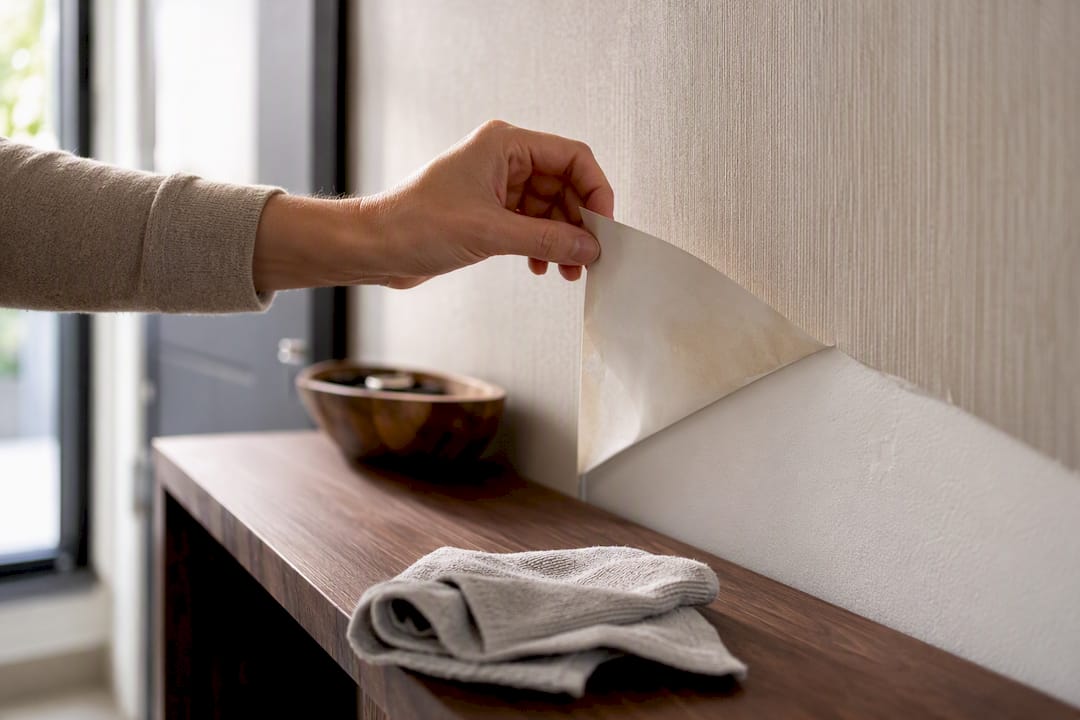
Pro Tip: If a seam starts lifting a few weeks after installation, press it back down with a seam roller and a little extra heat from a hair dryer on low. Most lifting happens because the adhesive didn’t fully bond in that spot, not because the material failed.
Common installation problems have straightforward fixes. Bubbles usually mean trapped air; a pin prick and gentle smoothing resolve most cases. Misaligned patterns almost always trace back to skipping the proof review or measuring corners incorrectly. For a full tools list and step-by-step walkthrough, Wallsneedlove’s installation guide covers the process panel by panel.
What Makes Wallsneedlove a Reliable Custom Wallpaper Provider?
A provider is only as good as what they can actually prove, not just promise. Wallsneedlove backs its custom wallpaper service with a few checkable specifics rather than vague claims.
- Product range spans floral, geometric, watercolor, scenic murals, faux textures, and kids’ designs, in both peel-and-stick and paste-backed formats.
- Environmental certification. Some providers offer papers that are Greenguard Gold certified, addressing indoor air quality for homes and offices alike.
- Turnaround. Custom wallpaper orders are typically produced within a few business days after artwork and proof approvals.
- Design support. Some providers offer design support such as help with mockups, sample requests, and layout adjustments before production.
- Installation resources. Detailed guides walk buyers through ordering, prepping walls, and applying both removable and paste-backed material.
| What buyers need | What Wallsneedlove offers |
|---|---|
| Fast custom production | Typical 1 to 3 business day turnaround after proof approval |
| Renter-friendly options | Peel-and-stick, removable without paint damage on primed walls |
| Indoor air quality assurance | Greenguard Gold certified materials |
| Design flexibility | Custom murals, repeat patterns, and design assistance available |
| Installation confidence | Step-by-step guides for both substrate types |
This combination, proofed production speed, a real certification, and installation support that doesn’t disappear after checkout, is what separates a dependable custom wallpaper source from a vendor that just prints whatever file you upload.
What Are Wallsneedlove’s Payment, Refund, and Cancellation Policies?
Custom products carry different rules than off-the-shelf goods, and it’s worth understanding those rules before you submit a file for production.
Payment is typically collected in full at the time of order, since custom wallpaper is printed specifically for that buyer rather than pulled from existing stock. This is standard across the custom print industry: production starts only after payment clears and, in most cases, after the buyer approves a digital proof.
Cancellation windows tend to be narrow. Once a design moves into production, and given Wallsneedlove’s fast turnaround of one to three business days, there’s often a short window, sometimes just hours, to cancel or modify an order before printing begins. Reaching out immediately after placing an order gives you the best chance of catching a mistake before it’s too late.
Refunds on custom, made-to-order wallpaper generally apply to defects in printing, shipping damage, or errors that don’t match the approved proof, rather than buyer’s remorse over a design choice the buyer approved. This is why the proofing step matters so much: approving a proof is effectively confirming that the file, colors, and layout are correct before production locks in.
If a panel arrives damaged or misprinted compared to the approved proof, documenting the issue with photos and contacting the seller promptly is the standard path toward a reprint or refund. Reading the specific policy listed at checkout before finalizing payment avoids surprises later.
What Actually Separates a Good Custom Wallpaper Order From a Bad One?
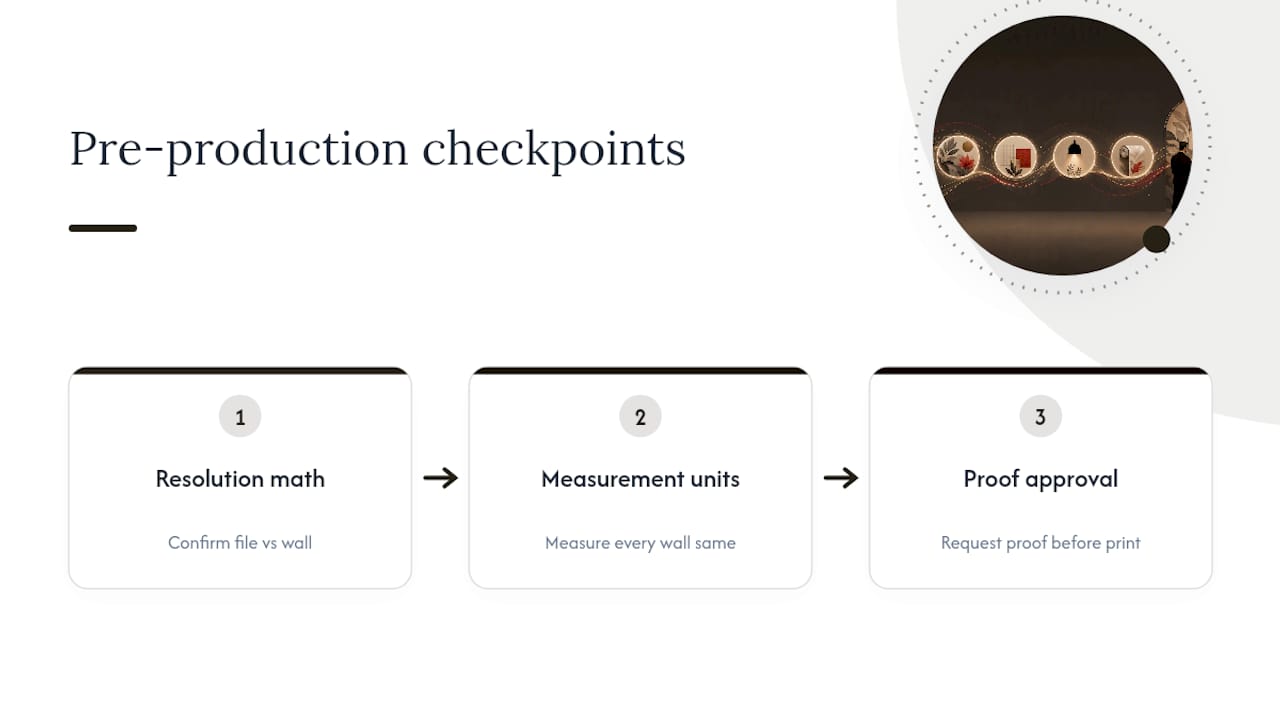
Most advice on custom wallpaper focuses on inspiration: mood boards, color trends, style categories. That’s the easy part. The gap that actually causes problems is technical, not creative, and it shows up in resolution math, measurement units, and proof approval, not in whether a pattern is trendy.
The conventional wisdom oversells design tools and undersells preparation. A slick AI-generated mockup means nothing if the export resolution can’t hold up at mural scale. Buyers who skip the sample swatch step, thinking it’s an unnecessary delay, are the same buyers who end up requesting reprints two weeks later.
Prioritize in this order: confirm your file’s real resolution against your actual wall size, measure every wall the same way with the same units, and request a proof before anything gets printed. Everything else, finish choice, pattern style, installation timing, is far more forgiving than a file that’s too low resolution to print clean at eight feet wide.
— Wallsneedlove
Ready to Order? Start With This Quick Checklist
Wallsneedlove skips the guesswork that comes with generic print shops by combining fast production with design support built specifically for wall-sized files, not standard paper sizes. Before placing an order, run through a short checklist: measure every wall in the same units, prepare or request help with a print-ready file, order a sample swatch if you’re printing a large photographic mural, and upload your final artwork for a proof.
A few product pages show what’s possible once that checklist is done. The Monkeying Around peel-and-stick design demonstrates how a playful repeat pattern tiles cleanly across multiple panels. The Java Mountain wall mural shows how a single large-format landscape image scales across an entire wall without repeating. And Pixel Diamonds illustrates a tight geometric repeat, useful for buyers deciding how pattern scale should relate to room size. Coordinating wallpaper scale with existing trim and door styles also matters more than most buyers expect, and current interior door trends are worth a glance before finalizing a bold pattern choice.
Once your file and measurements are ready, submit your design through Wallsneedlove’s ordering process to get a proof started.
Sources
- Free Wallpaper Designer: Create Custom Wallpapers Online | Adobe Express
- Free Wallpaper Maker | Create Wallpaper Online in Seconds | Designhill
- Free Wallpaper Maker - Make and Personalize Your Own Wallpaper | Kittl
- Free Wallpaper Maker Online: Design Stunning Custom Wallpapers Easily


Leave a comment