

Top Renter-Friendly Wall Covering Options: 9 Easy Ideas
The best renter-friendly wall covering options are peel-and-stick removable wallpaper, vinyl decals and removable murals, washi tape designs, fabric-based coverings, peel-and-stick wood-look planks, and stencils with temporary paint alternatives. For most renters, a peel-and-stick accent wall delivers the strongest visual payoff with the lowest deposit risk.
Before picking any option, check three things:
- Wall condition: Freshly painted walls (under 30 days) and heavily textured surfaces increase the chance of paint damage on removal.
- Room humidity: Standard vinyl and fabric options are not rated for bathrooms or kitchens unless the product label says so.
- Lease terms: Some leases restrict adhesive products. Confirm in writing before you install anything.
Table of Contents
- How these renter-friendly wall covering options compare
- 1. Peel-and-stick removable wallpaper
- 2. Vinyl decals, removable murals, and large stickers
- 3. Washi tape and tape-based accent designs
- 4. Fabric wall coverings and the fabric-with-starch method
- 5. Peel-and-stick wood-look planks and lightweight wall panels
- 6. Stencils, peel-off paints, and temporary painted looks
- 7. Surface prep, test patch protocol, and safe removal steps
- 8. How to choose the right wall covering for your rental
- 8. Wallsneedlove: a vetted peel-and-stick option for renters
- Key Takeaways
- What most renters get wrong about removable wall coverings
- Custom peel-and-stick murals from Wallsneedlove
- Where to buy and where to learn more
How these renter-friendly wall covering options compare
The table below maps each option to its primary use-case, damage risk, installation difficulty, typical cost, durability, and visual finish. Use it to match your constraint — budget, wall texture, lease rules, or room type — to the right choice.
| Option | Best for | Damage risk | Install difficulty | Cost range | Durability / moisture | Visual finish |
|---|---|---|---|---|---|---|
| Peel-and-stick wallpaper | Accent walls, full rooms | Low (on smooth walls) | Easy | $1–$4 per sq ft | Typically designed for several years under ideal conditions; avoid steam rooms unless bathroom-rated | High — print depth, pattern variety |
| Vinyl decals / murals | Partial features, art accents | Very low | Very easy | $15–$150 | Moderate; wipe-clean vinyl holds well | Medium-high — bold graphics |
| Washi / decorative tape | Geometric lines, borders | Very low | Very easy | $5–$15 per roll | Low — seasonal or short-term only | Low-medium — graphic, minimal |
| Fabric wall coverings | Textured, photography-friendly | Low-medium | Moderate | $2–$6 per sq ft | Low — moisture-sensitive | High — rich texture |
| Peel-and-stick wood planks | Feature walls, accent sections | Medium (direct adhesion) | Moderate | $1.50–$5 per square foot | Medium; acoustic PET felt panels publish NRC ratings of 0.4–0.85 | High — dimensional, realistic |
| Stencils / temp paint | Borders, geometric patterns | Low-medium | Moderate | $10–$50 for supplies | Medium — depends on paint type | Medium — hand-crafted look |
Quality and adhesive type predict both removal cleanliness and visual finish. Designers prefer heavier vinyl (9-mil) and fabric-based papers for a higher-end look and longer-lasting installs. Thin 4–6 mil papers tend to show seams more and may not hold as long on walls with minor imperfections.
Peel-and-stick wallpaper lifespan is finite. Quality brands typically aim for 3–5 years under ideal conditions; humidity, wall prep, and traffic determine actual life.
1. Peel-and-stick removable wallpaper
Peel-and-stick wallpaper is a pressure-sensitive, self-adhesive sheet that applies directly to a wall and removes without paste or professional tools. It comes in three main material families:
- Vinyl peel-and-stick — the most common, available in 4–6 mil (budget) and 9-mil (premium) weights. Heavier mil holds better and photographs with more depth.
- Paper-based smooth-finish — thinner, often lower cost, best for smooth drywall accent walls with short install timelines.
- Non-woven pre-pasted alternatives — a hybrid that performs better on lightly textured surfaces where standard vinyl adhesive struggles to bridge high spots.
When it works — and when it does not
Peel-and-stick performs best on smooth, flat drywall. Vinyl peel-and-stick struggles on orange-peel or knockdown textures because the adhesive cannot bridge the high spots. On those surfaces, switch to higher-mil vinyl or a non-woven pre-pasted product. Avoid standard vinyl in bathrooms or kitchens unless the label confirms it is bathroom-rated for steam and daily wiping.
Shopping checklist
- Pattern scale relative to your wall size (large repeats waste more material)
- Mil thickness: 9-mil for textured walls or long-term installs; 4–6 mil for smooth accent walls
- Bathroom-rated vinyl for any humid room
- Sample availability — always order a sample before a full roll purchase
Installation and removal tips
Clean the wall with a damp cloth, let it dry fully, then start from the top. Use a squeegee to push out air bubbles as you go. Align seams carefully before pressing firmly — most quality products allow repositioning during the first few minutes.
For removal, peel slowly at a low angle (roughly 45 degrees or less). A hair dryer on low heat softens the adhesive and reduces the chance of paint lift. If paint starts to come up, stop immediately, apply gentle heat, and work even more slowly.
Pro Tip: Request a sample panel and press it to an inconspicuous corner of the wall. Leave it for 48–72 hours, then peel. If paint comes with it, the wall’s paint is not in good enough condition for direct adhesive products.
2. Vinyl decals, removable murals, and large stickers
Vinyl decals and removable murals are the lower-commitment end of the removable wall covering spectrum. They cover partial wall areas rather than full surfaces, which makes them easy to swap out without touching the rest of the room.
Best use-cases:
- Partial murals behind a bed, sofa, or dining table
- Kitchen backsplash strips (confirm wipe-clean rating before buying)
- Furniture accents and cabinet fronts
- Art-backed features in a home office or nursery
Pros:
- Very low commitment — individual panels replace in minutes
- No seam matching required on most designs
- Wide price range, from small accent stickers to full-wall mural sets
Cons:
- Edges can lift on textured walls if adhesive does not make full contact
- Large murals applied in sections require careful alignment
- Quality varies widely; always check adhesive type and product reviews before ordering
Buying tips: Order a small panel or sample first. Confirm the product uses indoor-grade removable adhesive, not permanent. For kitchens and bathrooms, verify the vinyl is rated for moisture and wipe-clean cleaning.
Wallsneedlove offers removable wall murals in custom sizes, printed to order, so the design fits the exact wall rather than requiring awkward trimming.
3. Washi tape and tape-based accent designs
Washi tape is a lightweight, paper-based decorative tape with a low-tack adhesive that peels cleanly from most painted surfaces. Painter’s tape and purpose-made decorative tape work on the same principle. None of these options create a heavy-duty finish, but for geometric lines, grid patterns, or framed photo arrangements, they are the fastest and cheapest approach available.
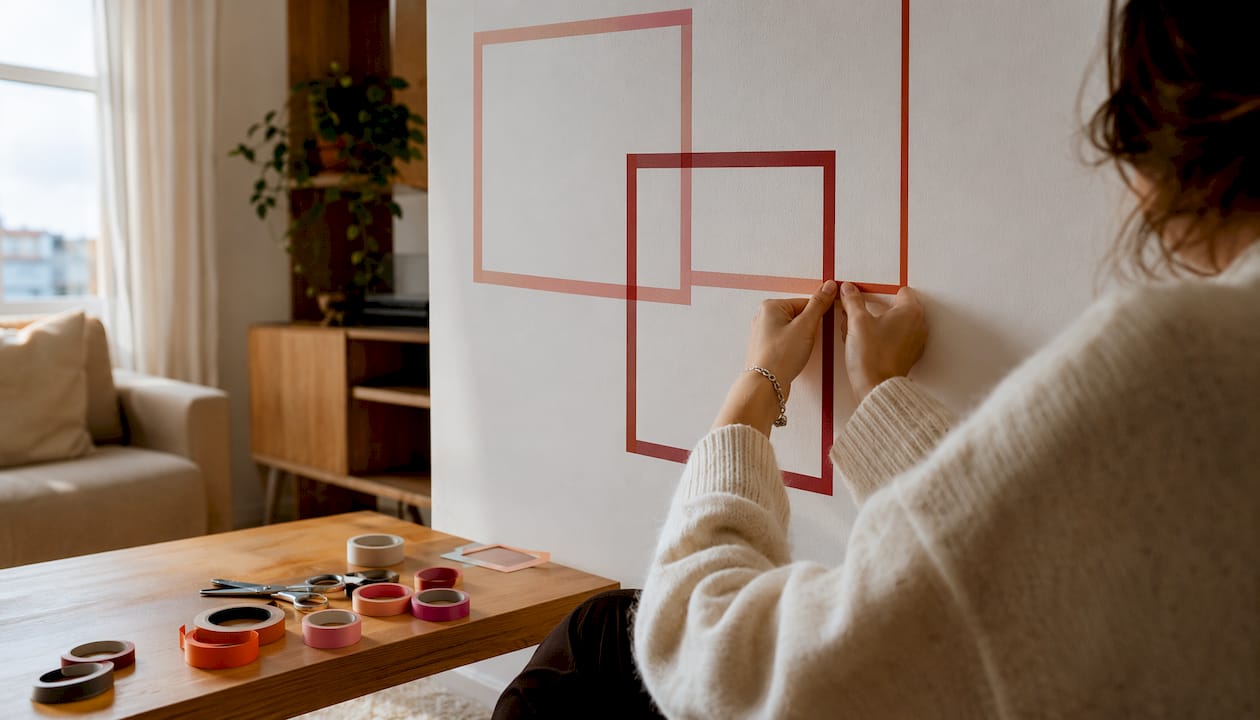
What they deliver: Clean lines, color-block sections, and graphic borders without any tools beyond scissors and a level. A roll of washi tape costs $5–$15 and covers a surprising amount of wall.
Their limits: Tape-based designs do not hold up to humidity, direct sunlight over long periods, or walls with a chalky or poorly adhered paint surface. They are best for short-term leases or seasonal refreshes.
Practical how-to:
- Plan the layout on paper or with a phone app before touching the wall.
- Use a level or laser level for straight lines.
- Test a 6-inch strip in a hidden corner for 24 hours before committing to the full design.
- Avoid applying tape to walls painted within the last 30 days — the paint is still curing and the tape adhesive can pull it.
- Remove by peeling slowly at a low angle; no heat required for most washi tape.
Pro Tip: Combine washi tape with a gallery wall of framed prints. Use the tape to create a simple geometric border around the cluster — it ties the arrangement together and removes in seconds when you move out.
4. Fabric wall coverings and the fabric-with-starch method
Fabric wall coverings offer a texture and visual depth that printed vinyl cannot match. Two main approaches exist for renters.
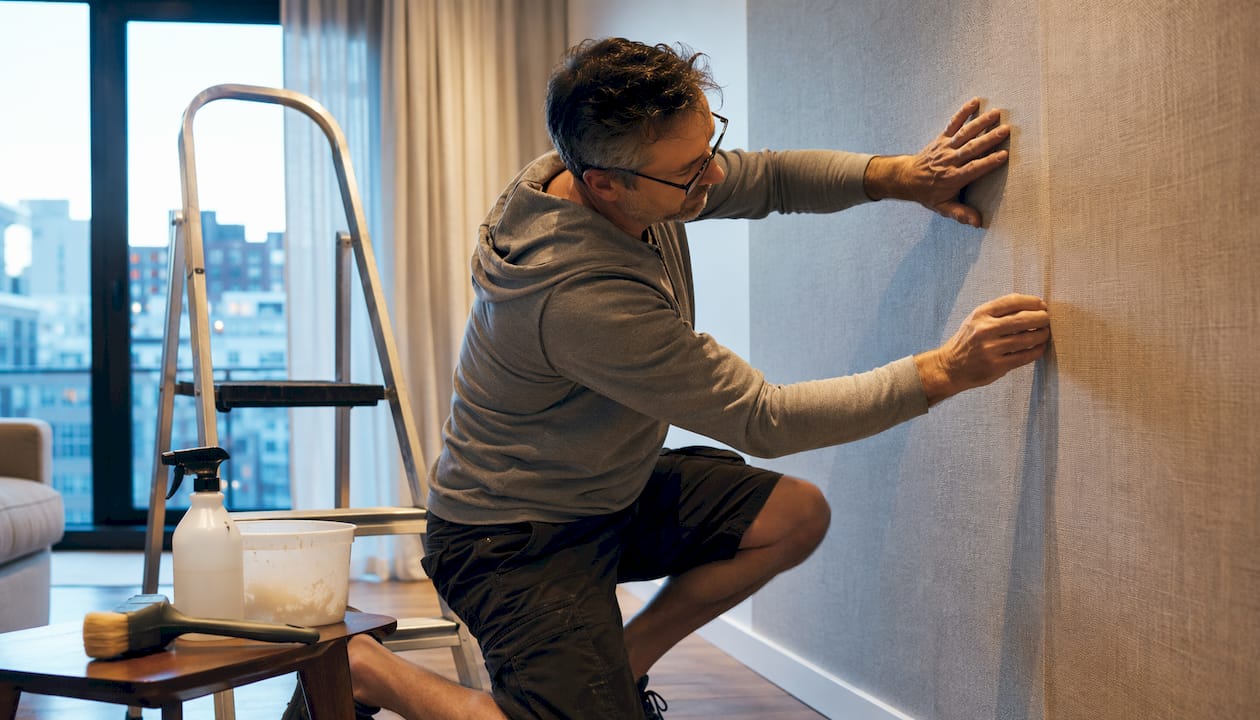
Pre-backed fabric wallpaper comes with a woven or non-woven backing and a pressure-sensitive adhesive, similar to peel-and-stick vinyl but with a textile surface. It installs the same way and removes cleanly when the wall surface is in good condition.
DIY fabric with starch or removable adhesive uses raw fabric panels applied with liquid starch or a diluted removable paste. The starch holds the fabric flat against the wall and washes off cleanly with water on removal. This method works on smooth and lightly textured walls and leaves no adhesive residue.
Pros and cons at a glance:
- High visual depth and a photography-friendly finish
- Richer texture than vinyl at comparable price points
- Seam handling is the primary failure mode — fabric installations require careful seam overlap and are less moisture-tolerant than vinyl options
- Not suitable for bathrooms or humid rooms unless the product is specifically rated for moisture
- Removal typically requires steam or a mild adhesive remover for pre-backed versions; starch installations wash off with warm water
Pro Tip: Always run a test patch with the exact starch-to-water ratio you plan to use. Too much starch leaves a stiff, visible residue; too little and the fabric sags before drying.
A professional drywall surface in good condition is the single biggest factor in whether fabric installations go up cleanly and come down without damage.
5. Peel-and-stick wood-look planks and lightweight wall panels
Peel-and-stick wood planks and decorative panels create a dimensional, carpentry-style finish without a single nail. Three product families cover most of the market:
- Solid plank peel-and-stick: Real or engineered wood veneer with adhesive backing. Highest realism, highest weight.
- Foam or composite planks: Lightweight, lower cost, convincing from a few feet away. Panel-style products often read convincingly from typical viewing distances but can betray their material up close.
- Acoustic PET felt panels: Decorative and functional. Published NRC ratings of 0.4–0.85 depending on thickness and mounting method.
Safety and weight considerations:
- Check the panel weight per square foot before ordering. Heavier panels need a stable, well-adhered paint surface.
- For heavier planks, mount a thin hardboard sheet as a sacrificial substrate first. The planks adhere to the hardboard, not the rental paint, and the hardboard attaches with removable picture-hanging strips.
- Limit heavier panels to accent sections rather than full walls to reduce load and deposit risk.
Budget note: Cheap unbranded foam panels at very low price points show a higher failure rate over time — they compress, curl, or pull paint. Spending slightly more on a branded product protects the deposit.
Pro Tip: If you want a wood-look finish without the weight or adhesion risk of physical planks, Wallsneedlove’s faux wood grain removable wallpaper delivers a similar visual effect at lower cost and with far simpler removal.
6. Stencils, peel-off paints, and temporary painted looks
Stencils and removable paint products let renters create paint-style effects without permanently altering the wall color. They make the most sense for small accent walls, borders, or geometric patterns where full wallpaper coverage would be excessive.
- Assess the lease first. Any paint that visibly changes wall color typically requires landlord approval in writing. Get that before buying supplies.
- Choose the right paint type. Chalk-based and peel-off removable paints are the lowest-risk options. Standard latex paint is not removable and should only be used with explicit landlord permission and a plan to repaint on move-out.
- Gather supplies. Stencil brush or small foam roller, painter’s tape, drop cloth, and the stencil itself. A level or laser level keeps geometric patterns straight.
- Apply in thin coats. Multiple thin passes produce cleaner edges than one heavy coat. Let each layer dry before repositioning the stencil.
- Test the removal method. For peel-off paints, follow the manufacturer’s removal instructions exactly. Skipping steps or using a scraper can pull the underlying paint.
Red flags to avoid: Do not use harsh chemical strippers or permanent primers without written landlord approval. Do not apply stencil paint over wallpaper — the moisture can cause the wallpaper to bubble or peel.
7. Surface prep, test patch protocol, and safe removal steps
Wall surface condition is the single biggest predictor of whether a removable covering comes off clean. Even the best adhesive can pull poorly adhered paint if the underlying surface is compromised.
Pre-install checklist
| Step | What to do | Why it matters |
|---|---|---|
| Inspect paint condition | Look for peeling, bubbling, or chalky patches | Damaged paint pulls regardless of adhesive quality |
| Clean the surface | Wipe with a mild soap solution; let dry fully | Dust and grease prevent adhesion |
| Check cure time | Wait 30+ days after any fresh paint | Fresh paint is still off-gassing and bonds poorly |
| Confirm wall type | Smooth drywall vs. textured vs. plaster | Determines which product family to use |
| Run a test patch | Apply a 12-inch square in an inconspicuous spot | Reveals adhesion issues before full install |
Test patch protocol
Choose a spot behind a door or furniture. Apply a 12-inch square of the product, press firmly, and leave it for 48–72 hours. Then peel slowly at a low angle. If paint comes with it, the wall is not ready for direct adhesive products. Document the test with a photo before and after.
Safe removal steps
- Start at a top corner and peel at a low angle, pulling back on itself rather than away from the wall.
- Apply low heat from a hair dryer to stubborn sections — 10–15 seconds per area is enough.
- If paint begins to lift, stop. Apply more heat and slow down further.
- Remove any adhesive residue with a manufacturer-approved solvent or a small amount of rubbing alcohol on a cloth.
- If paint does lift despite careful removal, photograph the damage immediately, document the wall condition before and after, and notify the landlord in writing.
Detailed removal guidance is available in Wallsneedlove’s DIY wallpaper removal guide, which covers repair steps alongside the removal process.
8. How to choose the right wall covering for your rental
Work through these questions in order. Each answer narrows the field.
- What does the lease say? Check for restrictions on adhesives, paint, or wall modifications. If unclear, ask the landlord in writing and keep the response.
- What is the wall surface? Smooth drywall supports the full range of options. Textured walls (orange-peel, knockdown) require higher-mil vinyl, non-woven products, or a sacrificial substrate. Plaster walls need extra care — test patch is mandatory.
- What is the room humidity? Bathrooms and kitchens require moisture-rated products. Standard vinyl and fabric options will fail in steam-heavy rooms.
- How long is the lease? Short-term (under 12 months): washi tape, decals, or a single accent panel. Medium-term (1–3 years): peel-and-stick wallpaper or fabric options. Long-term: any option with proper prep.
- What is the budget? Washi tape and stencils cost the least. Peel-and-stick wallpaper sits in the mid range. Custom-printed murals and fabric wallpaper are the premium tier.
- What is the installation skill level? Decals and washi tape require no experience. Peel-and-stick wallpaper needs patience and a squeegee. Fabric installations and stencils require moderate skill.
Questions to ask the landlord — and get in writing:
- Which adhesive types are permitted?
- Is any paint alteration allowed, and under what conditions?
- What is the repair expectation if minor paint damage occurs on move-out?
Quick red flags:
- Fresh paint under 30 days old
- Heavy knockdown or popcorn texture without a tested substrate plan
- High humidity rooms without moisture-rated materials
Wallsneedlove’s guide to wallpaper on rental walls covers lease considerations and paint conditions in more detail.
8. Wallsneedlove: a vetted peel-and-stick option for renters
Wallsneedlove produces custom-printed peel-and-stick wallpaper and wall murals available in both removable and traditional paste formats. Products are printed to order, typically within 1–3 business days, and cover a wide range of styles: florals, geometric patterns, watercolor designs, scenic murals, and faux textures.
Key trust signals for renters:
- Greenguard Gold certification: Products meet strict chemical emission standards, relevant for bedrooms, nurseries, and any enclosed space.
- Peel-and-stick format: The removable adhesive is designed for clean removal from properly prepared walls.
- Sample availability: Wallsneedlove offers samples so renters can test color accuracy and adhesion before committing to a full order.
- Installation guides: Detailed step-by-step guides are available on the Wallsneedlove site, covering surface prep, squeegee technique, seam alignment, and removal.
- Custom sizing: Murals and wallpaper are printed to the exact dimensions provided, reducing waste and awkward seam placement.
For renters specifically, the peel-and-stick format and sample-first ordering process address the two biggest concerns: deposit safety and design fit. The removable wallpaper collection includes options suited to accent walls, full rooms, and statement murals.
Key Takeaways
Peel-and-stick removable wallpaper on a smooth, properly prepared wall is the most reliable renter-friendly option for visual impact with low deposit risk.
| Point | Details |
|---|---|
| Test patch first | Apply a 12-inch square and wait 48–72 hours before full installation on any wall. |
| Match product to surface | Use higher-mil vinyl or non-woven products on textured walls; standard vinyl on smooth drywall only. |
| Moisture-rated for wet rooms | Confirm bathroom-rated vinyl for kitchens and bathrooms before purchasing. |
| Remove slowly with heat | Peel at a low angle with a hair dryer on low; stop immediately if paint lifts. |
| Wallsneedlove for custom options | Greenguard Gold-certified peel-and-stick wallpaper and murals, printed to order in 1–3 days with sample availability. |
What most renters get wrong about removable wall coverings
The conventional wisdom says peel-and-stick wallpaper is foolproof. It is not. The product is only as reliable as the wall it goes on. A $200 roll of premium removable wallpaper will still pull paint off a wall that was painted six weeks ago with a low-quality latex and never properly cured. The product does not fail — the surface does.
The second mistake is skipping the sample. Ordering a full roll based on a screen image is a gamble on color accuracy, texture, and adhesion. A $5–$10 sample panel answers all three questions before any real money is spent.
The third mistake is treating all removable products as equivalent. A 4-mil vinyl sheet and a 9-mil fabric-backed wallpaper are not the same product. The thicker option holds better, photographs with more depth, and removes more cleanly. For a short-term lease, the budget option may be fine. For a two-year stay in a well-lit apartment where the walls are part of the daily environment, the upgrade is worth it.
Renters who take 20 minutes to prep the wall, run a test patch, and choose the right product for their surface type almost never lose their deposit over wall coverings. Those who skip those steps often do.
Custom peel-and-stick murals from Wallsneedlove
Renters who want a statement wall without the permanence of traditional wallpaper have a direct path: measure the wall, select a design or upload original art, request a sample, and order. Wallsneedlove prints custom murals and peel-and-stick wallpaper to exact dimensions, typically within 1–3 business days.
The Java Mountain wall mural and the Monkeying Around removable wallpaper are two ready-made options that work well as rental accent walls. Both are available in peel-and-stick format with Greenguard Gold certification. Installation guides are included with every order, and the Wallsneedlove support team is available for questions on surface prep, seam alignment, and removal. Request a sample at wallsneedlove.com before placing a full order.
Where to buy and where to learn more
U.S. vendors and marketplaces:
- Wallsneedlove (wallsneedlove.com) — custom-printed peel-and-stick wallpaper and murals, Greenguard Gold certified, ships within 1–3 days
- Spoonflower — independent artist designs available in peel-and-stick and traditional wallpaper formats; order swatches before a full purchase
- Chasing Paper — poly-woven fabric peel-and-stick, strong matte finish, good for high-traffic areas
- Tempaper — repositionable adhesive, faux grasscloth and metallic finishes, widely available in the U.S.
- Amazon and Target — broad selection of budget and mid-range peel-and-stick options; read reviews carefully for adhesive quality and mil thickness
Sample-request tip: Always order a sample and run a 48–72 hour test patch on your actual wall before purchasing a full order. Color rendering on screens varies, and adhesion depends on your specific wall surface and paint condition.
Wallsneedlove installation resources:
- What is peel-and-stick wallpaper: renter’s guide — material types, installation basics
- Wall types peel-and-stick wallpaper works on best — surface compatibility guide
- How long will peel-and-stick wallpaper last? — lifespan factors and care tips
- Wallpaper adhesive types explained — adhesive families and renter-appropriate choices
For renters combining wall treatments with window decor, mid-century modern window treatment options offer a useful reference for layering non-permanent interior updates.


Leave a comment