

Why Environmental Certification Matters for Wallpaper Design
Specify UL GREENGUARD Gold for wallpaper and murals whenever indoor air quality, sensitive occupants, or long daily occupancy are part of the project brief. This certification uses environmental chamber testing, meets stricter VOC emission limits than standard GREENGUARD, and references CDPH Section 01350 compliance for sensitive settings such as nurseries, schools, and healthcare spaces. Wallsneedlove carries GREENGUARD Gold certified options across its wallpaper and mural collections.
Three reasons this matters immediately:
- Reduced VOC emissions. Certified products are tested to emit low levels of volatile organic compounds from inks, substrates, and adhesives.
- Verified test method. Environmental chamber testing under controlled temperature and humidity produces measurable emission data, not self-reported claims.
- Sensitive-space benchmark. CDPH Section 01350 compliance, referenced in the Gold standard, sets the threshold used for schools, healthcare, and children’s spaces.
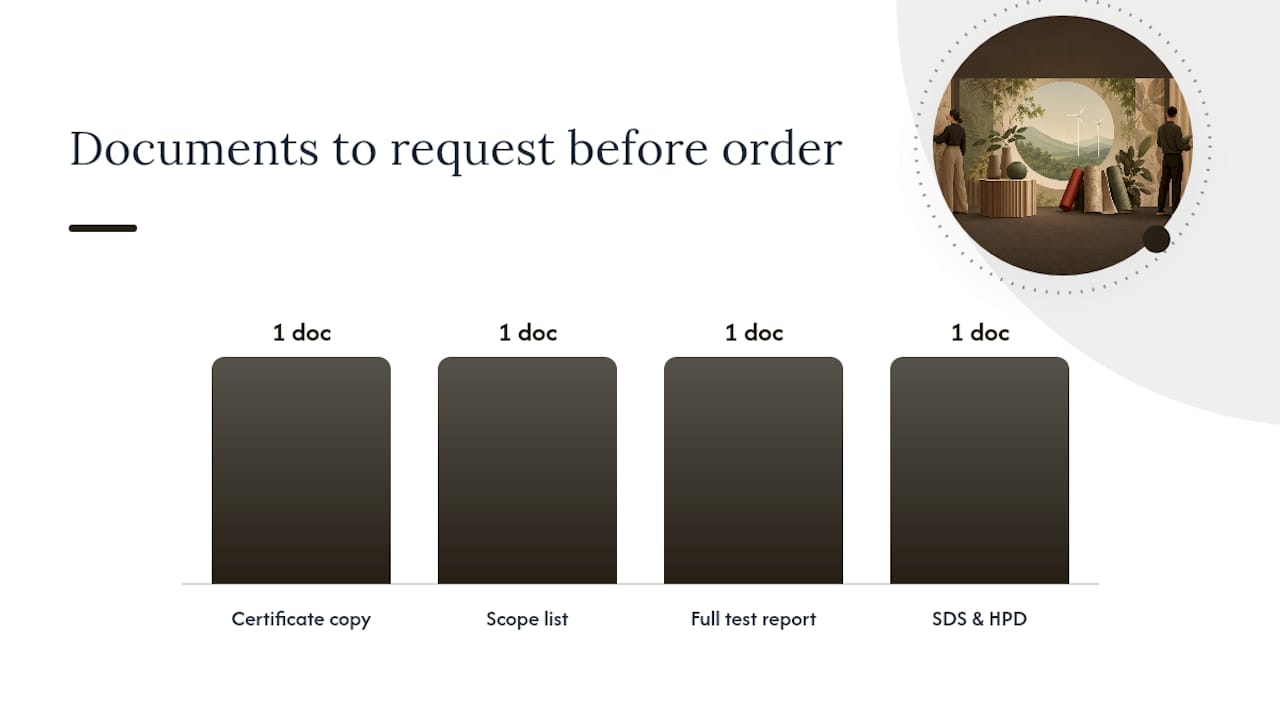
Before placing any order, request these four documents from your supplier:
- Certificate copy with certificate number and expiry date
- Scope list confirming the specific SKU or product family is covered
- Full test report showing chamber results and CDPH Section 01350 compliance
- Safety Data Sheet (SDS) and Health Product Declaration (HPD) if available
Pro Tip: Ask the supplier to confirm the exact SKU you are ordering appears on the certificate scope list. A product family certificate does not automatically cover every colorway or substrate variant.
Key Takeaways
Product-level environmental certification for wallcoverings, specifically UL GREENGUARD Gold, is the most direct way to verify low VOC emissions and protect indoor air quality for sensitive occupants.
| Point | Details |
|---|---|
| Specify GREENGUARD Gold | Required for nurseries, K-12, healthcare, and any enclosed space with sensitive occupants. |
| Request four documents | Certificate copy, scope list, CDPH Section 01350 test report, and SDS before every order. |
| Adhesives affect IAQ too | Paste-applied wallpaper needs a separate low-VOC adhesive SDS; peel-and-stick includes adhesive in the product test. |
| Certification has limits | GREENGUARD Gold measures air emissions only; it does not certify product content, PFAS, or recyclability. |
| Wallsneedlove | Carries GREENGUARD Gold certified wallpaper and murals with certificate numbers and test reports available on request. |
Table of Contents
- What environmental certification actually measures in wallcoverings
- Why certification matters for design projects and occupant health
- How to specify and verify certified wallpaper from suppliers
- When certification is required and what trade-offs to expect
- How Wallsneedlove approaches certification for its products
- Why certification changes how experienced designers specify materials
- Wallsneedlove certified wallpaper: ready to specify
- Sources
What environmental certification actually measures in wallcoverings
Product-level environmental certification for wallcoverings focuses on one thing: what a product emits into the air after installation. VOCs, or volatile organic compounds, are gases released by inks, substrates, coatings, and adhesives as they off-gas. Formaldehyde is the most commonly regulated VOC in interior finishes, but GREENGUARD Gold screens for hundreds of individual compounds, not just formaldehyde.
Testing uses dynamic environmental chambers. A sample of the product is placed in a sealed chamber at controlled temperature and humidity. Air is drawn through the chamber at a set rate, and the outgoing air is analyzed for specific VOC concentrations. Results are compared against allowable emission limits. GREENGUARD Gold sets lower limits than standard GREENGUARD and requires compliance with California’s CDPH Section 01350, the benchmark most commonly referenced for sensitive-occupant environments in the United States.
What GREENGUARD Gold measures vs. what it does not:
| Measured | Not Measured |
|---|---|
| VOC emissions into air (hundreds of compounds) | Chemical content of the product itself |
| Formaldehyde off-gassing levels | Operator safety during manufacturing |
| Compliance with CDPH Section 01350 limits | Recyclability or end-of-life sustainability |
| Emissions over time in chamber conditions | Presence of PFAS, flame retardants, or other non-emitting chemicals |
GREENGUARD Gold does not mean a product is chemical-free. It measures what leaves the product and enters the air. Designers who need broader sustainability documentation, such as recycled content claims or restricted substance lists, should request separate certifications or supplier declarations alongside the GREENGUARD Gold certificate.
Statistic: Indoor air can be significantly more polluted than outdoor air when multiple new products off-gas simultaneously in a small, enclosed space. Cumulative VOC load from wallpaper, adhesive, flooring, and furniture compounds quickly in rooms with limited ventilation.
Why certification matters for design projects and occupant health
Certified low-emission wallpaper reduces the cumulative VOC load in enclosed spaces. A single wall covering may contribute only a small amount of off-gassing, but combined with new flooring, paint, and furniture, the total indoor concentration rises. Specifying GREENGUARD Gold certified products for the largest surface areas, such as walls, is one of the most direct ways to control that cumulative load.
Sensitive occupant groups face higher risk from VOC exposure:
- Children breathe more air per body weight than adults and spend more hours in bedrooms and classrooms.
- Asthmatics can experience respiratory irritation at lower VOC concentrations than the general population.
- Pregnant people and newborns are particularly vulnerable during the first months in a newly finished nursery or bedroom.
For commercial clients, certification carries procurement advantages. Many RFPs for healthcare, K-12, and government facilities now require documented IAQ compliance. A certificate number and test report satisfy that requirement without additional negotiation. Certification also reduces post-occupancy complaints about odor, which is one of the most common triggers for client callbacks after a wallpaper installation. Scott Steady of UL Solutions notes that VOCs produce the characteristic “new product” odors and that certified products are scientifically tested to emit low levels of those gases.
How to specify and verify certified wallpaper from suppliers
Clear specification language prevents substitution and protects the project record. Use this language for general commercial and residential projects:
“Wallcovering products shall carry UL GREENGUARD Gold certification. Supplier shall provide certificate number, scope confirming the specified SKU or product family, and full test report prior to order confirmation.”
For sensitive spaces such as nurseries, K-12 classrooms, or healthcare rooms, add:
“Test report shall confirm compliance with CDPH Standard Method v1.2, Section 01350. Certificate shall be current at time of installation.”
Verification checklist for every certified wallpaper order:
- Request the certificate PDF directly from the supplier or manufacturer.
- Confirm the certificate number is active on the UL Product iQ database.
- Check the scope section of the certificate to confirm your specific SKU or colorway is listed.
- Review the test report for CDPH Section 01350 compliance notation.
- Request the SDS for the wallpaper substrate and, separately, for any recommended adhesive.
- Ask for an HPD if the project requires one for procurement or building documentation.
- Confirm the certificate expiry date falls after your planned installation date.
Adhesives and installation method matter. Peel-and-stick wallpaper uses a pressure-sensitive adhesive already applied to the backing, so the adhesive’s emissions are included in the product test. Traditional paste installations introduce a separate adhesive whose VOC content is not covered by the wallpaper’s certificate. Always request a low-VOC paste and its SDS when specifying paste-applied products. Plan for ventilation during and after installation regardless of application method.
Pro Tip: Log certificate numbers, expiry dates, and test report file names in your project handover documentation. This record protects you if a client or building inspector requests IAQ compliance evidence after occupancy.
For designers coordinating multiple interior finishes, a designer trade program can streamline vendor coordination across wallpaper, doors, and other finish categories.
When certification is required and what trade-offs to expect
Some spaces leave no room for compromise on certification:
- Nurseries and children’s bedrooms. Children spend many hours per day in these rooms. GREENGUARD Gold is the appropriate standard.
- K-12 classrooms. Many school districts and state procurement guidelines require documented low-emission finishes.
- Healthcare facilities. Hospitals, clinics, and assisted living spaces often mandate CDPH Section 01350 compliance by contract.
- Small enclosed offices. Low air exchange rates mean VOCs accumulate faster. Certification reduces baseline risk.
- Any space with immunocompromised or asthmatic occupants.
The trade-offs are real. Certified SKUs sometimes carry a modest price premium, and not every pattern or colorway in a manufacturer’s catalog will be in scope. Lead times for certified products can run slightly longer if the specific SKU requires a new test run. Strategies to manage this:
- Prioritize certification for the highest-occupancy rooms and use uncertified options only in low-occupancy or well-ventilated areas.
- Confirm certification scope before finalizing a design direction, not after.
- If a preferred pattern is not certified, ask the manufacturer whether a comparable design in the same substrate family is in scope.
If a certified option is genuinely unavailable, plan a ventilation strategy: open windows and run exhaust fans for 48-72 hours post-installation, delay occupancy where possible, and avoid installing multiple new finish products simultaneously in the same room.
Pro Tip: Build a line item for certification verification into your procurement timeline. Confirming scope and expiry before ordering takes less than 30 minutes and prevents last-minute substitutions.
How Wallsneedlove approaches certification for its products
Wallsneedlove carries GREENGUARD Gold certified wallpaper and murals across its collections, covering both peel-and-stick and traditional paste substrates. The certification badge appears on individual product pages, and customers can request certificate numbers and test reports through customer support.
Key proof points for specifiers:
- GREENGUARD Gold certification covers printed wallpaper and mural products, confirming low VOC emissions from inks and substrates.
- Orders are custom-made within 1-3 business days, so lead time for certified products is consistent with the standard catalog.
- Both peel-and-stick and paste options are available. Peel-and-stick products include the adhesive in the tested product, simplifying VOC documentation.
- Installation guides, SDS documents, and product support are available on Wallsneedlove.
Product pages such as the Growing Greens removable wallpaper and Growing Greens wall mural show where certification badges and supporting documentation appear in the listing.
Pro Tip: When reviewing any Wallsneedlove product page, look for the GREENGUARD Gold badge and note the certificate number before adding to a project spec. Contact support to request the full test report if your project requires CDPH Section 01350 documentation.
Why certification changes how experienced designers specify materials
The conventional view is that certification is a checkbox, something to confirm once and move on. That framing misses the practical value. When a client questions odor after installation, or when a building manager asks for IAQ documentation six months after project close, a certificate number and a dated test report resolve the issue in minutes. Without them, the conversation becomes a dispute.
GREENGUARD Gold signals low long-term emissions suitable for bedrooms, nurseries, and high-use spaces, but it works best when paired with SDS documentation and supplier transparency. Designers who treat it as one layer in a broader material review, rather than a complete safety guarantee, make better specification decisions. The certification tells you what leaves the product and enters the air. Other documents tell you what is in the product. Both matter.
Where to be firm: nurseries, classrooms, healthcare, and any enclosed space with limited ventilation. Where flexibility is reasonable: low-occupancy storage areas, exterior-facing commercial spaces with high air exchange, or short-term installations in well-ventilated rooms. The goal is matching the certification requirement to the actual occupancy risk, not applying the same standard uniformly regardless of context.
Wallsneedlove certified wallpaper: ready to specify
Wallsneedlove delivers GREENGUARD Gold certified custom wallpaper and murals with a 1-3 day production turnaround, available in peel-and-stick or paste formats. Certificate numbers and test reports are available on request, making specification verification straightforward for designers and procurement teams.
Browse certified options including the Out Wall Mural for large-format commercial installations or the Monkeying Around removable wallpaper for a certified peel-and-stick example. Contact Wallsneedlove customer support to request certificate numbers, CDPH Section 01350 test reports, and SDS documents for any product in the catalog before placing your order.
Sources
Use these resources to confirm certification status and review test documentation:
- What Does “GREENGUARD Certified” Mean? | UL Solutions
- Understand Greenguard Gold certified—end off-gassing in your home. - Reviewed
- Sustainability in wall decoration - the writing is on the wall | Xeikon
- What Is GREENGUARD Gold Certified? - The Goodness Well
This article is general information, not a substitute for advice from a qualified doctor. Consult a qualified healthcare professional about your own circumstances before acting on anything here.


Leave a comment