

Verify PVC‑Free Wallpaper Claims: Certificates, Backing, and a 24–72‑Hour Sample Test
PVC-free wallpaper replaces polyvinyl chloride with materials like paper, non-woven cellulose blends, polyolefin, or bio-based composites, cutting out phthalates and chlorine-based chemicals tied to vinyl production. Choose it if you’re decorating a nursery, bedroom, or any space where indoor air quality matters more than maximum scrub-resistance. Before buying, verify claims with certifications like GREENGUARD and request a physical sample. The sections below cover material types, trade-offs, installation, and where a source such as Wallsneedlove fits into the decision.
TL;DR:
- PVC-free wallpaper typically uses materials like paper, non-woven fibers, or bio-based composites, which generally emit fewer toxic chemicals and are more eco-friendly.
- Certifications such as GREENGUARD Gold, Oeko-Tex, and Declare help verify low chemical emissions and responsible ingredient sourcing, but do not guarantee PVC-free status.
- These wallpapers perform well in low-moisture spaces like bedrooms and nurseries but may struggle with prolonged exposure to high humidity or heavy abrasion.
- Custom PVC-free wallpapers cost more upfront but can save money over time by reducing wall repair and removal costs compared to vinyl options.
- Always request certification documents, samples, and ask specifically about backing and adhesive materials before purchasing or installing.
Table of Contents
- What Does “PVC-Free” Actually Mean?
- Is PVC Wallpaper Actually Bad for Indoor Air?
- How Do You Choose the Right PVC-Free Wallpaper?
- How Do You Install and Remove PVC-Free Wallpaper Without Wall Damage?
- Where Does PVC-Free Wallpaper Fall Short on Durability?
- What Does PVC-Free Wallpaper Cost Compared to Vinyl?
- Does PVC-Free Wallpaper Actually Help the Environment?
- What Styles and Patterns Are Available in PVC-Free Wallpaper?
- Where WallsNeedLove Fits Into a PVC-Free Wallpaper Search
- Ready to Order PVC-Free Custom Wallpaper?
- Where to Verify PVC-Free Wallpaper Claims
- Sources
What Does “PVC-Free” Actually Mean?
PVC-free means a wallcovering contains no polyvinyl chloride in its face material or backing, and typically skips the phthalate plasticizers manufacturers add to keep vinyl flexible. That distinction matters because “vinyl” and “wallpaper” have been treated as synonyms in the trade for decades. They’re not the same thing, and the alternatives now cover most style and performance needs.
The material families you’ll actually encounter:
- Paper: the original wallpaper substrate, breathable and biodegradable, but least tolerant of moisture.
- Non-woven: a blend of cellulose fibers and polyester, dimensionally stable and common in peel-and-stick lines.
- Polyolefin (TPO): a plastic alternative to PVC that skips chlorine and most plasticizers while still offering a wipeable surface.
- Silicone textiles: fabric-backed coverings used in commercial settings that need higher durability.
- Bio-based composites: flax and resin blends, such as Ekoa’s engineered panels, built for wall protection in high-traffic zones.
Here’s where marketing gets slippery: a peel-and-stick product can advertise a “PVC-free” printable film while the adhesive layer or backing still contains vinyl. According to The Good Trade, some removable wallpapers use polyester or woven non-woven backings while others quietly stay vinyl-based underneath a non-PVC top coat. Always ask what the backing and adhesive are made of, not just the face. Commercial buyers should also ask about Type II PVC-free wallcoverings, a heavier-duty category built for hospitals, hotels, and offices where code compliance and wear resistance both matter.
Is PVC Wallpaper Actually Bad for Indoor Air?
The concern isn’t hypothetical. Vinyl production and use has been linked to vinyl chloride exposure and phthalate leaching, chemicals that Safer Chemicals, Healthy Families flags as worth avoiding where safer materials exist. Separate from that is the VOC question: volatile organic compounds off-gas from adhesives, inks, and coatings regardless of whether the base material is PVC or not, and the EPA recommends choosing low-emission products and ventilating rooms during and after installation.
Statistic Callout: Historical lab testing cited by My Chemical-Free House found PVC coatings in the overwhelming majority of wallpaper samples tested, which is why “vinyl-free” became a meaningful shopping filter rather than a niche one.
Certifications help you sort real claims from vague ones:
- GREENGUARD Gold / Clean Air: verifies chemical emissions stay below strict limits for indoor use, including schools and health care spaces.
- Oeko-Tex: focuses on textile-based products and caps specific chemical residues.
- Declare / Red List Free: discloses ingredients and confirms the product avoids a defined list of chemicals of concern.
- FSC chain-of-custody: tracks wood-pulp content back to responsibly managed forests, relevant for paper-based wallcoverings.
None of these certify “PVC-free” and “low-VOC” as the same thing. A product can be one without the other, so ask for the actual certificate PDF or lab report rather than trusting a “low odor” label on a product page.
How Do You Choose the Right PVC-Free Wallpaper?
Start with the room, because durability needs shift dramatically by location.
- Match material to room. Paper and non-woven work well in bedrooms, nurseries, and living rooms with normal humidity. Bathrooms and kitchens need a wipeable, moisture-tolerant surface, which usually means polyolefin or a silicone textile rather than plain paper.
- Check removability. Ask whether the product is designed for peel-and-stick removal or traditional paste, and whether the manufacturer states expected wall residue on removal.
- Confirm fire rating. Commercial spaces typically require Class A or Type II fire ratings; residential buyers rarely need to worry about this, but designers speccing offices or lobbies should ask directly.
- Request certification proof. A real GREENGUARD or Oeko-Tex certificate has a certificate number you can verify, not just a logo on a webpage.
- Compare cost against stock versus custom. Custom murals and made-to-order patterns cost more than stock rolls but eliminate seam-matching guesswork on accent walls.
- Review the return and sample policy. A supplier confident in its materials will usually offer swatches before you commit to a full order.
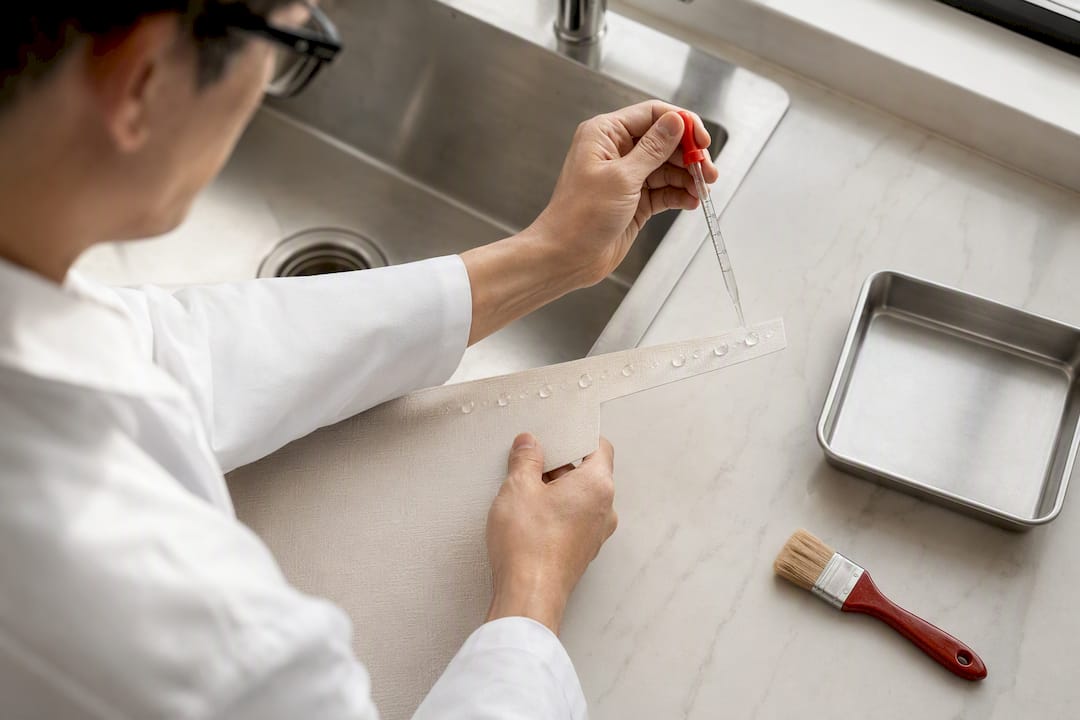
Pro Tip: Order a sample and tape it to the wall you plan to cover for 24 to 72 hours. Smell it, press on the adhesive, and see how it reacts to the room’s actual humidity before buying a full roll.
How Do You Install and Remove PVC-Free Wallpaper Without Wall Damage?
Surface prep differs by product type. Peel-and-stick wallpaper needs a clean, smooth, fully cured painted wall, ideally installed at room temperature with moderate humidity. Traditional paste-up non-woven or paper wallpaper tolerates slightly rougher walls but demands a proper primer and adequate dry time before and after hanging.
Removal is where PVC-free materials often outperform vinyl. Because they don’t rely on a thick plastic film bonded to the wall, non-woven and polyolefin products tend to lift more cleanly, especially from painted drywall.
- Peel slowly from a top corner rather than pulling straight down.
- Use a dry-strip method first before reaching for water or removal solution.
- Test any cleaner on a hidden section before treating the whole wall.
- Avoid ammonia-based or highly abrasive cleaners, which can degrade printed inks and adhesive backing alike.
For a full walkthrough on minimizing wall damage during takedown, Wallsneedlove’s removal guide covers technique by wall type, and its maintenance basics guide covers ongoing cleaning care.
Where Does PVC-Free Wallpaper Fall Short on Durability?
PVC-free doesn’t mean fragile, but it does mean you match the material to the job. Polyolefin and silicone textile products hold up close to vinyl’s wear resistance, standing up to scuffs and repeated wiping in kitchens and hallways. Plain paper and lighter non-woven options look better than they perform under heavy abrasion, so they’re a better fit for low-traffic walls like bedrooms or dining rooms.
- Polyolefin and TPO: near-vinyl durability, chlorine-free.
- Silicone textiles: strong wipeability, common in commercial specs.
- Bio-based composites (flax/resin): built for impact resistance in high-traffic zones.
- Plain paper: attractive but the least tolerant of scrubbing or moisture.
Fire ratings still deserve a direct question to your supplier. Commercial installers should confirm Type II or Class A ratings on the spec sheet rather than assuming a “commercial-grade” label covers it automatically.
The one place PVC-free products still struggle is prolonged, heavy moisture exposure, think steam showers or outdoor-adjacent walls. In those cases, a sealant coat or a polyurethane-based PVC-free textile closes most of the performance gap without bringing chlorine or phthalates back into the mix.
What Does PVC-Free Wallpaper Cost Compared to Vinyl?
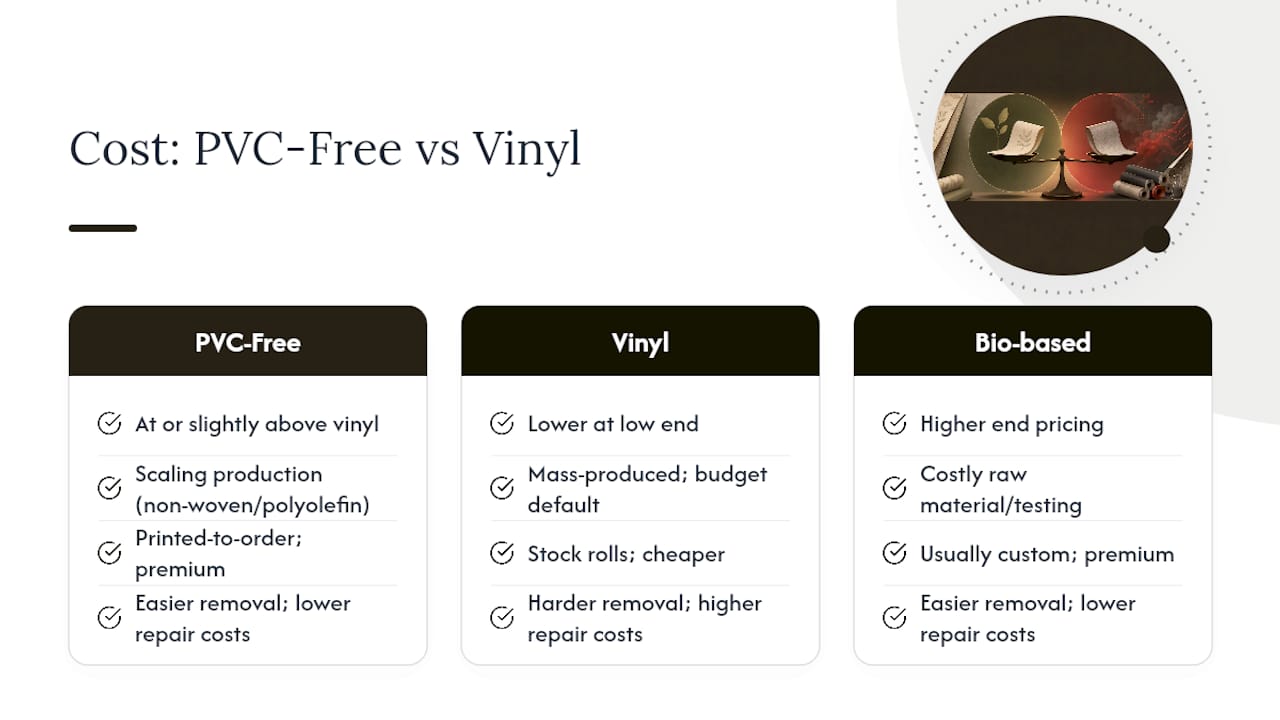
PVC-free wallpaper generally sits at or slightly above vinyl pricing per roll, though the gap has narrowed as non-woven and polyolefin production has scaled up. Vinyl earned its reputation as the budget option decades ago, largely because it was the default commercial substrate and manufacturers optimized production around it. That cost advantage still exists at the low end of the market, especially for mass-produced patterns sold by big-box retailers.
Custom PVC-free wallpaper and murals cost more than stock vinyl rolls for a straightforward reason: each design is printed to order rather than mass-produced in bulk runs. That premium buys you exact sizing for your wall dimensions, no repeat-pattern seams to match, and a design that isn’t sitting in ten thousand other living rooms. Bio-based composites like flax-resin panels sit at the higher end of the price range because the raw material and certification testing both cost more than standard cellulose pulp.
Where PVC-free options actually save money is in the long run, not the checkout total. Because most PVC-free wallcoverings remove more cleanly, you avoid the wall-repair costs that come with scraping down old vinyl, including skim-coating and repainting damaged drywall. Factor that into any cost comparison rather than looking only at price per roll. If you’re pricing out a full room, request quotes for both a stock pattern and a custom size. The difference is often smaller than buyers expect, particularly for accent walls where a single custom panel replaces several rolls of a repeating print.
Does PVC-Free Wallpaper Actually Help the Environment?
PVC production relies on chlorine chemistry and generates byproducts that environmental groups have flagged for decades, while most PVC-free alternatives use cellulose, wood pulp, or bio-based fibers that come from renewable or recycled sources. That’s the core sustainability argument, and it holds up whether you’re talking about a nursery wall or a hotel lobby.
FSC chain-of-custody certification adds a second layer to that claim for paper-based and non-woven products. It confirms the wood pulp in the wallcovering traces back to forests managed under specific replanting and harvesting standards, rather than unregulated logging. That’s a meaningfully different guarantee than “eco-friendly” marketing language, which carries no third-party verification at all.
End-of-life disposal is where the gap widens further. Paper and many non-woven wallcoverings break down in landfill conditions far faster than PVC-based products, which resist decomposition for decades due to their chlorinated plastic structure. Bio-based composites split the difference: they’re not always fully biodegradable, but they typically avoid the persistent chlorine byproducts associated with vinyl disposal and incineration.
None of this means every PVC-free product is automatically the greener choice in every category. A polyolefin wallcovering is still a plastic, just one without chlorine, and manufacturing any wall product uses energy and raw material. But swapping vinyl for paper, non-woven, or bio-based composites removes a specific, well-documented chemical liability from both production and disposal, which is the concrete benefit worth weighing against the modest cost premium discussed earlier.
What Styles and Patterns Are Available in PVC-Free Wallpaper?
Style range used to be the real trade-off with PVC-free wallpaper. Early paper-based options came in limited prints, and anyone chasing a bold mural or photorealistic scene often had to accept a vinyl substrate to get it. That’s no longer true. Digital printing on non-woven and polyolefin substrates now handles the same range of florals, geometrics, watercolors, and scenic murals that vinyl printing does, with color accuracy that holds up just as well.
Custom printing has closed the gap further. Instead of choosing from a fixed catalog, buyers can now commission a specific pattern, scale, and color palette on a PVC-free non-woven or polyolefin base, whether that’s a faux-texture finish for a study or a full-wall scenic mural for a dining room. Peel-and-stick construction on non-woven backing has also made removable, renter-friendly application standard across most style categories, not just simple geometric prints.
The one category still catching up is ultra-glossy, deeply textured faux finishes, where vinyl’s thicker, more moldable structure sometimes produces a more dramatic three-dimensional effect. For most residential and commercial applications, that’s a narrow gap, and it keeps closing as non-woven and polyolefin printing technology improves.
Where WallsNeedLove Fits Into a PVC-Free Wallpaper Search
Some custom wallpaper and mural providers offer production times typically completed in one to three days rather than weeks. That turnaround matters for designers working on a client deadline or homeowners who don’t want to wait a month for a nursery to be finished before a baby arrives.
Some providers emphasize environmental certification and lower-VOC printing across curated collections that span florals, geometrics, watercolors, scenic murals, and faux textures in both peel-and-stick and traditional paste formats. That range covers use cases where PVC-free materials matter most: nurseries, rental apartments where removability is non-negotiable, and commercial lobbies that need a design statement without a heavy chemical footprint.
Request samples and certification documentation directly before committing to a full order, the same verification step recommended throughout this guide.
— Wallsneedlove
Ready to Order PVC-Free Custom Wallpaper?
Some companies turn a specific pattern into a made-to-order, peel-and-stick or paste wallcovering in a few days, reducing wait times compared to big-box retailers. That speed matters when you’ve already spent time verifying materials and certifications and just want the right design on your wall without a six-week wait.
If you’re drawn to nature-inspired scenes, the Monkeying Around removable wallpaper shows how a playful, custom-scaled pattern looks in a peel-and-stick format suited to nurseries and playrooms. Prefer something bolder for a living room or office accent wall? The Java Mountain wall mural demonstrates the custom-mural route for a single statement wall. Whichever direction fits your space, request a sample first, check it against the certification questions covered above, then place your order sized exactly to your wall.
Where to Verify PVC-Free Wallpaper Claims
For direct research beyond this guide, the EPA’s VOC guidance explains indoor-air testing standards. Safer Chemicals, Healthy Families covers vinyl chloride risk. The Good Trade reviews specific removable, non-toxic brands worth cross-checking against certification claims before you buy.
Sources
- What are volatile organic compounds (VOCs)? — EPA
- Vinyl chloride — Safer Chemicals, Healthy Families
- 7 Best Removable And Nontoxic Wallpaper Brands We Love — The Good Trade


Leave a comment