

Gym and Fitness Studio Mural Installation: A Complete Guide
Yes. A professionally printed or peel-and-stick mural is a practical upgrade for any gym or fitness studio, and it works in almost every layout, from a single accent wall behind the squat racks to a full panoramic wraparound. Choose peel-and-stick when you need speed and low disruption to member traffic. Choose printed vinyl or professionally installed wallpaper when durability, seam control, and long-term brand permanence matter more than a fast turnaround.
Here’s what to expect before you request a quote:
- DIY peel-and-stick: one to two days for an average wall, minimal downtime, lowest cost per square foot.
- Professional wallpaper or vinyl install: typically completed within a single business day for most walls, higher upfront labor cost, best seam and alignment results.
- Painted mural: days to weeks depending on artist availability and wall size, highest customization, longest cure time before heavy gym traffic resumes.
Wallsneedlove supplies custom-printed murals in either format, with lead times of one to three days on most orders and installation guides included with every purchase.
Key Takeaways
Gym mural success depends on matching substrate to traffic level, measuring the wall correctly before ordering, and choosing an installation method that fits your downtime tolerance and budget.
| Point | Details |
|---|---|
| Match material to use | Peel-and-stick suits fast, low-disruption jobs; vinyl or paste suits high-abuse, long-term walls. |
| Measure before you design | Document obstacles, wall finish, and multiple height points to avoid costly reorders. |
| Use a two-stage mockup | Approve a grayscale composition before locking color to catch layout errors early. |
| Budget beyond the material | Wall prep, equipment moving, and lift rental often add more to cost than the print itself. |
| Wallsneedlove delivers fast, certified murals | Custom orders ship in one to three days on Greenguard Gold materials, with installation guides included for peel-and-stick or paste backing. |
Table of Contents
- How to Define a Mural Brief for Your Gym or Studio
- Which Substrates Work Best in High-Sweat, High-Traffic Gym Spaces
- How Do You Measure Walls and Plan Panels Correctly?
- DIY vs. Professional Gym Mural Installation: What’s the Difference?
- How Much Does a Gym Mural Cost, and What Drives the Price?
- Where Should You Place Murals for the Biggest Impact?
- Cleaning and Repair: Keeping a Gym Mural Looking New
- Should You Hire a Professional or DIY Your Gym Mural?
- Why Wallsneedlove Approaches Gym Murals This Way
- Start Your Gym Mural Order With Wallsneedlove
- Sources
How to Define a Mural Brief for Your Gym or Studio
A mural fails when it’s chosen for looks alone. The wall needs a job to do, and that job should be decided before anyone opens a design tool.
Start by naming the primary purpose. Is this wall meant to motivate someone mid workout, reinforce your brand to a new member walking in, create a photo backdrop members will tag on social media, or help people find the stretching area from across the floor? A cardio wall competing for attention during a 20 minute treadmill session needs different visual pacing than a reception wall someone glances at for three seconds. Trying to make one mural do all four jobs usually means it does none of them well.
Trends fade faster than gym leases. A mural referencing this year’s fitness aesthetic will look dated well before you’re ready to repaint or reorder, so lean on your brand’s actual identity instead of a passing look. Integrate your logo, brand colors, and any mission-driven language deliberately rather than as an afterthought layered on top of stock art. The Silhouette Fitness Centre case study documented measurable member engagement gains after a full-gym mural project built specifically around brand identity rather than generic decorative art, a strong argument for designing to your actual mission instead of a mood.
Before you approve any design, request four specific deliverables from your designer or vendor:
- A mood board showing color direction, style references, and tone.
- A grayscale composition proving the layout works before color decisions complicate feedback.
- A full color rendering once the composition is locked.
- A mockup showing exactly where equipment, mirrors, and structural features will overlap the art.
That fourth item gets skipped more often than it should, and it’s the one that prevents the worst surprise in gym mural installation: discovering after the fact that your squat rack blocks the mural’s focal point. ABV Creative Agency’s Rumble Boxing project shows what a properly managed client-agency-artist workflow looks like, with equipment placement considered from the earliest design stages rather than patched around later. If you’re working with an outside designer, our guide to specifying custom murals for clients walks through exactly what to hand over so nothing gets lost in translation.
Pro Tip: Photograph your wall from the exact angles members actually see it, at eye level from a treadmill or bench, not just standing dead center. Design decisions made from a straight-on photo often look off once someone is fifteen minutes into a workout and glancing up sideways.
Which Substrates Work Best in High-Sweat, High-Traffic Gym Spaces
Material choice matters more in a gym than almost any other commercial interior. Sweat, cleaning chemicals, body contact near equipment, and constant foot traffic will expose any weak substrate within months.
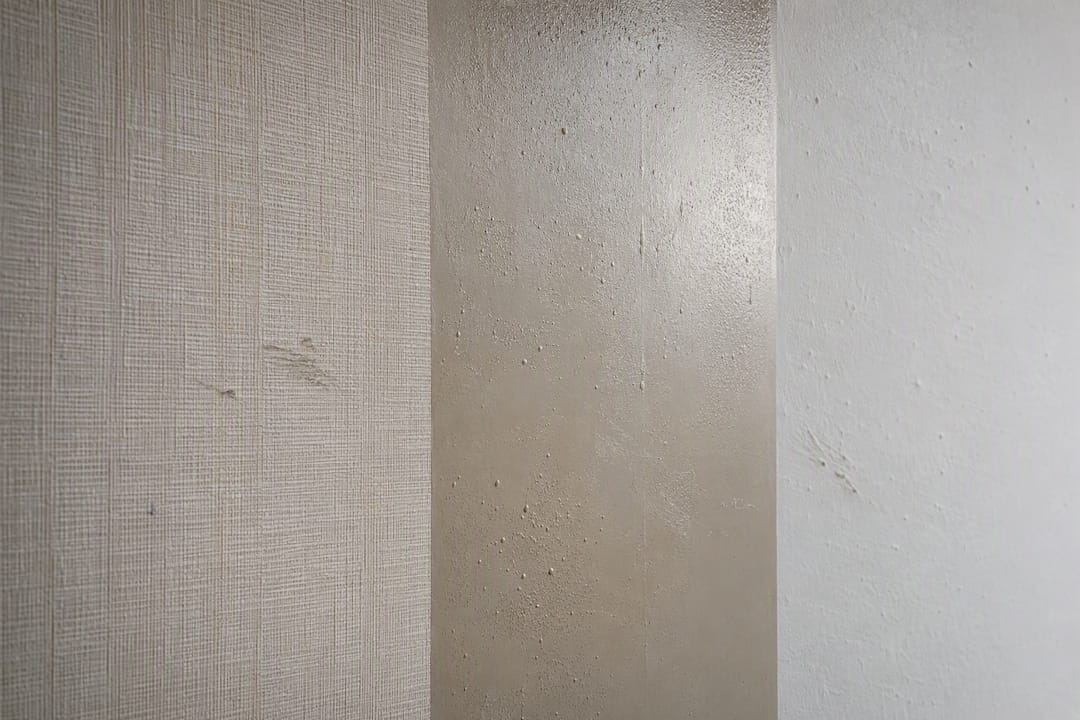
Peel-and-stick wallpaper offers the fastest install and the easiest removal, which makes it the right call for studios on a lease, seasonal rebrands, or gyms testing a wall before committing to something permanent. It handles moderate humidity well but isn’t the first choice for walls that take direct splash contact or heavy abrasion.
Traditional paste wallpaper creates a more seamless, permanent finish and tends to hold up slightly better over years of wear, but it’s harder to remove without wall damage and requires more skilled labor to install correctly.
Printed vinyl and films are the standard for genuinely high-abuse zones, locker room adjacent walls, areas near water fountains, or spaces that get wiped down daily with disinfectant. Vinyl resists moisture and chemical exposure far better than paper-based products.
Painted murals deliver a one-of-a-kind look and can be touched up locally, but they lack the protective consistency of a manufactured print and are the slowest and most disruptive option to install.
Whatever substrate you choose, ask about protective coatings and cleanability before finalizing. A mural that can’t survive a spray bottle and a cloth isn’t built for a gym floor, regardless of how good it looks in a rendering.
Indoor air quality deserves real attention in a space where people are breathing hard for an hour at a stretch. Specify low-VOC inks and ask directly whether the material carries Greenguard Gold certification, which sets stricter chemical emissions limits than standard indoor air quality benchmarks. This matters more in gyms than in a living room, since elevated breathing rates mean occupants are moving more air through their lungs per hour.
Large-format panels introduce one more variable: seam visibility. Higher resolution printing and tighter panel matching reduce visible seams, but no printed product is completely seamless at gym scale. Ask your supplier for a seam map before installation day so you know exactly where those lines will fall relative to your composition’s focal points.
How Do You Measure Walls and Plan Panels Correctly?
Bad measurements are the single most common reason gym murals need a costly redo. Equipment shifts, outlets and vents interrupt flat surfaces, and gym walls are rarely the clean rectangles they appear to be in a quick glance.
Work through this checklist before ordering anything:
- Measure width and height at multiple points, not just one corner, since gym walls settle unevenly over time.
- Mark every obstacle: outlets, light switches, HVAC vents, mounted TVs, mirror edges, and structural columns.
- Note the wall finish underneath, since drywall, concrete block, and painted brick each need different prep and adhesion methods.
- Photograph the wall with a tape measure visible in frame for scale reference your designer can use remotely.
- Confirm ceiling height and any sloped sections that will affect panel drops.
Panel planning follows from those measurements. Full-width panels look cleanest but require a flawless flat surface. Partial panels give you flexibility to route seams into equipment gaps, mirror edges, or corners where a seam is nearly invisible anyway, a technique detailed in Dan Cohen Creative Labs’ Fitness Compound project, where composition was deliberately built around rack placement rather than fighting it. Confirm bleed and overlap specs with your printer; most commercial murals need a small overlap allowance so panels align without a gap showing through.
This is exactly why the two-stage mockup process matters. A grayscale review catches composition and placement problems while changes are still cheap. Locking color only after the layout is approved, the approach Siena Baldi used for the Capture Fitness mural, prevents the expensive scenario where a client requests both structural and color changes in the same round. Our paneling layout guide for oversized custom murals breaks this down wall by wall.
Pro Tip: Order one extra panel’s worth of material if your budget allows it. A damaged panel during installation, or a small repair down the road, is far cheaper to fix with matching stock on hand than to reprint from scratch months later.
DIY vs. Professional Gym Mural Installation: What’s the Difference?
The right installation method depends less on preference and more on wall size, ceiling height, and how much downtime your gym can absorb.
DIY peel-and-stick, day-of checklist:
- Clean and fully dry the wall surface, free of dust and residue.
- Confirm room temperature is within the manufacturer’s recommended range.
- Lay out panels in order before starting to avoid mismatched sequencing.
- Have a smoothing tool and a second person for anything above head height.
Signs you need a professional instead: ceilings over roughly ten feet, walls with visible waves or texture, multi-panel murals wider than a single reachable span, or any job where a fall risk exists without proper equipment.
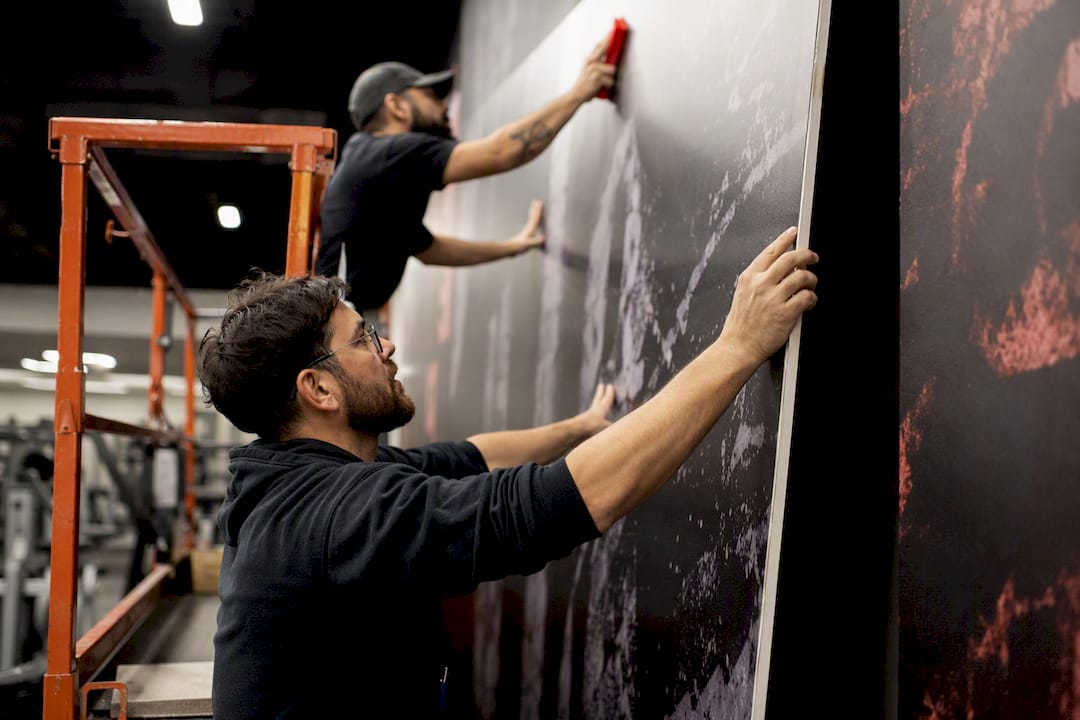
Professional installers bring what most gym staff don’t have on hand: scaffolding or lifts for tall walls, multi-person crews trained to hang large panels without trapping air bubbles, and the experience to read a wall’s quirks before they become a problem mid-install. Professional teams working on commercial gyms often schedule installation during off-hours specifically to avoid disrupting members, a detail worth requesting explicitly when you book. For an average gym wall, a trained crew typically completes a wallpaper or vinyl install within a single working day. A documented on-site install shows this workflow start to finish, including the surface prep steps that happen before any material goes up.
Painted murals follow a different timeline entirely. After the design is locked, expect a projector transfer or grid layout session, then multiple painting sessions spread across days depending on wall size and detail level, followed by a curing period before the wall should face heavy contact or cleaning. Painted work also can’t be rushed the way a printed panel can, since color layering and drying time are fixed by the paint itself, not by crew size.
Whichever route you choose, plan for at least some closure or roped-off access around the work zone. Members walking through wet paint or brushing against a freshly applied panel creates both a safety issue and a finish problem you’ll be fixing twice.
How Much Does a Gym Mural Cost, and What Drives the Price?
Cost ranges depend heavily on wall size, but the pattern holds across most projects: peel-and-stick runs lowest, professionally installed wallpaper or vinyl sits in the middle, and fully painted custom murals land highest due to artist time and multi-day labor.
The biggest swing factor isn’t the material itself, it’s everything around it. Design complexity moves the number more than square footage alone; a photorealistic scene with fine detail costs more to produce and install correctly than a bold graphic pattern of the same size. Wall prep can add unexpected cost too: patching, priming, or leveling a rough commercial wall before mural application is a separate line item most first-time buyers don’t budget for.
Other cost drivers worth flagging before you request quotes:
- Equipment moving: relocating racks, benches, or machines to access the full wall adds labor hours on both ends of the project.
- Lift or scaffold rental: any wall over standard reach height adds equipment rental to the estimate.
- Installation labor hours: professional crews price by time on-site, and irregular walls take longer than flat, obstacle-free ones.
- Panel count: more panels mean more seams to align, which adds install time even when total square footage stays the same.
When you request estimates from multiple vendors, ask each one to quote against the exact same measurements, obstacle list, and substrate choice. Vague requests get vague quotes that are nearly impossible to compare side by side. Include your wall dimensions, photos with obstacles marked, your preferred material (peel-and-stick, paste, or vinyl), and whether you’re supplying design or need one created. A quote missing any of those inputs is a quote you can’t trust to compare fairly against another.
Where Should You Place Murals for the Biggest Impact?
Not every wall in a gym deserves the same investment. Some locations earn their cost back in member motivation and marketing value far faster than others.
The cardio row is prime real estate. Members face it for 20 to 45 minutes at a stretch, making it one of the few walls where a mural gets sustained, repeated attention rather than a passing glance. Free-weight visual walls work differently, since members glance up between sets rather than staring continuously, so bold, high-contrast imagery reads better there than fine detail. Reception and entry walls function as your first brand impression and your best built-in photo backdrop, worth designing specifically for phone camera angles since that’s where most social tags originate.
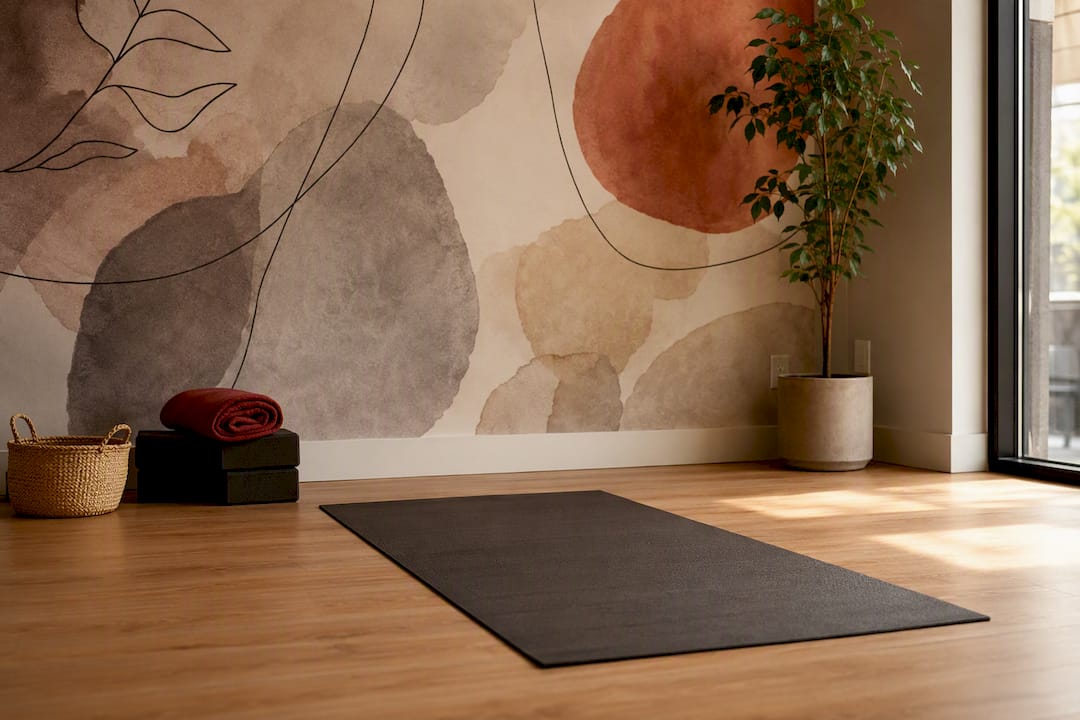
Specialized rooms need their own logic entirely. Yoga and recovery spaces benefit from calmer palettes and slower visual movement, the opposite of the high-energy graphics that work in a free-weight area. Design guidance on home gym wall decor makes the same point for smaller studios: placement near natural light or sightlines people already look toward tends to outperform a wall chosen for size alone.
Pro Tip: Check how your mural wall reads in a mirror before finalizing anything. Mirror-backed gym walls double their visual presence, and text or logos can appear reversed or awkwardly cropped in reflection if you don’t account for it during design.
Cleaning and Repair: Keeping a Gym Mural Looking New
Maintenance needs vary by substrate, and using the wrong cleaner is the fastest way to shorten a mural’s lifespan. Vinyl tolerates most standard disinfectant wipes used in gyms, but printed wallpaper needs a softer, non-abrasive approach, usually a damp microfiber cloth rather than a spray-and-scrub routine. Painted murals should avoid solvent-based cleaners entirely, since they can lift or dull pigment.
- Wipe down high-touch areas near equipment weekly, since that’s where sweat and hand contact concentrate.
- Avoid abrasive scrubbing on any printed surface, which can wear through the print layer faster than expected.
- Spot-check corners and floor-level sections, common wear points where mop water or foot traffic causes the earliest damage.
- Keep source files on hand so a damaged panel can be reprinted and swapped rather than replacing the entire wall.
Expect vinyl and quality printed wallpaper to hold up well for several years under normal gym conditions. Harsh chemicals, constant abrasion, and high humidity are what shorten that lifespan, so matching your cleaning routine to the substrate protects the investment more than any other single decision.
Should You Hire a Professional or DIY Your Gym Mural?
The decision usually comes down to four factors: budget, how permanent you want the result, your tolerance for installation risk, and how complex the wall actually is.
Choose DIY peel-and-stick when the wall is small, flat, reachable without a lift, and the budget favors speed over perfection. Choose a professional installer when the wall is large, tall, textured, or when a flawless finish matters more than saving on labor.
If you go the professional route, vet vendors with specific questions:
- Can you show proof of prior commercial gym installations, not just residential work?
- What’s your approach to paneling and seam placement around equipment?
- Are you insured for on-site commercial work?
- Can you provide references from a comparable fitness facility?
- What warranty or touch-up support comes with the install?
Watch for red flags that predict a bad experience: no documented commercial project history, vague or shifting timelines, reluctance to provide insurance proof, or an unwillingness to walk the space before quoting. Reliable installers, the kind referenced in commercial mural business listings, are upfront about pricing structure and timeline from the first conversation.
Pro Tip: Ask for photos of a past gym or commercial install, not just a residential portfolio. Commercial walls behave differently than home walls, and a vendor who’s only done living rooms may underestimate how much labor a gym-scale wall actually needs.
Why Wallsneedlove Approaches Gym Murals This Way
Gyms need murals that survive real conditions, not just look good in a rendering. That’s why Wallsneedlove builds every mural on Greenguard Gold certified materials, keeping air quality standards high in spaces where members are breathing hard for an hour at a time.
Custom orders are typically produced within one to three days, fast enough that a rebrand doesn’t sideline a facility for weeks. We offer both peel-and-stick for gyms that need speed and low disruption, and heavier printed substrates for facilities prioritizing years of durability over a quick swap. Our curated collections and installation guides exist because we’ve seen how often a mural project stalls out on measurement or paneling questions, not design taste.
— WallsNeedLove
Start Your Gym Mural Order With Wallsneedlove
Wallsneedlove turns a wall measurement into a finished custom mural faster than most commercial print shops, without locking you into a multi-week production queue. Upload your wall dimensions and a reference photo, choose peel-and-stick for a fast, low-disruption install or traditional paste backing for maximum permanence, and your custom print typically ships within one to three days.
Every order includes detailed installation guides covering surface prep, panel sequencing, and smoothing technique, so your team or a hired installer has exact steps to follow rather than guesswork. If your gym wants a managed install rather than a DIY job, the same guides make it easy to hand off to a local professional with clear paneling instructions already documented. Browse finished mural styles like the Java Mountain scenic mural or the bold Monkeying Around removable wallpaper for a sense of scale and finish quality, or if your walls need something more durable underneath, Custom Signs Today’s vinyl wallpaper options cover heavier-duty commercial films worth comparing.
Ready to move forward? Head to Wallsneedlove’s product pages to submit your wall measurements and request a custom quote today.
Sources
- Rumble Studio Mural — ABV - CREATIVE AGENCY + ART GALLERY
- Silhouette Fitness Centre | Full Gym Wall Branding Case Study
- Capture Fitness | Create Bold Murals – Siena Baldi | Imaginative Illustration & Murals
- Custom gym mural installation complete! — Unique Wallcovering (Facebook video)


Leave a comment