
Wallpaper Art Licensing: A 2026 Guide for Creatives
Wallpaper art licensing is defined as a legal arrangement where an artist grants a business the right to reproduce their artwork on wallpaper products for a set period, while retaining full copyright ownership. The artist does not sell the design. Instead, they rent it under specific terms, earning income through royalties or flat fees. This model applies across the surface design market, covering everything from residential peel-and-stick patterns to large-scale commercial murals. Understanding the wallpaper art licensing process is the first step for any creative professional or business that wants to use original artwork legally and profitably.
What is wallpaper art licensing and how does it work?
Art licensing is a rental agreement for designs, not a sale. The artist keeps the copyright and grants only limited usage rights. Those rights are defined by the license agreement, which specifies the product type, territory, duration, and exclusivity level.
A typical wallpaper art licensing agreement covers three core elements: what the licensee can produce, where they can sell it, and for how long. A business might receive the right to print a floral pattern on wallpaper for sale in the United States for two years. That same artist can simultaneously license the same design for fabric in Europe or stationery in Canada. The same design licensed across markets generates income from multiple sources without the artist giving up any ownership.
This structure benefits both parties. Businesses get access to original, trend-relevant artwork without commissioning a full design from scratch. Artists generate ongoing income from work they have already completed. Wallsneedlove, for example, supports local artists and works with original designs to produce custom-printed wallpaper and wall murals for residential and commercial interiors.
What types of licenses exist in wallpaper art licensing?
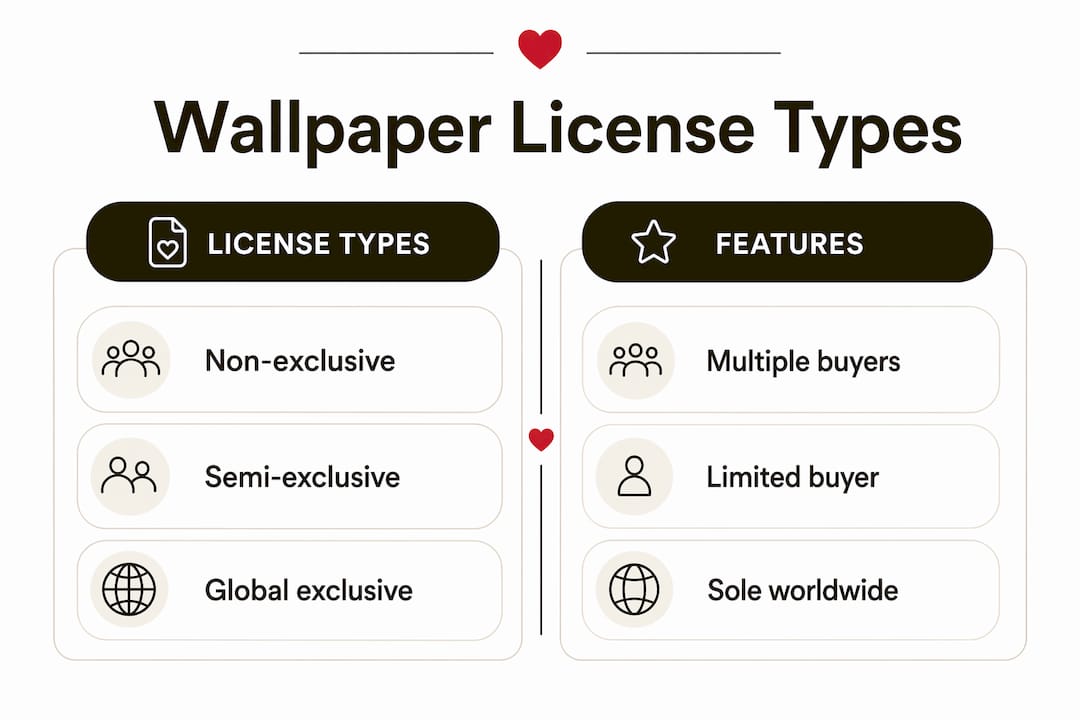
License types in surface pattern design fall into three main categories, each with different levels of exclusivity, cost, and usage rights.
Non-exclusive licenses are the most common and affordable option. The artist can sell the same design to multiple businesses at the same time. This keeps costs low for the licensee and maximizes income for the artist. Flat fees for non-exclusive licenses typically start between $250 and $1,000 for a one-year term.

Semi-exclusive licenses grant limited exclusivity. A business might be the only licensee for that design within a specific product category or geographic region, but the artist can still license it elsewhere. This is a middle-ground option that gives businesses a degree of market protection without the full cost of exclusivity.
Global exclusive licenses give one licensee sole rights to use the design worldwide across all agreed product categories. These command the highest fees and are less common in wallpaper licensing because they prevent the artist from earning additional income from that design.
| License type | Exclusivity | Typical cost range | Usage rights |
|---|---|---|---|
| Non-exclusive | None | $250–$1,000+ per year | Multiple licensees allowed |
| Semi-exclusive | Limited by territory or category | $400–$1,500+ | One licensee per defined scope |
| Global exclusive | Full worldwide rights | $1,500+ or buyout | Single licensee only |
Surface pattern licensing agreements typically last 1–3 years and often include renewal options. Shorter terms protect artists by allowing them to renegotiate rates as a design gains commercial traction.
How do royalty rates and payment structures work?
Standard royalty rates for surface design licensing, including wallpaper, range from 3% to 15% of wholesale revenue. The exact rate depends on the exclusivity level, the product’s sales potential, and the territory covered.
Flat fees are the alternative to royalties. They work well for non-exclusive licenses with limited commercial scope. A business pays a one-time fee, uses the design for the agreed term, and owes nothing further. Royalties, by contrast, pay out over time as products sell. For high-volume wallpaper products, royalties can generate significantly more income than a flat fee.
Artists who work through surface design agencies receive representation but pay a commission. Agency commissions typically run 30%–50% of licensing income. That is a substantial cut, but agencies handle outreach, contract negotiation, and client relationships, which reduces the marketing workload for the artist considerably.
Buyouts are a separate category. A buyout permanently transfers usage rights for a lump sum, typically starting at $1,000 or more. Buyouts are less common in wallpaper licensing because they eliminate future royalty income for the artist. Most experienced artists avoid buyouts unless the fee is high enough to compensate for the loss of ongoing revenue.
| Payment type | How it works | Typical range |
|---|---|---|
| Royalty rate | Percentage of wholesale revenue per unit sold | 3%–15% |
| Non-exclusive flat fee | One-time payment for defined term | $250–$1,000+ |
| Exclusive flat fee | One-time payment for sole usage rights | $400–$1,500+ |
| Buyout | Permanent rights transfer, lump sum | $1,000+ |
| Agency commission | Deducted from licensing income | 30%–50% |
Pro Tip: Evaluate the “value of usage” before accepting any offer. A low flat fee makes sense for a niche product with limited distribution. A royalty structure is better when the licensee plans wide retail distribution, because your earnings scale with their sales volume.
What are the copyright and legal implications?
A license does not transfer copyright. The artist retains full ownership of the original work. The licensee receives only the specific rights written into the contract. This distinction matters because it determines what the business can and cannot do with the design.
Clearly defined contract terms on territory, product category, and duration protect both parties. An overbroad contract, one that grants rights across all product categories or all territories without limitation, reduces the artist’s ability to relicense the same design elsewhere. That directly cuts future income. Businesses benefit from specificity too, because vague terms create disputes over what is and is not permitted.
Common legal pitfalls in wallpaper art licensing include:
- Undefined territory: A contract that says “worldwide” blocks the artist from licensing the same design in any market.
- Unlimited product categories: Granting rights to “all surface products” prevents the artist from licensing the design for fabric, stationery, or other categories separately.
- No end date: Open-ended licenses with no expiration tie up the design indefinitely.
- Missing renewal terms: Without renewal language, both parties face uncertainty when the initial term ends.
- Buyout disguised as licensing: Some contracts use licensing language but include terms that effectively transfer all rights permanently.
Pro Tip: Negotiate every contract to include specific product categories and geographic limits. A design licensed for wallpaper in North America can still be licensed for wallpaper in Asia or for fabric globally. Narrow scope creates more licensing opportunities, not fewer.
Understanding wallpaper rights on rental properties offers a useful parallel: just as a renter does not own the wall, a licensee does not own the design. Both have defined, temporary rights.
How can creative professionals and businesses collaborate effectively?
Brands license pre-existing designs for efficiency and trend relevance. Developing original artwork in-house takes time and budget. Licensing gives businesses access to a ready-made design library that matches current market aesthetics. The key is finding designs that align with the brand’s visual identity and target customer.
For artists, preparation is the starting point. A well-organized portfolio with high-resolution files, clear style categories, and documented copyright ownership makes outreach to agencies and brands far more effective. Artists should also research the commercial context: a hospitality brand needs different patterns than a children’s product line.
For businesses, the selection process should weigh three factors: trend relevance, product compatibility, and brand fit. Custom digital wallpaper uniquely brands commercial spaces, and high-resolution printing makes licensed designs reproducible at any scale without quality loss. That makes licensing particularly valuable for businesses using wallpaper as a branding tool in retail, hospitality, or office environments.
A first-time licensing collaboration typically follows these steps:
- Define the scope. Identify the product, territory, and duration before approaching any artist or agency.
- Source designs. Search artist portfolios, surface design agencies, or platforms that represent independent designers.
- Evaluate fit. Assess whether the design matches the brand aesthetic and the target market’s preferences.
- Request a quote. Ask for pricing based on the defined scope, specifying exclusivity requirements upfront.
- Review the contract. Confirm that territory, product category, duration, and renewal terms are all clearly stated.
- Agree on file delivery. Specify file format, resolution, and color profile requirements before signing.
- Launch and track. Monitor sales if the agreement includes royalties, and maintain records for renewal negotiations.
For businesses planning commercial-scale wallpaper orders, understanding the licensing scope before ordering print runs prevents costly contract disputes after production.
Key Takeaways
Wallpaper art licensing gives artists ongoing income from a single design while giving businesses legal access to original artwork without purchasing the copyright outright.
| Point | Details |
|---|---|
| Copyright stays with the artist | A license grants usage rights only; the artist retains full copyright ownership throughout. |
| License scope defines income potential | Narrow territory and category terms allow artists to relicense the same design multiple times. |
| Royalties vs. flat fees | Royalties (3%–15% of wholesale) suit high-volume products; flat fees suit limited-distribution use. |
| Contract specificity protects both parties | Undefined territory, product category, or duration creates legal risk and limits future deals. |
| Agencies accelerate reach at a cost | Surface design agencies charge 30%–50% commission but handle outreach and negotiation. |
Wallsneedlove’s take on licensing as a long-term design strategy
The “build-once, sell-many” model is the most underused advantage in surface design. Artists who license the same pattern for wallpaper in one market, fabric in another, and stationery in a third are not diluting their work. They are maximizing its commercial life. The misconception that licensing limits a career is exactly backward. A well-structured license with narrow scope creates more opportunities, not fewer.
The contracts that cause the most problems are the ones signed in a hurry. Overbroad territory clauses and unlimited product categories look harmless at the start of a relationship. They become expensive later, when the artist wants to license the same design to a second client and discovers the first contract blocks it. Specificity is not a negotiating tactic. It is the foundation of a sustainable licensing income.
For businesses, the value of licensed wallpaper art goes beyond aesthetics. A licensed design from a recognized artist adds credibility and originality to a commercial space. That is especially true in hospitality and retail, where the visual environment directly affects customer perception. Treating licensing as a creative partnership rather than a procurement transaction produces better results for both sides.
— Wallsneedlove
Custom wallpaper products at Wallsneedlove
Wallsneedlove offers a wide range of custom-printed wallpaper and wall murals suited to both residential and commercial projects. Products are available in peel-and-stick and traditional paste formats, with orders typically produced within 1–3 days. All products carry Greenguard Gold certification.
For businesses applying licensed artwork at scale, the Monkeying Around removable wallpaper and the Java Mountain wall mural illustrate the range of artistic styles available for commercial interiors. Wallsneedlove also supports independent artists, making it a practical starting point for creative professionals exploring how licensed designs translate into finished wall products. Browse the full collection at Wallsneedlove.
FAQ
What is wallpaper art licensing in simple terms?
Wallpaper art licensing is a legal agreement where an artist allows a business to reproduce their design on wallpaper products for a defined period, territory, and purpose, while the artist keeps the copyright.
Does licensing mean the artist gives up ownership of the design?
No. A license grants usage rights only. The artist retains full copyright and can license the same design to other businesses in different markets or product categories.
What royalty rate is standard for wallpaper art licensing?
Standard royalty rates for surface design licensing range from 3% to 15% of wholesale revenue, depending on exclusivity, territory, and the product’s sales volume.
How long does a typical wallpaper licensing agreement last?
Most surface pattern licensing agreements run for 1–3 years and include options for renewal, giving both parties the ability to renegotiate terms as the commercial relationship develops.
What is the difference between a license and a buyout?
A license grants temporary, defined usage rights while the artist retains copyright. A buyout permanently transfers usage rights for a lump sum, typically starting at $1,000 or more, and eliminates future royalty income for the artist.


Leave a comment