

10 Curated Custom Mural Styles for Homeowners in 2026
Ten mural styles define custom wall design in 2026: biophilic botanical scenes, Neo-Deco geometry, textured faux-plaster abstracts, heritage Art Nouveau revival, panoramic landscapes, painterly abstraction, moody dark academia motifs, minimalist line art, nostalgic archival prints, and playful kids’ murals. Each one solves a different room problem, from calming a home office to giving a nursery a focal point that survives a decade of taste changes.
Here’s the quick scan, with a use case for each:
- Biophilic botanical — oversized leaf or fern scenes for living rooms and home offices
- Neo-Deco geometric — angular metallics and fan motifs for entryways and powder rooms
- Textured faux-plaster abstract — embossed, tonal washes for primary bedrooms
- Heritage Art Nouveau revival — sinuous florals and stained-glass color for dining rooms
- Panoramic landscape — wraparound scenery for open-concept living areas
- Painterly abstraction — brushstroke-driven color fields for creative studios or lofts
- Dark academia motif — deep jewel tones and library imagery for reading nooks
- Minimalist line art — single-line sketches for small bathrooms and hallways
- Nostalgic archival print — vintage maps and botanical plates for libraries and studies
- Playful kids’ mural — whimsical animal or space scenes for nurseries and playrooms
Wallsneedlove produces custom murals in both peel-and-stick and traditional paste formats, and its Greenguard Gold certified materials matter if you’re specifying for a nursery or a healthcare waiting room. Most custom orders move through production in one to three days, which is fast enough to hold a renovation timeline instead of stalling it.
Key Takeaways
The right custom mural for 2026 matches room function, scale, and finish to one of ten curated styles, backed by fast production and certified low-VOC materials.
| Point | Details |
|---|---|
| Ten styles cover most briefs | Biophilic, Neo-Deco, textured abstract, heritage revival, panoramic, painterly, dark academia, minimalist, nostalgic, and kids’ murals span nearly every room. |
| Scale drives the placement strategy | Choose a focal wall, panoramic wrap, or accent fragment based on room size and how often you view the wall up close. |
| Material choice affects longevity | Peel-and-stick suits renters and DIY installs; paste and textured substrates suit permanent, high-traffic walls. |
| Request proofs before production | A scaled sample swatch confirms color accuracy and prevents costly reprints. |
| Wallsneedlove supports fast, certified custom orders | Custom peel-and-stick and paste murals typically complete production in one to three days with Greenguard Gold certified materials. |
Table of Contents
- What’s Driving Curated Custom Mural Styles in 2026?
- Which Mural Styles Should You Choose for 2026?
- How Do You Match a Mural Style to Each Room?
- Which Materials and Finishes Fit Each Mural Style?
- How Do You Commission and Budget for a Custom Mural?
- How Wallsneedlove Delivered a Custom Panoramic Mural
- What Should You Ask Before You Choose a Mural Style?
- Why Curated, Custom Murals Still Matter in 2026
- Bring Any of These 2026 Mural Styles to Your Walls
- Sources
What’s Driving Curated Custom Mural Styles in 2026?
Three forces are shaping every curated custom mural styles’ 2026 shortlist: a pull toward nature and texture, a swing back to ornamental heritage design, and printing technology that makes true customization affordable at any scale. Biophilic design keeps climbing because people spend more time indoors and want walls that feel alive rather than flat. Tactile, embossed finishes are having a moment too, driven by a broader interior design shift toward materials you can feel, not just see.
Heritage revival is the more surprising thread. Collections like Astek’s Eterna Nouveau take Art Nouveau’s sinuous lines and stained-glass palettes and rebuild them as hand-created artwork that gets digitized for custom sizing. That digitization step is the real story: a century-old aesthetic movement is now scalable to a 9-foot accent wall or a 30-foot commercial lobby without losing detail.
Digital printing and fast custom manufacturing are what make any of this practical. Wallsneedlove typically completes custom mural production in a short timeframe, a turnaround that shortens the gap between “I found a style I love” and “it’s on my wall.” That speed matters more than it sounds. Slow production used to push people toward safe, generic patterns because a bold custom choice felt risky to commit to months in advance. Compressed lead times remove that friction, so bolder personalized mural designs get greenlit more often.
Low-VOC and Greenguard Gold certified inks also widen what’s usable in bedrooms and nurseries, where air quality concerns used to rule out heavily printed surfaces.
Residential and commercial briefs pull in different directions, though:
- Residential clients prioritize personality and mood, favoring biophilic and painterly designs that feel personal.
- Commercial clients prioritize durability and cleanability, favoring textured or matte finishes that hold up to foot traffic.
- Hospitality and retail briefs increasingly ask for brand storytelling, using scenic or abstract murals as a backdrop that reinforces identity without a logo in sight.
- Healthcare and office spaces lean toward calming, low-contrast palettes to reduce visual fatigue over an 8-hour shift.
Which Mural Styles Should You Choose for 2026?
These ten styles made the cut because they balance visual impact with manufacturability. Providers can print them accurately at almost any scale, and hospitality and design projects have already proven their durability outside a designer’s mood board. Curated collections like Goodrich’s Wall Edits work the same way: a small set of editable templates that get personalized by color and surface rather than built from scratch every time.
Biophilic botanical
Oversized ferns, palm fronds, or a single dramatic leaf rendered at architectural scale. Palettes lean toward deep forest green, sage, and warm terracotta accents. This style works best in living rooms, home offices, and sunrooms, especially where natural light already reinforces the theme. Go full-wall or a corner-to-corner wrap for maximum immersion; a single focal wall works if the room already has strong greenery or wood tones. Wallsneedlove’s Herb Garden mural is a compact example of how vegetative imagery reads at a smaller scale, too.
Pro Tip: Botanical prints with high leaf density can visually shrink a small room. If your space is under 120 square feet, choose a design with negative space or a lighter background rather than an all-over jungle pattern.
Neo-Deco geometric
Angular fans, chevron repeats, and metallic gold or brass accents against black, emerald, or navy grounds. Best suited to entryways, powder rooms, and dining rooms where a bolder statement doesn’t compete with daily lounging. Scale it as a focal wall behind a console table or bar cart. Matte finishes keep the metallics from looking cheap under overhead lighting. Wallsneedlove’s Art Deco City wallpaper shows the palette in a diamond repeat that suits smaller rooms just as well as a full mural.
Textured faux-plaster abstract
Tonal washes that mimic Venetian plaster or limewash, usually in warm neutrals, dusty pink, or clay. This is a primary bedroom and hallway favorite because it reads as calm rather than decorative. Full-room coverage works if the palette stays within two closely related tones; a single accent wall behind a headboard is the safer default for a first-time buyer. Textured, embossed substrates amplify the plaster illusion far more than a flat print ever will, and providers increasingly recommend tactile additions to add real dimension rather than relying on the print alone, per SpeedPro’s mural guidance.
Heritage Art Nouveau revival
Sinuous floral lines, stained-glass color blocking, and organic curves borrowed directly from early-1900s design. Dining rooms and libraries suit this style because the ornamentation rewards slower viewing. Keep it to one focal wall unless the room is large and the ceiling height can absorb the visual weight. This is the style most likely to be commissioned as a custom illustration rather than pulled from a stock catalog, since Astek’s Eterna Nouveau collection shows how hand-drawn artwork gets digitized for exact color and size matching.
Panoramic landscape
Wide-format mountain ranges, coastlines, or forest vistas designed to wrap a room rather than sit flat on one wall. Best in open-concept living areas, primary bedrooms with a wall-length run, and conference rooms where the goal is a sense of place. Providers commonly highlight the ability to produce large panoramic or wrap-around outputs specifically because they create immersive spaces that a single framed print never could. Wallsneedlove’s Java Mountain mural and Out mural both demonstrate how this plays out at real scale.
Pro Tip: A panoramic wrap needs corner planning before you order. Measure inside corners separately from flat runs, and confirm your printer can adjust the image so the horizon line stays level across the seam.
Painterly abstraction
Brushstroke-driven color fields and expressive mark-making, often inspired by contemporary fine artists working in abstraction. This crossover between gallery art and wallcovering is growing, with artist marketplaces and platforms making it easier to source or license high-resolution work for a mural-scale reproduction. Best for creative studios, lofts, and statement powder rooms. Wallsneedlove’s Inner Symphony and Inner Beauty murals both work as ready-made examples of this palette-driven abstract approach.
Dark academia motif
Deep burgundy, forest green, and charcoal grounds paired with library, botanical illustration, or architectural line imagery. This suits reading nooks, home libraries, and media rooms where you want moodiness rather than brightness. Keep it to a single wall in smaller rooms; the saturated palette overwhelms fast if it wraps a whole space with low natural light.
Minimalist line art
Single continuous lines forming faces, botanicals, or abstract forms against a plain ground. Ideal for small bathrooms, hallways, and rental units where a bold pattern would feel permanent. This style scales down gracefully, so it works as well in a 40-square-foot powder room as it does on a larger wall. SpeedPro’s design categories specifically call out minimalist repeats as the right choice for an understated accent wall.
Nostalgic archival print
Vintage botanical plates, old maps, or archival illustration reproduced at mural scale. Works well in studies, libraries, and boutique hospitality settings that want a collected, storied feel. Wallsneedlove’s Vintage Garden mural is a direct example of botanical nostalgia rendered for a full wall rather than a framed print.
Playful kids’ mural
Whimsical animals, space themes, or storybook scenes built for nurseries and playrooms. Scale to a single accent wall behind a crib or reading corner rather than wrapping the whole room, since children’s taste shifts faster than any other demographic’s. Wallsneedlove’s Forest Friends mural and Monkeying Around wallpaper both suit this brief, and peel-and-stick material makes a future style change painless.
How Do You Match a Mural Style to Each Room?
Three placement strategies cover nearly every project: a focal wall for a single strong statement, a panoramic wrap for immersive open spaces, and accent fragments for smaller or transitional areas like hallways. Choosing between them comes down to room size, sightlines, and how often you’ll be looking at it up close.
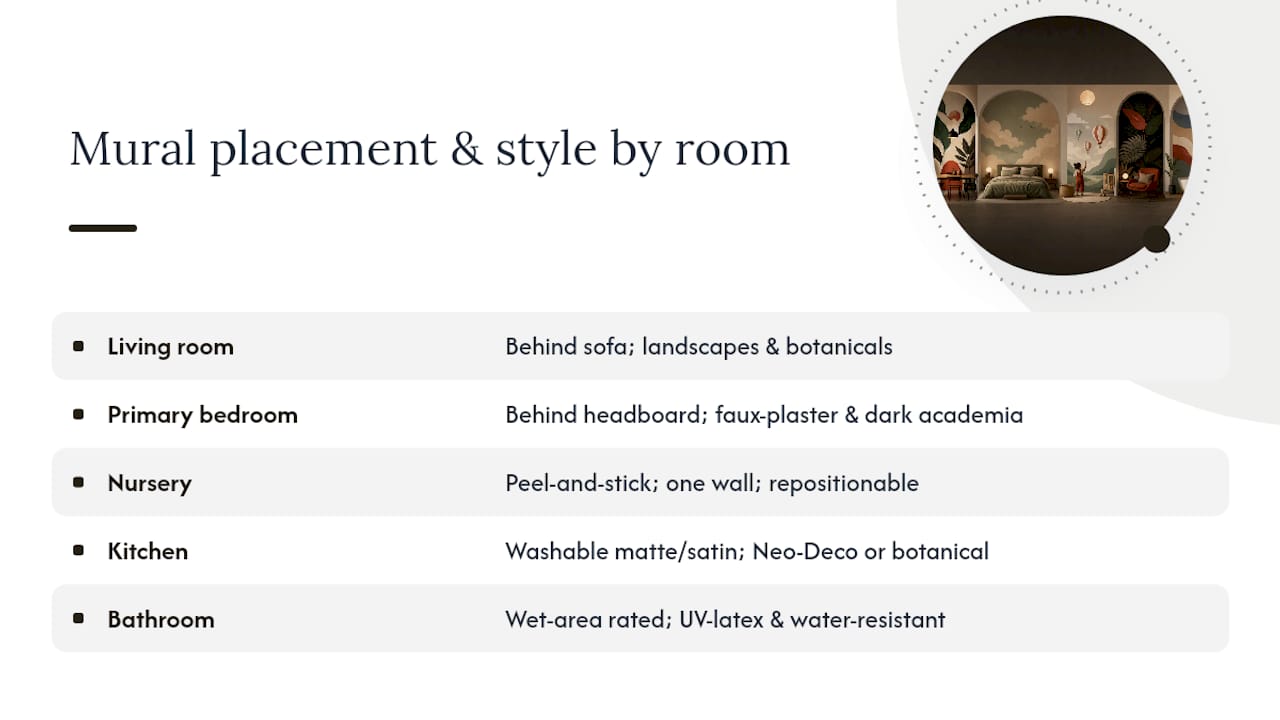
In the living room, a floor-to-ceiling mural behind the sofa, anchored by low-profile furniture that doesn’t compete with the pattern, gives the biggest visual payoff for the least commitment. Panoramic landscapes and biophilic botanicals both suit this placement.
In the primary bedroom, place the mural behind the headboard only, leaving side walls plain so the room still feels restful. Textured faux-plaster and dark academia both work well here because they read as calm rather than busy at a resting distance.
The nursery benefits from peel-and-stick playful murals scaled to one wall, since babies grow into toddlers with very different taste within a few years. Repositionable material protects your deposit against that inevitability.
Kitchens need washable, matte or satin finishes that resist grease and steam; a Neo-Deco geometric backsplash-adjacent wall or a botanical accent near a breakfast nook both hold up if the finish is right.
Bathrooms, especially powder rooms, call for wet-area-rated substrates. UV-latex inks and water-resistant finishes matter more here than anywhere else in the house, and providers that offer these inks specifically flag them for wet-area applications.
Home offices do well with minimalist line art or a single biophilic panel positioned in the camera frame for video calls, since that’s the wall people see most.
Commercial spaces like lobbies and retail floors usually need durable, cleanable finishes and benefit from panoramic scale to make an entrance feel intentional rather than decorated.
Watch for installation constraints before you commit to any layout: HVAC vents, light switches, and door swings can all interrupt a pattern’s flow, and older plaster walls sometimes need skim-coating before a peel-and-stick product will adhere properly.
Which Materials and Finishes Fit Each Mural Style?
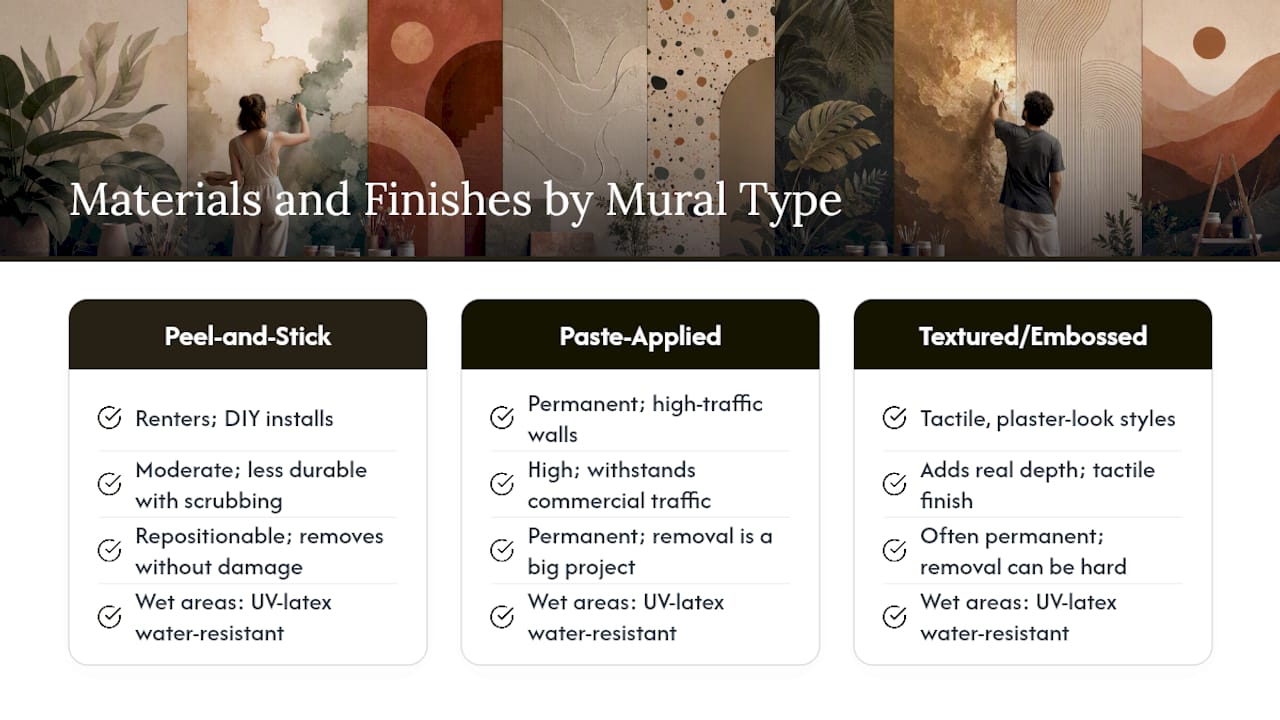
Three production paths cover almost every custom mural project: peel-and-stick for renters and DIY installs, traditional paste for permanent high-traffic walls, and specialty textured or embossed substrates for tactile styles like faux-plaster. Peel-and-stick wins on repositionability, since you can pull it down without wall damage, but it trades off some durability against heavy scrubbing. Paste-applied murals last longer and stand up to commercial traffic, but removal is a bigger project.
Textured and embossed substrates add real depth to plaster-look and heritage designs, and large-format print providers increasingly recommend tactile additions and contour cuts as a way to make a mural feel dimensional rather than flat. For wet areas, look for UV-latex printed, water-resistant finishes designed specifically for bathrooms and kitchens.
Maintenance is straightforward across most materials: a dry microfiber cloth for dust, and a lightly damp cloth for smudges on matte or satin finishes. Avoid abrasive cleaners on any printed surface, textured or flat. If indoor air quality matters to your household, specifically ask whether a mural is Greenguard Gold certified before you order, since that certification signals low chemical emissions relevant to nurseries, bedrooms, and offices.
Pro Tip: A peel-and-stick mural under 10 feet wide is genuinely DIY-friendly for most homeowners. Once you’re wrapping corners, working above 10 feet, or dealing with heavily textured plaster walls, hire an installer. A botched seam on a $400 mural costs more to fix than the install would have cost upfront.
How Do You Commission and Budget for a Custom Mural?
Commissioning a custom mural follows four stages: brief, proofs, production, and installation, and the full process typically runs anywhere from a few days to a few weeks depending on how custom the artwork is. A stock design personalized by color and scale moves fastest; a fully bespoke illustration takes longer because it requires additional design rounds.
Here’s the checklist to work through before you request a quote:
- Measure your wall precisely, including height, width, and any obstructions like outlets or trim.
- Decide on resolution needs, especially if you’re supplying your own photography or artwork.
- Choose your color references, ideally against real paint chips or existing furniture, not just a screen.
- Take clear site photos so your printer can flag installation issues before production starts.
- Select your substrate: peel-and-stick, paste, or a specialty textured option.
- Request a proof or sample swatch before committing to full production, since color can shift meaningfully between a screen and a printed wall.
Cost bands vary widely, but the factors that push a project higher are consistent:
- Lower cost: stock or lightly personalized designs, standard peel-and-stick material, single focal wall under 100 square feet.
- Mid cost: fully custom color matching, larger scale, or a panoramic wrap across an open floor plan.
- Higher cost: bespoke illustration commissions, textured or embossed substrates, and rush timelines.
Many providers let customers order sample swatches and scaled previews before full production, which is worth the extra step and small delay to confirm color accuracy. On turnaround, Wallsneedlove typically moves custom orders through production in one to three days once a proof is approved, which is fast relative to the multi-week timelines some traditional mural painters require.
How Wallsneedlove Delivered a Custom Panoramic Mural
A homeowner replacing a blank open-concept living room wall ended up with a panoramic mural that reads as a single continuous scene rather than a printed accent, and it installed without a professional crew.
The process ran in four steps: an initial brief specifying wall dimensions and a preferred landscape palette, a scaled proof to confirm color and crop before production, a peel-and-stick substrate selected for a straightforward weekend install, and a same-week installation using Wallsneedlove’s own install guide.
- Production completed within Wallsneedlove’s typical one-to-three-day custom turnaround.
- Material carried Greenguard Gold certification, relevant since the room doubles as a home office.
- Design sourcing drew on Wallsneedlove’s support for local artists, giving the mural a less mass-produced feel than a stock catalog print.
What Should You Ask Before You Choose a Mural Style?
The decision comes down to five factors: room function, scale, finish, maintenance demand, and budget, in roughly that order of importance. Get those five right and the aesthetic choice almost picks itself.
Work through this checklist before you brief a designer or printer:
- What is this room actually used for, and how much wear will the wall see?
- What’s the true wall measurement, including obstructions and corners?
- Does this space need a wet-area or washable finish?
- Is the design a stock personalization or a fully bespoke commission?
- What’s your realistic budget band, and does it match the finish you want?
Watch for these red flags in any quote: vague or missing proofs, no clear substrate specification, and no eco-certification claims at all when you’ve asked about air quality. Ask suppliers directly about color-matching accuracy, how seams are handled on oversized walls, how much material waste to expect, and what warranty covers a defective print. A supplier who can’t answer those four questions clearly probably isn’t ready for your project.
Why Curated, Custom Murals Still Matter in 2026
Standardized wallpaper never disappeared, but curated custom murals keep winning because they let a room say something specific instead of something generic. That’s the actual value: personalization with a point of view, not personalization for its own sake.
The renter’s dilemma is real, and reversible peel-and-stick material solves it honestly rather than forcing a compromise on style. A rented apartment doesn’t need to look temporary just because it is temporary. Choose the boldest style your walls can hold, but choose a material that lets you take the boldness with you when you move.
Bring Any of These 2026 Mural Styles to Your Walls
Wallsneedlove turns any of these ten curated styles into a wall-ready custom mural in as little as one to three days, in peel-and-stick or traditional paste, with Greenguard Gold certified materials available for nurseries and bedrooms alike. The catalog spans the exact styles covered here, from panoramic landscapes to geometric repeats to botanical accents, so you’re not starting a custom brief from a blank page.
If a panoramic scene fits your living room brief, the Java Mountain mural is a ready example of that scale done right. Prefer a modern geometric repeat for a home office or hallway? The Pixel Diamonds wallpaper shows how a contemporary pattern reads at real scale. For readers still narrowing down a direction, browse the full collection and request a sample swatch before committing to a full custom order. That one small step, checking real color against your real wall, is the difference between a mural you love and one you second-guess.
Sources
- A Line of Mural Wallpapers from Astek Celebrates ‘Eterna Nouveau’ — Colossal
- Custom Wall Murals | Create Your Own Mural | CanvasChamp


Leave a comment